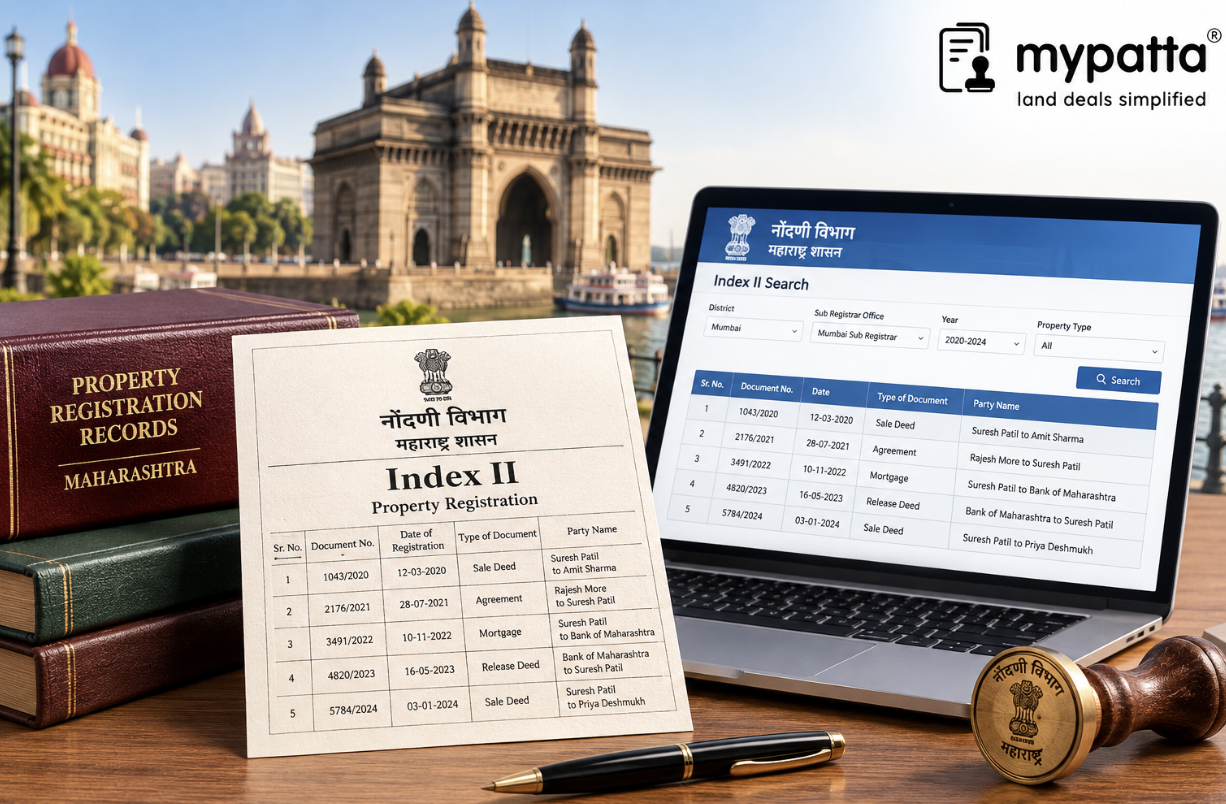
How to Download Index 2 in Maharashtra
You can get the Index 2 in Maharashtra online easily via mypatta without visiting the Sub-Registrar office.
- Open mypatta and log in or sign up if needed.
- Go to property documents, ensure “Maharashtra” is selected as the state, then tap the “Index 2” icon.
- Enter required information.
- Tap “Search”
- Once the Index 2 is available to download, tap “View Document”. You can now save or share or download this document in PDF on your device.
Can Index II Be Used as Ownership Proof?
Index II can support an ownership claim, but it should not ordinarily be used as conclusive ownership proof by itself.
It is an official index prepared from the registration record. It may show that a document of a particular type was registered between identified parties and that the transaction was connected with a stated property. This makes it useful for confirming the existence and basic particulars of a registered transaction.
However, Index II does not independently establish that:
- the transferor had a valid and complete title;
- the instrument legally transferred ownership;
- the transfer covered the entire property;
- every co-owner or legal heir participated;
- the transaction was never cancelled or challenged;
- no later deed affects the property; or
- the property described in the entry is the same property available on the ground.
Under Section 55 of the Registration Act, 1908, Index No. II is maintained as an index containing property-related particulars connected with documents entered in Book No. 1. Its purpose is to identify and facilitate the search of registered documents; the index itself is not the complete conveyance.
The legal effect also depends on the nature of the document mentioned in Index II. For example:
- an Index II for a sale deed may support a claim that a sale was registered;
- an Index II for an agreement for sale does not establish that ownership was transferred;
- an Index II for a mortgage shows an encumbrance rather than ownership;
- an Index II for a release deed may concern only one co-owner’s share;
- an Index II for a development agreement may grant development rights without transferring the entire title; and
- an Index II for a lease records leasehold rights rather than absolute ownership.
The Supreme Court has reiterated that registration alone does not prevent a competent civil court from examining and deciding a dispute concerning title. A registration entry therefore proves that a document entered the official registration system, but it does not make every underlying title claim indisputable.
Index II becomes stronger supporting evidence where:
- the complete registered deed is available;
- the transferor’s earlier title is traceable;
- the parties and property particulars match the deed;
- subsequent searches reveal no conflicting transfer;
- revenue or municipal records reflect the same owner; and
- the physical property corresponds with the registered description.
The correct conclusion is not that Index II proves ownership, but that it helps locate and verify one part of the documentary title chain.
How Is Index II Different From the Registered Sale Deed?
Index II and the registered sale deed arise from the same registration process, but they contain substantially different levels of information.
| Point of comparison | Index II | Registered sale deed |
|---|
| Nature | Summary index of the registered transaction | Complete instrument executed by the parties |
| Main purpose | Helps identify and search the registration entry | Records the transfer, terms and rights agreed between the parties |
| Party details | Usually contains names and limited identifying particulars | Contains detailed descriptions, capacities, representations and execution particulars |
| Property description | May contain abbreviated survey, CTS, plot, flat and area details | Contains the full property schedule, boundaries and appurtenant rights |
| Consideration | May show declared consideration and market value | Explains payment terms, amounts paid, balance and contractual adjustments |
| Rights and obligations | Usually not reproduced in full | Records covenants, indemnities, possession, easements and other conditions |
| Signatures and execution | Does not reproduce the full executed instrument | Contains signatures, witnesses and registration endorsements |
| Use in due diligence | Helps identify and cross-check a transaction | Must be read to determine what was actually transferred |
The sale deed records the language through which the seller purports to convey rights to the purchaser. It may state:
- how the seller acquired the property;
- what share or interest is being sold;
- whether possession is delivered;
- how consideration is paid;
- whether the property is free from encumbrances;
- what rights in common areas or access roads are included;
- whether any conditions or reservations apply; and
- how the property is described in the detailed schedule.
Index II ordinarily does not reproduce all these clauses.
This difference is particularly important where the document type is unclear. An entry may state that an “agreement” or “release” was registered, but only the complete instrument will show whether the transaction created an immediate right, imposed a future obligation or transferred only a limited share.
The Supreme Court has repeatedly distinguished an agreement for sale from a conveyance. An agreement may create contractual or possessory rights in appropriate circumstances, but it does not itself operate as a completed deed of transfer.
The complete deed must also be checked for limitations that may not appear in the index, such as:
- transfer subject to an existing tenancy;
- exclusion of parking or common areas;
- transfer of only an undivided share;
- life interest retained by the transferor;
- conditional possession;
- obligation to obtain permissions;
- pending consideration; or
- execution through a power of attorney.
Where the original deed is unavailable, Maharashtra’s Registration and Stamps Department provides facilities for obtaining certified copies of registered documents. It also recognises certified copies of indexes and searches of registered transactions as separate services, confirming that the Index II and registered deed are distinct official records.
How to Use Index II to Trace Earlier Property Transactions
Index II is most useful when it is used chronologically to reconstruct the registered transaction history of a property.
The exercise should not begin and end with the seller’s acquisition document. A buyer should work backwards from the current owner and then search forward again to identify later transactions.
Begin with the current seller’s document
Record the following details from the seller’s Index II:
- document number and year;
- Sub-Registrar Office;
- type of instrument;
- execution and registration dates;
- transferor and transferee names;
- survey, Gat, Hissa or CTS number;
- plot, building or flat number;
- area or extent; and
- consideration and market value.
These particulars should be compared with the complete deed.
Identify the seller’s predecessor
The sale deed should explain how the seller acquired the property. Locate the Index II or registration entry for that earlier transaction.
Repeat this process for each prior link until the title can be traced for an appropriate period and through a legally satisfactory root document.
For example, the chain may appear as:
Original allotment or conveyance → first sale → subsequent sale → inheritance or release → present seller
Every step should be supported by the actual registered document, not merely a list of Index II entries.
Search through both document and property particulars
Maharashtra’s official e-Search service allows searches:
- by property details;
- by document number; and
- for available scanned copies of registered documents.
The Department specifically states that transaction searches can assist in identifying multiple transactions and recommends checking the system close to the time of execution or registration.
A document-number search is useful where the deed already provides the registration details. A property-based search is useful for locating transactions that may not be disclosed by the seller.
Property searches should use all available identifiers, such as:
- village or locality;
- survey or Gat number;
- Hissa;
- CTS or city-survey number;
- plot number;
- flat number; and
- building or society details.
The official e-Search guide indicates that property searches may be carried out using CTS, survey, Gat, plot or flat numbers after selecting the relevant district and area.
Search the same property under earlier and current identifiers
The property number may have changed because of:
- subdivision;
- consolidation;
- resurvey;
- conversion from a survey number to a CTS number;
- municipal renumbering; or
- redevelopment.
A search limited to the latest number may miss older transactions. The old deed, Property Card, 7/12 extract, Ferfar entry and survey-correlation records should be used to identify previous parcel references.
Search the parties where necessary
A property description may have been entered differently in an older registration. Searching the names of earlier owners and checking their known transactions can help locate missing deeds.
Name-based findings must be used cautiously because several persons may have the same name. The property particulars and registration office must still correspond.
Read the actual instruments
Once the transaction sequence is identified, obtain and examine the registered deeds or certified copies.
The Index II chain should lead to the documentary chain; it cannot replace it.
What Missing, Inconsistent or Subsequent Transactions Should Be Investigated?
A title investigation should pause wherever the Index II entries do not form a clear and consistent sequence.
Missing link in the title chain
A missing link arises where the seller’s deed refers to an earlier owner, but the earlier registered transfer cannot be located.
Possible explanations include:
- incorrect document number;
- registration at another office;
- use of an older survey or CTS number;
- inheritance without a registered conveyance;
- loss or non-digitisation of an older record; or
- an incomplete or unsupported title claim.
The missing document should be obtained from the registration record or explained through the relevant succession, allotment, court or government record.
Different transferor or predecessor
The person shown as transferor in one entry should ordinarily correspond with the transferee under the preceding title document.
A break in names may indicate:
- inheritance;
- partition;
- release among co-owners;
- company merger or change;
- court decree;
- power-of-attorney execution; or
- a missing intermediate transfer.
The reason must be supported by documents.
Difference in property description
Particular attention is required where Index II entries show differences in:
- survey, Gat, Hissa or CTS number;
- plot or flat number;
- village or locality;
- area or extent;
- floor;
- building or society; or
- share transferred.
A minor formatting variation may be harmless. A materially different property number or area may indicate that the entries concern different properties or only part of the same property.
Inconsistent document type
A buyer should not assume that every entry represents a completed transfer.
For example:
- an agreement may precede a later sale deed;
- a mortgage may be followed by a release;
- a development agreement may be accompanied by a power of attorney;
- a release may affect only one co-owner’s share; or
- a cancellation deed may alter the effect of an earlier document.
The legal relationship between the instruments must be understood from their complete terms.
Subsequent sale, gift or release
A later transaction executed by the seller may show that the property or part of it was already transferred.
Check whether the later instrument covers:
- the entire property;
- only one share;
- one subdivision;
- one flat or unit;
- development rights; or
- another interest connected with the land.
Mortgage or charge
A registered mortgage may affect the seller’s ability to transfer the property free from encumbrances. The corresponding release, reconveyance or satisfaction document should be obtained.
A lender’s return of the original deed does not necessarily replace the need to verify that the registered mortgage has been formally released where required.
Cancellation or rectification
A rectification deed may alter the area, survey number, party name or property description appearing in the original document.
A cancellation instrument may indicate that the parties purported to cancel an earlier transaction. Its legal effect must be examined from the complete documents and surrounding facts.
Power of attorney and will-related gaps
The official Maharashtra e-Search user guide states that powers of attorney and wills are not included in the ordinary property-search result described in that guide. A buyer should therefore not assume that the absence of such a document from an Index II-based search proves that it does not exist.
Where a deed was executed through an attorney, the power of attorney must be obtained and verified separately. Where title is claimed through a will, the will, probate or succession position and subsequent mutation should be examined independently.
Very recent transactions
A fresh deed may not yet appear across every connected revenue, society or municipal record.
Maharashtra’s current electronic search portal shows continuously updated transaction data, but the buyer should still conduct a final registration search immediately before completion and verify the latest available records.
What Information Cannot Be Verified Through Index II?
Index II provides only selected registration particulars. It cannot answer every question involved in property due diligence.
It cannot conclusively verify:
Validity of the transferor’s title
The entry does not prove that the transferor was the true owner or had authority to transfer the entire interest.
A person may register a document even though:
- an earlier title is disputed;
- the person owns only a partial share;
- another legal heir has not joined;
- the authority under a power of attorney is defective; or
- the underlying deed is challenged as void, fraudulent or unauthorised.
Complete terms of the transaction
Index II does not ordinarily reproduce all covenants, reservations, indemnities, payment terms, possession clauses or property-schedule details.
Unregistered rights or arrangements
It may not reveal:
- unregistered agreements;
- oral family arrangements;
- informal tenancies;
- equitable claims;
- unregistered easements;
- possession disputes; or
- unpaid consideration not reflected in the index.
Current physical possession
The entry does not show who actually occupies the property, whether the seller has vacant possession or whether a tenant, licensee or encroacher is present.
Exact physical boundaries
Index II may mention the survey, CTS, plot or flat particulars, but it cannot confirm that the property on the ground corresponds with the registered description.
Survey maps, measurement records and physical inspection are required for parcel identification.
Building legality
It does not confirm:
- building permission;
- sanctioned plan;
- occupancy certificate;
- permitted use;
- unauthorised additions; or
- compliance with development-control requirements.
Court and tribunal proceedings
A title suit, injunction, attachment, insolvency matter or redevelopment dispute may not be apparent from Index II alone.
Complete encumbrance position
A registration search can reveal many registered transactions, but it may not capture every statutory liability, court claim, municipal demand, society due or unregistered charge.
Index II must therefore be treated as one layer of verification, not as a complete title report.
Which Title, Revenue and Registration Records Should Be Checked Along With It?
A buyer should compare Index II with records establishing the title chain, registration history, present revenue position and physical identity of the property.
Title documents
Check:
- current registered sale or conveyance deed;
- mother deed and earlier link documents;
- allotment or government grant;
- gift, settlement, release or partition deeds;
- succession papers and wills;
- court decrees affecting ownership;
- development agreements;
- powers of attorney; and
- rectification or cancellation deeds.
Where an original is unavailable, obtain a digitally certified or certified copy from the registration authority. Maharashtra’s Department of Registration and Stamps provides online services for searches and certified copies of registered documents.
Registration records
The registration review should include:
- Index II for each relevant transaction;
- complete scanned or certified deeds;
- document-based and property-based e-Search;
- mortgage and release records;
- subsequent sale, gift or partition entries;
- rectification and cancellation instruments; and
- searches under old and current property identifiers.
The Department’s e-Search system is specifically designed to enable both property-wise and document-wise searches and access to available scanned documents.
Rural revenue records
For agricultural or rural land, examine:
- 7/12 extract;
- 8A extract;
- Ferfar or mutation entries;
- village map;
- Bhunaksha map;
- subdivision or phodi record;
- Tippan or measurement record; and
- official survey papers.
Maharashtra’s Mahabhumi system provides digitally signed 7/12, 8A, Ferfar and Property Card records, together with maps and measurement-related services.
Urban land and apartment records
Depending on the property, check:
- Property Card;
- CTS or city-survey map;
- municipal assessment;
- sanctioned building plan;
- occupancy certificate;
- society share certificate;
- society transfer records;
- maintenance and other dues;
- conveyance or deemed-conveyance document; and
- redevelopment documents.
Mutation history
A registered transaction should ordinarily be compared with the resulting mutation or Property Card update.
Maharashtra provides facilities to check mutation status using the mutation number or registered-document particulars. A failure to update the revenue record does not automatically invalidate a registered deed, but it may indicate an incomplete, disputed or incorrectly recorded change.
Court and authority searches
Where the risk or property value justifies it, examine:
- civil-court cases;
- revenue appeals;
- cooperative-court or society disputes;
- insolvency proceedings;
- acquisition notifications;
- planning reservations;
- municipal notices; and
- attachments or prohibitory orders.
Physical verification
Finally, confirm that:
- the property exists at the stated location;
- the seller has the claimed possession;
- the survey, CTS, plot or flat number is correct;
- the area and boundaries correspond;
- no encroachment or competing occupation exists; and
- the unit shown to the buyer is the unit described in the registered deed.
A sound due-diligence conclusion should establish consistency across four layers:
- Title: How ownership legally moved to the seller.
- Registration: What registered dealings affect the property.
- Revenue or municipal records: How the property is presently recorded.
- Physical verification: Whether the property on the ground matches the documents.
Why mypatta?
- Trusted by 7 Lakh+ Customers
- 1 Crore+ Documents Delivered
- mypatta Guarantee: Guaranteed delivery or a 100% refund
- 4.8-Star App Rating
Your money is safe with us: Guaranteed delivery or a 100% amount refund.
Frequently Asked Questions
- 1. Can Index II alone prove that the seller owns the property?+
No. It confirms selected particulars of a registered transaction but does not establish the seller’s complete title. The registered deed, earlier title chain and later transaction history must also be checked.
- 2. Why should the registered deed be obtained when Index II is available?+
The deed contains the complete property schedule, rights transferred, payment terms, possession clauses, reservations and obligations. Index II contains only a summary of selected registration details.
- 3. Can Index II reveal every mortgage or transfer affecting the property?+
It may help identify registered transactions found through the relevant search, but it cannot be assumed to reveal every liability, unregistered claim, court dispute or document excluded from the ordinary online search.
- 4. What should be done if two Index II entries show different areas for the same property?+
Compare the complete deeds, mutation records, subdivision history and current 7/12 or Property Card. The difference may result from a partial transfer, rectification, redevelopment, subdivision or incorrect property identification.
Shivangi
Real Estate Content Writer
Shivangi is a real estate content writer with 3+ years of experience helping readers understand property documentation, land records, and legal requirements through clear and actionable content.