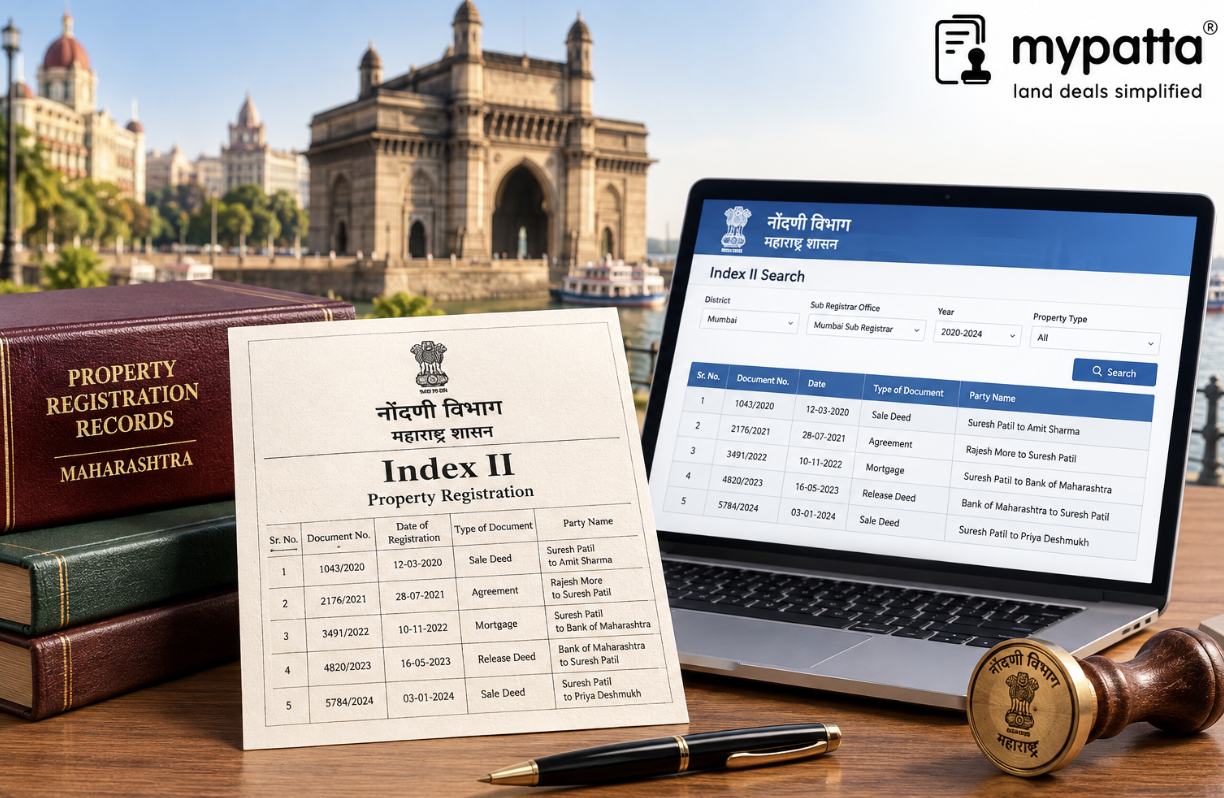
How to Download Index 2 in Maharashtra
You can get the Index 2 in Maharashtra online easily via mypatta without visiting the Sub-Registrar office.
- Open mypatta and log in or sign up if needed.
- Go to property documents, ensure “Maharashtra” is selected as the state, then tap the “Index 2” icon.
- Enter required information.
- Tap “Search”
- Once the Index 2 is available to download, tap “View Document”. You can now save or share or download this document in PDF on your device.
What Is an Index II Document in Maharashtra?
Index II is an index entry prepared by the registration authority for documents relating to immovable property. It records selected particulars of a registered transaction so that the document can be identified and searched in the registration records.
The legal basis for Index II is found in Section 55 of the Registration Act, 1908. The Act requires registration offices to maintain four indexes. Index No. II contains the property-related particulars referred to in Section 21 for documents entered or memoranda filed in Book No. 1, together with any additional particulars directed by the Inspector General of Registration. Book No. 1 is the register for non-testamentary documents relating to immovable property.
In Maharashtra, an Index II may be generated for registered instruments such as:
- sale deeds;
- gift deeds;
- agreements for sale;
- conveyance deeds;
- partition deeds;
- release deeds;
- mortgage-related instruments;
- development agreements;
- leases; and
- other registered documents affecting immovable property.
The exact information varies according to the nature of the instrument. A sale deed may show the seller, buyer, consideration and property details, while a gift deed may record a transfer without a conventional sale price.
Index II is useful because it provides a concise summary of the transaction maintained in the registration system. It can help a property owner, buyer, bank or legal professional quickly identify:
- whether a document was registered;
- where it was registered;
- when registration occurred;
- who the parties were;
- what type of transaction was recorded; and
- which property was connected with the document.
It is important to distinguish Index II from the registered deed itself. The deed contains the complete terms of the transaction, detailed property schedule, representations, covenants, rights, obligations, signatures, endorsements and annexures. Index II contains only selected registration particulars.
The Registration Act also distinguishes between viewing an index entry and obtaining a certified copy. Under Section 57, Book No. 1 and its connected indexes are open to inspection, subject to payment of the applicable fee. Signed and sealed copies supplied by the registering officer have evidentiary value for proving the contents of the original registration record.
What Information Does Index II Contain?
The layout and entries may differ depending on the document type, registration year and system through which the record was generated. However, an Index II commonly contains the following categories of information:
| Category | Details that may appear |
|---|
| Document identification | Document number, year, document type or article and registration office |
| Registration particulars | Date of execution, presentation and registration |
| Party information | Names and addresses of persons executing and claiming under the document |
| Property description | District, taluka, village, survey number, Gat number, CTS number, plot, flat or unit details |
| Area or extent | Land area, built-up area, carpet area or share, depending on the transaction |
| Transaction value | Consideration stated in the document and market value adopted for stamp purposes |
| Government charges | Stamp duty and registration fee, where displayed |
| Other particulars | Property description, municipal details, share transferred or relevant remarks |
Document number and year
The document number is one of the most important identifiers. Registered documents are numbered within the relevant registration office and year.
For example, the same numerical document number may exist in different years or Sub-Registrar Offices. The complete identification should therefore include:
Document number + document year + Sub-Registrar Office
Nature of the document
The Index II may identify the instrument as a sale, gift, lease, mortgage, release, partition, agreement or another registered transaction.
The nature of the document determines what rights were purportedly dealt with. A sale deed and an agreement for sale do not necessarily have the same legal effect. Similarly, a release deed may transfer only an existing share rather than the entire property.
Names of parties
The Index II may show persons executing the document and persons claiming under it.
In a straightforward sale:
- the seller ordinarily appears as the person executing or transferring the interest; and
- the buyer ordinarily appears as the person claiming or receiving the interest.
The roles may be different in a gift, release, mortgage, lease or development agreement. The party names must therefore be read with the document type.
Property particulars
The property description may contain a combination of identifiers, including:
- district and taluka;
- village or locality;
- survey or Gat number;
- Hissa or subdivision;
- CTS or city-survey number;
- plot number;
- municipal house number;
- building or society name;
- floor and flat number;
- area or extent; and
- boundaries or other descriptive particulars.
The level of detail may be shorter than the property schedule in the deed. Index II should therefore be used to identify the transaction, after which the complete property schedule should be read from the registered document.
How to Read the Party, Registration and Property Details
Index II should be read in a fixed sequence so that a transaction involving a similarly named person or nearby property is not mistaken for the intended registration.
Start with the registration office
Check the Sub-Registrar Office where the document was registered. The office should correspond with the registration particulars shown on the deed.
The registration office is important because identical document numbers can exist across different offices.
Check the document number and year
The document number and year should match:
- the registration endorsement on the deed;
- the certified copy of the document;
- any earlier title opinion;
- an agreement referring to the transaction; and
- connected mutation or society records.
A difference of even one digit may lead to a completely unrelated document.
Identify the document type
Determine whether the entry relates to a sale deed, agreement, gift, release, mortgage or another instrument.
The presence of the correct buyer and seller names does not mean that the document transferred ownership. It may only record an agreement, mortgage, power-related transaction or another limited arrangement.
Read the party roles
The names should be checked with the capacity in which each party appears.
Pay particular attention to:
- complete name and initials;
- father’s, husband’s or authorised representative’s details;
- individual, company, trust or society status;
- persons acting through a power of attorney;
- multiple sellers or buyers;
- co-owners and confirming parties; and
- shares or interests transferred.
A person may appear in the transaction without transferring or receiving the entire property. The complete deed is required to understand each party’s legal role.
Match the property description
The property details should be compared with the registered deed and current land or municipal record.
For rural land, examine:
- village;
- survey or Gat number;
- Hissa;
- extent; and
- land description.
For urban property, examine:
- CTS or city-survey number;
- plot number;
- building or society;
- floor;
- flat or unit number;
- area; and
- municipal location.
Apartment buyers should ensure that the Index II relates to the exact flat and not merely another unit in the same project.
Check execution and registration dates
Several dates may be relevant:
- date on which the document was executed;
- date on which it was presented;
- date on which it was registered; and
- date on which the index was generated.
A short difference between execution and registration may be routine. A substantial difference should be examined with the registration endorsements and applicable circumstances.
The Registration Act requires registration offices to prepare current indexes of registered records and to make index entries, as far as practicable, after the connected document or memorandum has been copied or filed.
How Are Consideration Value and Market Value Reflected?
Index II may display both the consideration value stated in the transaction and the market value adopted for stamp-duty purposes. These figures do not necessarily mean the same thing.
Consideration value
Consideration is the amount or value stated by the parties as being paid or payable under the document.
In a sale transaction, this is generally the agreed sale price. Depending on the instrument, consideration may also include:
- an amount already paid;
- an amount payable later;
- adjustment of liabilities;
- exchange of property;
- construction or development obligations; or
- another form of value recognised in the deed.
Some instruments, such as gifts, may not involve ordinary monetary consideration.
Market value
Market value is the value considered for assessing the applicable stamp duty under Maharashtra’s stamp and valuation framework. It may be determined with reference to the property particulars, valuation rules and the Annual Statement of Rates commonly associated with ready-reckoner rates.
Maharashtra’s official e-ASR system provides access to the Annual Statement of Rates according to the relevant year, district, taluka, village, zone and property category. The portal also cautions users to enter the property information accurately and verify the applicable valuation where necessary.
The Maharashtra Stamp (Determination of True Market Value of Property) Rules, 1995 provide the formal framework for determining the true market value of property for stamp purposes.
The values can therefore differ:
- If the consideration is lower than the applicable market value, stamp duty may be assessed on the higher value under the relevant rules.
- If the agreed consideration is higher than the prescribed valuation, that higher declared value may become relevant for stamp-duty calculation.
- In non-sale instruments, the value may be reflected according to the nature of the rights transferred and the applicable stamp provision.
A higher market value than consideration does not automatically prove that additional money was paid outside the document. Similarly, matching values do not independently prove that the complete consideration was actually paid.
The figures should be compared with:
- the full registered deed;
- payment clauses;
- bank records or payment receipts;
- stamp-duty challan;
- registration-fee receipt; and
- valuation details applicable on the date of the transaction.
Index II provides the recorded figures but usually does not explain the complete calculation, payment schedule or contractual adjustments.
How to Access Index II Online in Maharashtra
Maharashtra’s Department of Registration and Stamps provides electronic search services through which property transactions can be searched using property details or document particulars.
The official e-Search service allows users to:
- search by property details;
- search by document number; and
- access available scanned registration records.
The Department describes the service as an online, round-the-clock facility intended to reduce the need to visit multiple registration offices and to assist citizens in identifying property transactions.
A document-based search generally requires particulars such as:
- registration type;
- district;
- Sub-Registrar Office;
- document year; and
- document number.
A property-based search may require:
- district;
- area or village;
- survey, Gat, CTS, plot or flat number; and
- related location particulars.
The official user guide states that after the relevant search result appears, the Index II view can be opened from the transaction result.
The free-search Index II is expressly made available for viewing purposes. Maharashtra’s paid e-Search system also cautions that online extracts and downloaded data supplied through that service are informational and are not certified by the Department.
Where an authenticated copy is required, a digitally signed or certified Index II should be obtained through the relevant official service.
Maharashtra’s Right to Public Services portal currently lists digitally signed Index II as one of its available services. The official e-Praman manual indicates that applicants can request a digitally signed copy by selecting the district and Sub-Registrar Office and entering the document number and year.
The Department’s copy-and-search section also separately recognises:
- certified copy of a document;
- certified copy of an index; and
- search of registered transactions.
This distinction is important. A view-only Index II, a digitally signed Index II and a certified copy of the complete registered deed are not the same document.
How to Verify Whether Index II Relates to the Correct Registered Transaction?
Index II should be accepted as relating to the intended transaction only after its principal identifiers have been matched.
Verify the document particulars
Check:
- document number;
- year;
- Sub-Registrar Office;
- type of instrument; and
- registration date.
These should correspond with the registration endorsement on the deed.
Compare the parties
Confirm that the names and roles of the transferor and transferee match the transaction being examined.
Where a company, trust, society or power-of-attorney holder is involved, check the capacity in which the document was executed.
Match the property identifiers
The Index II should contain sufficient information to connect it with the intended property.
Compare:
- village or locality;
- survey, Gat, Hissa or CTS number;
- plot or flat number;
- building or society name;
- area or extent; and
- any available municipal particulars.
A matching party name is not enough where the person owns several properties.
Compare the transaction values
The consideration and market value should be compared with the registered deed and stamp-duty documents. A major unexplained difference may indicate that:
- a different document was retrieved;
- an amount was incorrectly entered;
- only part of the property was transferred;
- the valuation was revised; or
- the index entry requires clarification.
Confirm the document type and rights involved
An Index II for an agreement for sale should not be mistaken for one relating to a completed conveyance. Similarly, an Index II for a mortgage, release of part share or development agreement may not establish a complete transfer of the property.
Obtain the registered document
The most reliable confirmation is obtained by comparing Index II with the complete registered deed or its certified copy.
Maharashtra’s e-Search service permits searches by property or document details and provides access to available scanned documents. The Department advises transaction searches close to the time of execution to help identify multiple registrations or suspicious dealings.
The following warning signs require further verification:
- incorrect or incomplete party name;
- different registration office;
- document number or year mismatch;
- property number relating to another parcel or unit;
- materially different area;
- unexpected document type;
- unexplained consideration or market value;
- missing co-owner;
- unclear power-of-attorney role; or
- an Index II that cannot be matched with the complete deed.
Index II should ultimately correspond with four sources:
- Registered deed: The complete terms and property schedule.
- Registration record: Document number, office, year and transaction entry.
- Property records: Relevant 7/12, Property Card, municipal or society details.
- Physical property: The actual parcel, plot or unit intended to be transferred.
Why mypatta?
- Trusted by 7 Lakh+ Customers
- 1 Crore+ Documents Delivered
- mypatta Guarantee: Guaranteed delivery or a 100% refund
- 4.8-Star App Rating
- Your money is safe with us: Guaranteed delivery or a 100% amount refund.
FAQs
- 1. Is Index II the same as the registered sale deed?+
No. Index II is a summary entry containing selected registration particulars. The registered sale deed contains the complete terms, property schedule, rights, obligations and execution details.
- 2. Does every Index II relate to a transfer of ownership?+
No. Index II may relate to a sale, agreement, mortgage, lease, release, development agreement or another registered instrument. The document type must be checked before drawing any conclusion.
- 3. Why are consideration value and market value different in Index II?+
Consideration is the value stated by the parties in the document. Market value is the value adopted for stamp-duty purposes under the applicable valuation framework. The two figures may therefore differ.
Shivangi
Real Estate Content Writer
Shivangi is a real estate content writer with 3+ years of experience helping readers understand property documentation, land records, and legal requirements through clear and actionable content.