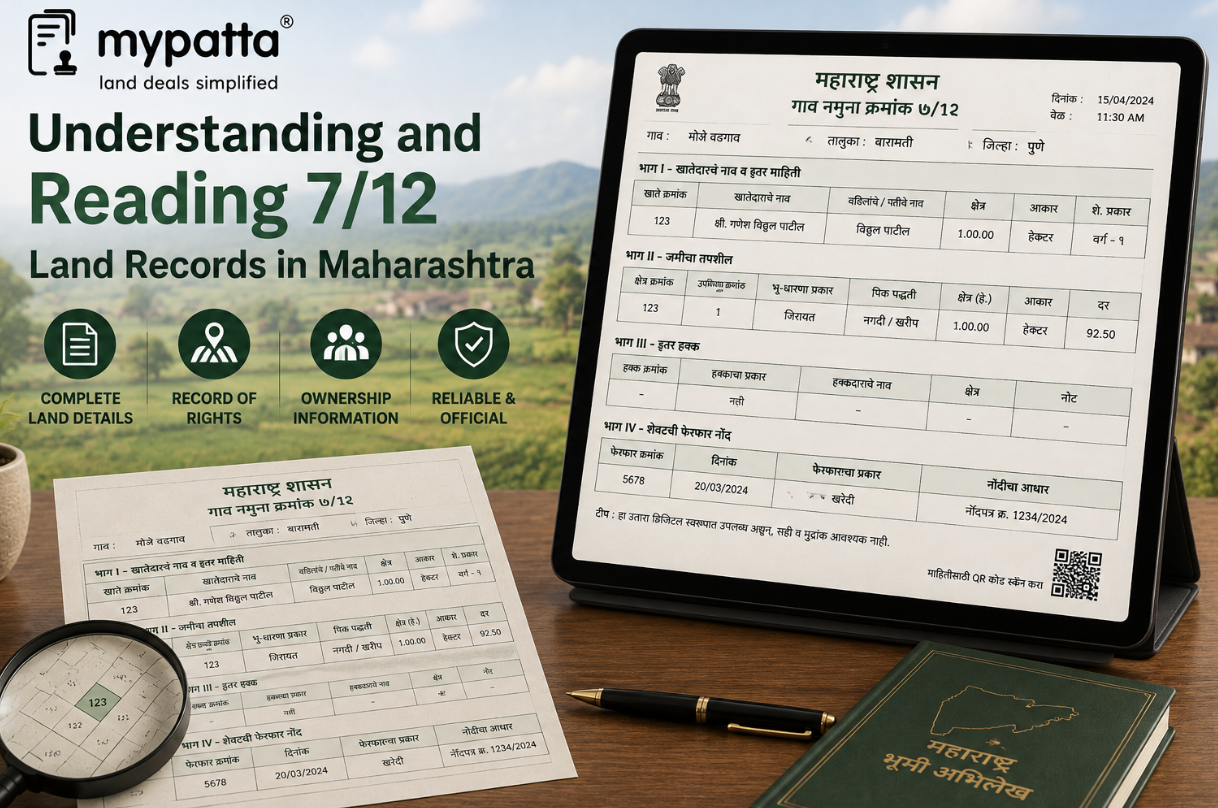
How to download 7/12 & 8A in Maharashtra
You can get the 7/12 & 8A in Maharashtra online easily via mypatta without visiting the Sub-Registrar office.
- Open mypatta and log in or sign up if needed.
- Go to property documents, ensure “Maharashtra” is selected as the state, then tap the “7/12 & 8A” icon.
- Enter required information.
- Tap “Search”
- Once the 7/12 & 8A is available to download, tap “View Document”. You can now save or share or download this document in PDF on your device.
What Is a 7/12 Extract in Maharashtra?
A 7/12 extract, commonly called Satbara Utara, is a survey-wise land record maintained for agricultural land in Maharashtra. It connects a particular survey or Gat number with the persons, interests, area, cultivation details and other matters recorded against that land.
The Maharashtra Land Revenue Code requires a Record of Rights to be maintained for every village. The record includes persons recognised as holders, occupants, owners, mortgagees, landlords, government lessees or tenants, along with the nature and extent of their interests and conditions or liabilities attached to those interests.
The 7/12 is especially useful for answering preliminary questions such as:
- Which survey or Gat number identifies the land?
- Who is currently recorded against it?
- What area is shown?
- Is the land divided into a Hissa or subdivision?
- What crops or cultivation details are recorded?
- Are any mortgages, access rights or other interests mentioned?
- Which Ferfar entries led to the present record?
Maharashtra’s official Mahabhulekh service presently allows citizens to view 7/12, 8A, Property Card and K-Prat records. The ordinary online view is meant for informational checking, while the State separately provides digitally signed 7/12 copies for official and legal use.
A 7/12 should not be confused with:
- a registered sale deed;
- an 8A extract;
- a Ferfar or mutation entry;
- a village map;
- an official measurement record; or
- a title-search report.
Each document answers a different question about the property.
What Information Does a 7/12 Extract Contain?
The precise appearance of a 7/12 may vary according to the district, record period and whether the copy is handwritten, computerised or digitally signed. However, it generally contains several groups of information.
| Part of the 7/12 | What it generally tells you | What should be verified |
|---|
| District, taluka and village | Revenue jurisdiction of the land | Whether the correct village and taluka were selected |
| Survey or Gat number | Number identifying the parcel | Whether it matches the deed and map |
| Hissa number | Recognised subdivision of the main parcel | Whether the subdivision is officially recorded |
| Land area | Recorded extent of the parcel or subdivision | Whether the unit and total area are correct |
| Holder or occupant details | Persons entered against the land | Their capacity, share and supporting mutation |
| Tenure or assessment details | Revenue status and assessment particulars | Whether any tenure restriction applies |
| Other rights | Mortgages, access rights, liabilities or other interests | Supporting order or document for each entry |
| Cultivation and crop details | Agricultural use recorded for the relevant period | Whether the entry is current and matches the field |
| Irrigation details | Recorded irrigation source or status | Whether it corresponds with present conditions |
| Ferfar references | Mutation numbers affecting the entry | Certification status and supporting transaction |
The official Mahabhulekh search itself uses details such as district, taluka, village and survey or Gat number to locate a 7/12. It also warns users to seek correction where the online and handwritten records differ in total area, unit, holder’s name or holder’s area.
A reader should not focus only on the name appearing prominently in the record. The complete extract, including shares, other rights, mutation references and cultivation information, must be examined.
How to Read the Survey Number, Hissa Number and Land Area
The first step is to identify the land correctly.
Survey number or Gat number
The survey or Gat number is the principal revenue identifier assigned to the parcel within the village.
It must always be read with:
- district;
- taluka;
- village;
- village code, where shown; and
- Hissa number, if applicable.
The same number may exist in different villages, so the survey number alone cannot safely identify the property.
The number appearing in the 7/12 should match the:
- registered deed;
- Ferfar entry;
- 8A extract;
- village map or Mahabhunakasha record;
- measurement or subdivision documents; and
- property physically shown by the holder.
Hissa number
A Hissa number identifies an officially recognised part or subdivision of a larger survey or Gat number.
For example, a larger parcel may later be divided into separate portions such as Hissa 1, Hissa 2 and Hissa 3. The Hissa should not be confused with an informal family division or a privately drawn sketch.
Where a seller claims a specific portion of a larger Gat, check whether:
- a lawful partition or subdivision occurred;
- the Hissa number was officially created;
- the map reflects the subdivision;
- a separate 7/12 exists; and
- the deed describes the same portion.
Land area
The area column should be read with the unit stated in the record. Do not compare figures until the measurement units have been confirmed.
The displayed figure may represent:
- the area of the entire Gat;
- the area of one Hissa;
- cultivable land;
- uncultivable land;
- the holder’s share; or
- another category shown separately in the form.
Important distinctions include:
- total parcel area versus seller’s fractional share;
- recorded area versus physically available area; and
- main Gat area versus subdivided Hissa area.
Where the online and handwritten 7/12 differ in area or unit, the Mahabhulekh portal directs the user towards the official correction mechanism rather than assuming that either figure is automatically correct.
How to Understand the Occupant, Owner and Other Rights Entries
Names appearing in different sections of the 7/12 may represent different legal or revenue interests. They should not all be treated as owners.
Recorded holder or occupant
This section generally identifies persons shown as holding or occupying the land in the Record of Rights.
The entry may have arisen through:
- purchase;
- gift;
- inheritance;
- partition;
- government grant;
- tenancy-related order;
- court order; or
- another mutation event.
Check whether the person is recorded:
- individually or jointly;
- for the entire parcel or only a share;
- in a particular legal capacity;
- subject to a tenure condition; or
- through a recent mutation that remains disputed.
A person’s name in the 7/12 is significant evidence of the revenue position, but revenue entries do not independently create or extinguish title. The Supreme Court has reiterated that mutation and revenue records primarily serve fiscal purposes and cannot by themselves determine ownership.
Joint holders and shares
Where several people appear, determine:
- whether their shares are stated;
- whether the holding is still undivided;
- whether all heirs or co-owners are included;
- whether a partition was completed; and
- whether the proposed seller is dealing only with their share.
A person recorded jointly with others should not represent the entire survey number as exclusively owned without supporting partition and subdivision records.
Other rights column
The other rights section may record interests or liabilities affecting the land in addition to the principal holder’s name.
Depending on the property, this section may refer to:
- mortgage or bank interest;
- tenancy or lease-related rights;
- access or agricultural pathway rights;
- government restrictions;
- court or Revenue orders;
- claims of another person;
- acquisition-related entries; or
- other liabilities attached to the land.
A 2025 Maharashtra Government Resolution, for example, directs that officially recognised agricultural access roads may be entered in the other-rights section with particulars such as the affected Gat or survey number, width, length, direction and boundaries.
Every material entry should be traced to its supporting order, deed or Ferfar record. An abbreviation or short remark should not be interpreted without obtaining the underlying document.
How to Read Crop, Cultivation and Irrigation Details
The cultivation portion of the 7/12 helps explain the agricultural position recorded for the land. It may contain crop, cultivation and irrigation-related information for the relevant period.
Crop details
Crop entries may indicate the crop or agricultural use recorded for a particular season or year.
They can help examine:
- whether the land was cultivated;
- the nature of the crop grown;
- whether cultivation changed over time;
- whether part of the land was fallow; and
- whether the field use corresponds with the seller’s description.
A crop entry should not be treated as proof of ownership. A tenant, family member, co-holder or another cultivator may grow crops on land recorded in someone else’s name.
Cultivation particulars
The record may show whether the land is:
- under cultivation;
- fallow;
- used for a particular agricultural purpose;
- partly uncultivable; or
- recorded with another field condition.
Because agricultural entries can change, the year or period of the 7/12 matters. An old extract may be useful for historical cultivation but should not be presented as the current field position.
Irrigation information
The 7/12 may contain particulars concerning irrigation status or source, depending on the record.
These entries may help indicate whether the land is recorded as:
- irrigated;
- unirrigated;
- supplied by a well;
- dependent on another recognised source; or
- partly irrigated.
The recorded irrigation position should be compared with the actual site. A well may have dried up, a canal may no longer serve the land or a new irrigation arrangement may not yet appear in the extract.
Crop and irrigation entries are therefore best used as supporting agricultural information, not as a substitute for physical inspection.
What Do Mutation or Ferfar References in the 7/12 Indicate?
A Ferfar reference indicates the mutation entry through which a change was proposed and, after certification, incorporated into the Record of Rights.
A Ferfar may arise from:
- sale;
- gift;
- inheritance;
- partition;
- release of a share;
- mortgage;
- discharge of a mortgage;
- lease;
- court or Revenue order;
- correction; or
- subdivision.
The Maharashtra Land Revenue Code provides for acquisition of rights to be reported, entered in the mutation register, notified to interested persons and certified after scrutiny. Only a certified mutation should be incorporated into the Record of Rights.
When a Ferfar number appears in the 7/12, check:
- the mutation number;
- date and reason for the entry;
- previous and new holder;
- survey or Gat number;
- Hissa and area affected;
- supporting deed or order;
- objections, if any;
- certification status; and
- whether the 7/12 reflects the decision accurately.
Maharashtra’s official mutation-status facility currently permits searches by mutation number or registered-document number. It also displays the deadline for objections against the relevant mutation.
A Ferfar reference does not replace the underlying document. For example, a sale-based mutation should be checked with the complete registered sale deed, while an inheritance mutation should be checked with the death and succession records.
What Information Cannot Be Confirmed From a 7/12 Extract Alone?
A 7/12 is an important revenue record, but it does not provide a complete title, transaction, survey or litigation report.
It cannot independently confirm:
Conclusive ownership
The entry supports the recorded revenue position but does not prove that the underlying deed, inheritance, partition or grant is legally valid.
Complete title chain
The extract does not reproduce every earlier sale deed, gift, partition, release, will or court decree through which rights moved to the present holder.
Exact physical boundaries
A survey or Gat number and area do not fix every boundary point on the ground. The village map, subdivision record, measurement papers and official survey may be required.
Actual possession
The person named in the record may not have vacant or exclusive possession. A tenant, co-holder, cultivator, neighbour or encroacher may occupy the land.
Every mortgage or encumbrance
The other-rights section may contain certain charges, but registration searches, lender records and other encumbrance checks may still be necessary.
Pending litigation
A civil, revenue, succession, partition or boundary case may not be fully explained in the 7/12. Court and Revenue proceeding searches should be conducted separately.
Lawful land-use conversion
Physical construction or non-agricultural use does not by itself prove that the necessary conversion or permission was obtained.
Accurate digital information in every case
The ordinary Mahabhulekh view is expressly stated to be unsuitable for official or legal use. A digitally signed 7/12 should be obtained for formal reliance, and the verification number can be checked through the official verification facility.
A complete land review should therefore compare the 7/12 with the 8A extract, Ferfar history, registered deeds, village map, measurement records, court searches and physical possession.
Why mypatta?
Trusted by 7 Lakh+ Customers
1 Crore+ Documents Delivered
mypatta Guarantee: Guaranteed delivery or a 100% refund
4.8-Star App Rating
Your money is safe with us: Guaranteed delivery or a 100% amount refund.
FAQs
Frequently Asked Questions
- 1. Is a 7/12 extract the same as a sale deed?+
No. A sale deed records the transaction through which rights are transferred. The 7/12 shows the resulting revenue-record position after the relevant mutation is incorporated.
- 2. What is the difference between a survey number and a Hissa number?+
The survey or Gat number identifies the main parcel. A Hissa number identifies an officially recognised subdivision within that parcel.
- 3. Does a person’s name in the 7/12 prove ownership?+
Not conclusively. It is important revenue evidence, but title must be verified through the deed, inheritance, partition, grant or court order supporting the entry.
- 4. Why should Ferfar entries be checked with the 7/12?+
Ferfar entries explain how a name, share, mortgage, correction or other right entered the 7/12. They help trace the basis and certification of the current entry.
Shivangi
Real Estate Content Writer
Shivangi is a real estate content writer with 3+ years of experience helping readers understand property documentation, land records, and legal requirements through clear and actionable content.