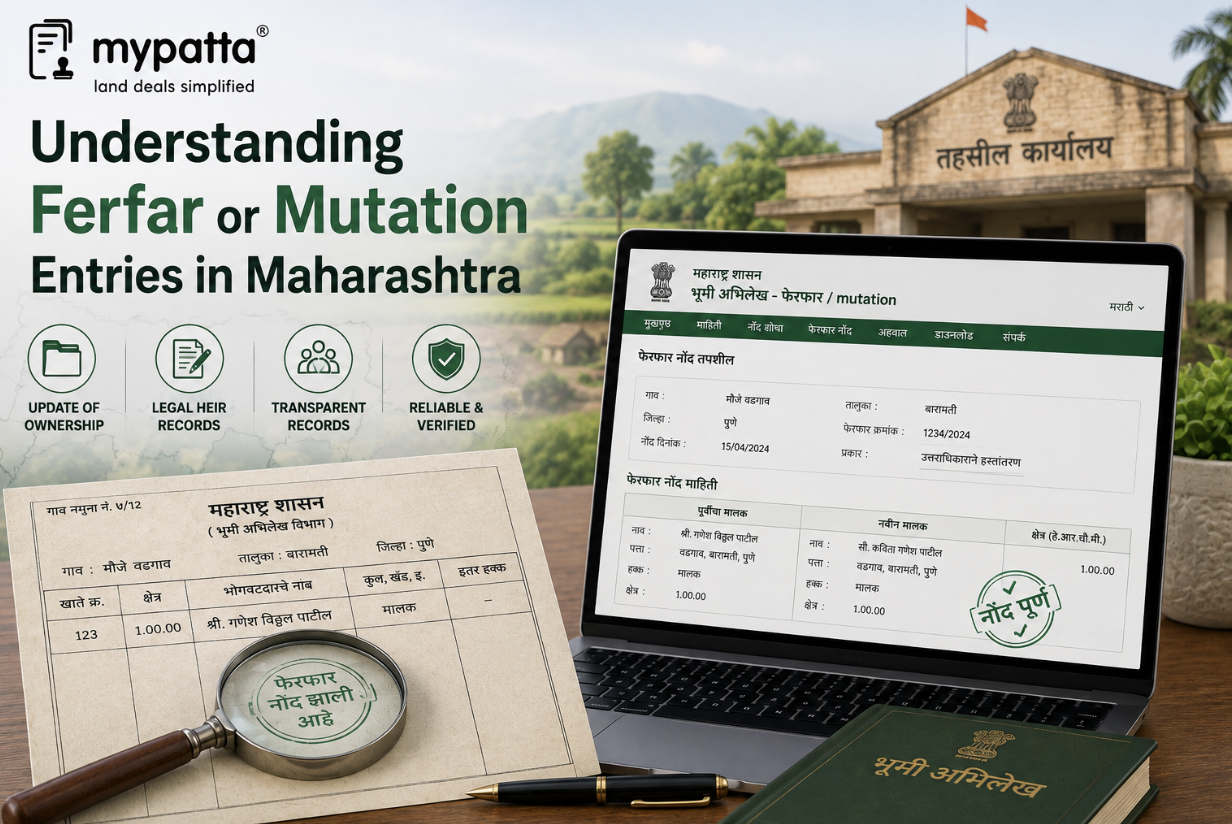
How to Ferfar or Mutation Entries in Maharashtra
You can get the Ferfar or Mutation Entries in Maharashtra online easily via mypatta without visiting the Sub-Registrar office.
- Open mypatta and log in or sign up if needed.
- Go to property documents, ensure “Maharashtra” is selected as the state, then tap the “Ferfar or Mutation Entries” icon.
- Enter required information.
- Tap “Search”
- Once the Ferfar or Mutation Entries is available to download, tap “View Document”. You can now save or share or download this document in PDF on your device.
Does a Ferfar Entry Create or Prove Ownership?
A Ferfar entry does not create ownership and cannot ordinarily be treated as conclusive proof of title.
Its purpose is to record a change affecting the rights, interests or liabilities shown in Maharashtra’s revenue records. A mutation may follow a sale, gift, inheritance, partition, mortgage, lease, court order or another event recognised under the Maharashtra Land Revenue Code, 1966.
Sections 149 and 150 of the Code provide the framework for reporting an acquisition of rights, entering the change in the mutation register, notifying interested persons, recording objections and certifying the entry. The process updates the revenue administration after the underlying legal event has occurred; it is not itself the event through which ownership arises.
For example:
- ownership after a purchase arises from the valid registered sale deed;
- ownership after a gift arises from the valid registered gift deed;
- inherited rights arise through succession;
- divided rights may arise through a partition deed or decree; and
- rights declared by a court arise from the relevant judgment or decree.
The Ferfar entry records the claimed consequence of that deed, succession or order in the revenue system.
The Supreme Court has repeatedly stated that mutation entries are primarily maintained for fiscal and revenue purposes. They neither create nor extinguish title, and disputed ownership must be decided on the basis of the underlying legal rights and documents.
This means that even a certified mutation cannot correct a legally defective transaction. A certified Ferfar entry may still be challenged where:
- the transferor had no title;
- only one co-owner transferred the entire property;
- a deed was forged, cancelled or executed without authority;
- legal heirs were omitted;
- the wrong survey number or area was mutated; or
- the supporting court or Revenue order was later set aside.
At the same time, a Ferfar entry should not be dismissed as irrelevant. When it is supported by a valid deed, correctly certified and consistently reflected in later revenue records, it becomes useful corroborative evidence of the recorded land-rights history.
How Does Ferfar Affect the 7/12 and 8A Extracts?
Ferfar is the mechanism through which an approved change is carried into the connected Record of Rights.
The three records perform different functions:
| Record | Main role in the land-record system |
|---|
| Ferfar or mutation entry | Explains the event, document or order that led to a proposed change |
| 7/12 extract | Shows the present survey-wise revenue position, including holder, area, cultivation and related entries |
| 8A extract | Shows the account-wise landholding particulars connected with a recorded holder or khata |
A mutation is first entered and processed in the mutation register. After notice, scrutiny and certification, the approved change may be incorporated into the 7/12 and the relevant landholder account.
For example, after a registered sale:
- The sale transaction is communicated to the Revenue authorities.
- A Ferfar entry is opened against the affected land.
- The seller, purchaser and other interested persons may be notified.
- The survey number, Hissa, area and deed particulars are verified.
- The entry is certified, corrected or rejected.
- If certified, the purchaser’s name or share is incorporated into the connected revenue records.
A Ferfar number alone does not mean that the 7/12 has already been updated. The entry may still be under notice, objection, enquiry or certification.
Similarly, certification does not guarantee that every connected record was updated accurately. Buyers should check whether:
- the purchaser’s complete name appears in the latest 7/12;
- the correct survey or Gat number and Hissa were updated;
- the transferred area or share is accurate;
- the seller’s remaining area is correctly shown;
- the buyer appears in the appropriate 8A account;
- mortgage or charge entries were added or removed correctly; and
- the certified Ferfar number is referenced in the updated record.
Mahabhumi provides separate facilities for digitally signed 7/12, 8A and Ferfar records, recognising that each must be examined for its own purpose.
A mutation may affect only part of a property. Where a deed transfers one Hissa out of a larger Gat number, the Revenue Department should not remove the transferor from the entire holding. The certified entry and updated 7/12 must reflect the precise parcel and area dealt with.
How to Compare a Ferfar Entry With the Sale, Gift or Partition Deed
The Ferfar entry must correspond with the document or legal event on which it is based. A genuine mutation entry can still contain an incorrect name, parcel number, area or share.
The comparison should begin with the basic transaction particulars.
Sale deed
For a mutation based on sale, compare:
- seller and purchaser names;
- document number and registration year;
- Sub-Registrar Office;
- execution and registration dates;
- village, survey or Gat number;
- Hissa or subdivision;
- area or share transferred;
- consideration, where mentioned; and
- rights retained by the seller.
If the deed transfers 0.50 hectare from a larger holding, the Ferfar should not show transfer of the entire Gat number unless the complete holding was actually conveyed.
Gift deed
For a gift-based mutation, check:
- donor and donee;
- property gifted;
- share or extent;
- acceptance and registration particulars;
- any retained life interest; and
- conditions contained in the deed.
The mutation should not describe the transaction as a sale merely because the property changed hands.
Partition deed
For a partition, compare:
- all co-owners or parties;
- their earlier shares;
- the properties allotted to each person;
- survey, Gat and Hissa numbers;
- separate areas allotted;
- common roads or undivided portions; and
- whether survey subdivision was required.
A partition deed may distribute shares legally, but the resulting physical parcels may still require phodi or subdivision before separate Hissa boundaries appear in the survey records.
Important comparison points
The supporting deed and Ferfar should agree on:
- the nature of the transaction;
- identity and capacity of the parties;
- property description;
- extent or fractional share;
- registration particulars; and
- date from which the change is claimed.
A difference may be clerical, but it should be corrected officially. The buyer should not rely on a handwritten explanation or assume that the 7/12 automatically overrides an inconsistent registered deed.
The mutation status can currently be checked through Maharashtra’s official service using either the Ferfar number or the registered-document particulars.
What Do Pending, Disputed or Rejected Ferfar Entries Indicate?
The status of a Ferfar entry reveals whether the proposed change has reached the final revenue record.
Pending entry
A pending entry indicates that the mutation process has not been completed.
It may be awaiting:
- generation or service of notice;
- expiry of the objection period;
- verification by the Talathi;
- supporting documents;
- clarification of land particulars;
- decision by the competent officer; or
- final certification.
A buyer should determine why the entry remains pending. A recent sale mutation may simply be under routine processing. An entry pending for a long period may indicate an unresolved documentation, survey or title problem.
Disputed entry
A disputed Ferfar generally means that an interested person has objected to the proposed change.
An objection may concern:
- omission of a legal heir;
- disputed will or inheritance;
- unauthorised sale by one co-owner;
- incorrect share;
- forged or cancelled deed;
- wrong survey or Hissa number;
- possession dispute;
- pending civil litigation; or
- alleged lack of authority of the transferor.
Section 150 of the Maharashtra Land Revenue Code requires objections to be entered in the register of disputed cases and dealt with through the prescribed Revenue process.
A disputed mutation does not automatically prove that the underlying deed is invalid. It means that the proposed revenue change is contested and the objection must be examined.
Rejected or uncertified entry
A rejected entry means that the proposed change was not accepted for incorporation into the Record of Rights.
Possible reasons include:
- insufficient supporting documents;
- mismatch between the deed and land record;
- incorrect property details;
- absence of a required permission;
- successful objection;
- failure to prove succession;
- application against the wrong parcel; or
- an adverse order from the competent authority.
The rejection order or certification remarks should be obtained. The label “rejected” does not by itself explain whether the defect is procedural or affects the underlying title.
Maharashtra’s official Aapli Chawdi service currently states notified timelines of 30 days for undisputed mutations and 365 days for disputed mutations. These are service timelines and do not guarantee approval of a particular entry.
A buyer should not complete a transaction merely because the seller states that a pending or rejected mutation is a “minor issue.” Its connection with the title, parcel and proposed sale must first be understood.
What Should Buyers Check in the Mutation History of the Land?
Buyers should examine the complete mutation sequence affecting the property, not only the Ferfar through which the seller’s name was entered.
The mutation history should broadly correspond with the title chain.
For example:
Earlier owner → sale mutation → inheritance mutation → partition mutation → seller’s present entry
Each change should have an identifiable basis.
Continuity between entries
The person removed under one mutation should normally correspond with the previous recorded holder. The person added should connect with the next transaction or succession event.
An unexplained change in names may indicate:
- a missing deed;
- inheritance not supported by documents;
- an omitted co-owner;
- correction of an earlier error;
- court-directed change; or
- mutation of a person who did not acquire title.
Parcel and area history
Track whether the survey or Gat number, Hissa and area remained consistent.
Investigate:
- reduction in area;
- creation of new Hissa numbers;
- transfer of only part of the holding;
- acquisition for a road or public purpose;
- consolidation or renumbering;
- repeated corrections; and
- differences between parent and subdivided parcels.
Mortgage history
Check for mutations recording:
- creation of a mortgage;
- bank or lender’s interest;
- charge over crops or land; and
- discharge or release of the mortgage.
Where a mortgage mutation appears, the later release or satisfaction should also be traceable.
Succession history
Where the land passed after death, confirm that:
- the deceased person was the recorded holder;
- all relevant legal heirs were considered;
- the shares were properly entered;
- any will or relinquishment is supported; and
- no heir was omitted before a later sale.
Disputed and corrected mutations
Repeated disputes, cancellations or corrections may indicate a deeper title or survey issue.
The mutation history should be compared with:
- registered deeds;
- Index II records;
- archived 7/12 extracts;
- present 7/12 and 8A;
- court or Revenue orders; and
- survey and subdivision papers.
The State’s e-Ferfar system separately tracks registered, unregistered, disputed, undisputed and pending mutations, reflecting the need to distinguish the source and status of each change.
Which Documents Should Support the Ferfar Entry?
The supporting documents depend on the reason for mutation.
For sale, gift or release
Check:
- complete registered deed;
- Index II;
- registration endorsement;
- earlier title deed;
- relevant permission, where required; and
- current parcel particulars.
For inheritance
Check:
- death certificate;
- legal-heir or family details;
- will, if relied upon;
- probate or court order where applicable;
- statements or consent of heirs; and
- earlier 7/12 showing the deceased holder.
For partition
Check:
- registered partition deed or court decree;
- family arrangement, where legally relevant;
- shares before and after partition;
- subdivision or phodi sketch;
- measurement record; and
- separate 7/12 or 8A entries created after division.
For mortgage or discharge
Check:
- registered mortgage deed or bank documentation;
- affected survey and area;
- lender’s details;
- release, reconveyance or satisfaction record; and
- later mutation removing the charge.
For a court or Revenue order
Check:
- certified copy of the judgment or order;
- case or proceeding number;
- whether the order is final or under challenge;
- exact property affected;
- appellate or revisional order; and
- compliance proceeding through which the mutation was made.
For correction or survey change
Check:
- correction application;
- earlier and current revenue extracts;
- Tippan or measurement papers;
- phodi or subdivision record;
- village map or Bhunaksha record;
- officer’s verification; and
- final correction order.
The strongest mutation entry is one supported by a valid legal document, accurately certified and consistently reflected in the current 7/12, 8A, registration record and physical parcel.
Why mypatta?
- Trusted by 7 Lakh+ Customers
- 1 Crore+ Documents Delivered
- mypatta Guarantee: Guaranteed delivery or a 100% refund
- 4.8-Star App Rating
Your money is safe with us: Guaranteed delivery or a 100% amount refund.
Frequently Asked Questions
- 1. Can a certified Ferfar entry prove that the recorded person owns the land?+
Not conclusively. It supports the revenue-record position, but ownership must be established through the deed, succession, partition, court order or other legal source on which the mutation is based.
- 2. What if the sale deed is registered but the Ferfar entry is still pending?+
The reason for the delay should be checked through the mutation status and supporting record. Registration and mutation are connected but distinct processes.
- 3. Can land be purchased when the seller’s Ferfar entry is disputed?+
The objection and its effect on the seller’s title, share and parcel should be examined first. A material dispute should ordinarily be resolved or formally clarified before purchase.
- 4. What if the Ferfar is certified but the purchaser’s name does not appear correctly in the 7/12?+
The certified entry, current 7/12 and 8A should be compared, and an official correction should be sought for any incomplete or inaccurate incorporation.
Shivangi
Real Estate Content Writer
Shivangi is a real estate content writer with 3+ years of experience helping readers understand property documentation, land records, and legal requirements through clear and actionable content.