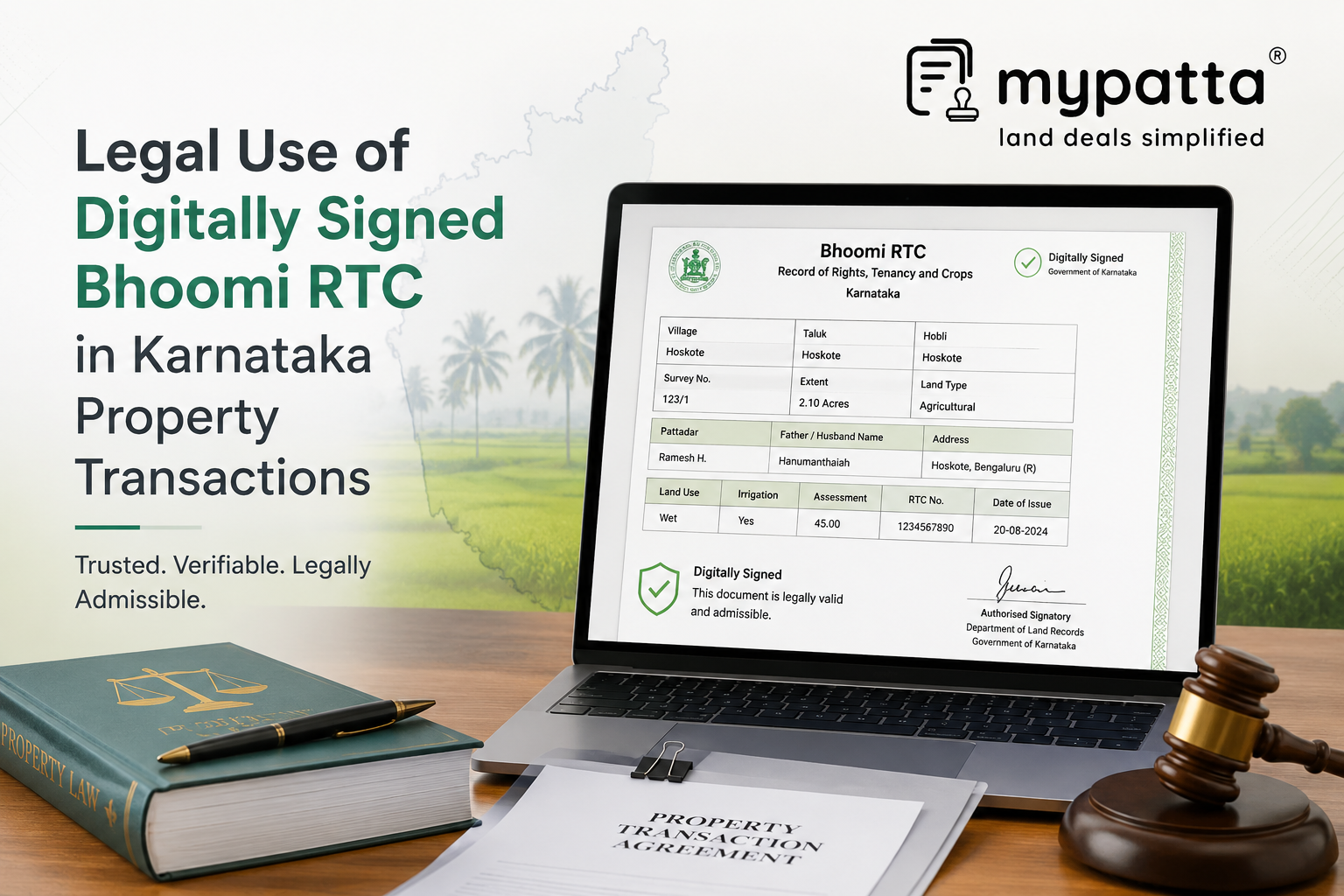
How to Download Signed Bhoomi RTC / Pahani in Karnataka
You can get the Signed Bhoomi RTC / Pahani online easily via mypatta without visiting the Sub-Registrar office.
- Open mypatta and log in or sign up if needed.
- Go to property documents, ensure “Karnataka” is selected as the state, then tap the “Signed Bhoomi RTC / Pahani” icon.
- Enter required information.
- Tap “Search”
- Once Signed Bhoomi RTC / Pahani is available to download, tap “View Document”. You can now save or share or download this document in PDF on your device.
Where Can a Digitally Signed RTC Be Used?
A digitally signed RTC can be used wherever an authenticated copy of Karnataka’s Record of Rights, Tenancy and Crops is required to establish the revenue-record position of agricultural land.
The Information Technology Act, 2000 recognises the authentication of electronic records through digital signatures and gives legal recognition to electronic signatures when the prescribed requirements are satisfied. The digital signature therefore supports the electronic authenticity of the RTC rather than merely reproducing the appearance of an official document.
A signed RTC may be useful in the following situations:
- preliminary verification before purchasing agricultural land;
- applications relating to agricultural loans or other institutional finance;
- mutation, conversion and revenue-related proceedings;
- applications before government departments or local authorities;
- court proceedings involving land, possession, tenancy or revenue entries;
- comparison with a sale deed, partition deed or inheritance document; and
- verification of the recorded holder, cultivator, extent and land classification.
The Karnataka Land Revenue Act, 1964 specifically requires certified copies of relevant Record of Rights or mutation entries to accompany certain suits and applications concerning land. This reflects the practical importance of authenticated revenue records in proceedings involving land, although the court may still examine the underlying title and other evidence.
The Karnataka Revenue Department separately provides facilities for viewing RTC information and for obtaining an i-RTC through online payment. This distinction matters because a view-only record may be useful for checking information, whereas an officially issued and authenticated RTC is better suited for formal submission.
The receiving authority may nevertheless prescribe its own requirements. A bank, court or government office may ask for a recently issued RTC, a certified mutation copy or additional records rather than accepting the RTC alone.
Does a Signed RTC Prove Legal Ownership of Land?
A digitally signed RTC does not, by itself, prove complete legal ownership of land.
The signature confirms the electronic source and integrity of the issued record. It helps show that the RTC was authenticated through the official system and that the electronic file has not apparently been altered after signing. It does not convert the RTC into a sale deed or independently validate the legal title of the person whose name appears in it.
Under Section 127 of the Karnataka Land Revenue Act, the Record of Rights may contain the names of holders, occupants, owners, mortgagees, landlords and tenants, together with the nature and extent of their interests and any attached liabilities. Different persons may therefore appear in different legal or factual capacities.
Section 133 gives entries in the Record of Rights and certified mutation entries a presumption of correctness until the contrary is proved or a new entry is lawfully substituted. This gives a signed RTC meaningful evidentiary value, but the presumption remains rebuttable.
Ownership must ordinarily be traced to the document or event through which rights were legally acquired, such as:
- a registered sale, gift, settlement, release or partition deed;
- inheritance supported by succession documents;
- a government grant;
- a court decree; or
- another legally recognised source of title.
The Supreme Court has reiterated that mutation and revenue entries are maintained principally for fiscal purposes and do not independently confer title. A dispute over ownership must be resolved by examining the title documents and, where necessary, through appropriate legal proceedings.
A signed RTC is strongest when it supports an already traceable title. For example, where the seller’s registered deed is valid, the earlier title chain is complete, the corresponding mutation is certified and the current signed RTC reflects the same holder, survey number and extent, the records reinforce one another.
The position is substantially weaker where the seller produces only a signed RTC and cannot show how the property was acquired.
How to Check Whether the Signed RTC Is Current and Transaction-Specific
A validly signed RTC may still be outdated or unrelated to the transaction being examined. The date, revenue period and property particulars must therefore be checked before relying on it.
The first question is whether the RTC relates to the latest available revenue-record position. An earlier RTC may accurately show the landholder for a previous period but fail to reflect a recent sale, inheritance, partition, subdivision or correction.
The RTC should be checked for:
- the year or period to which it relates;
- its date of issue or generation;
- district, taluk, hobli and village;
- survey number, surnoc, hissa and subdivision;
- recorded holder and the extent or share shown;
- relevant mutation number; and
- remarks referring to disputes, restrictions or pending changes.
The document should also be transaction-specific. A seller may own several parcels in the same village, or several subdivisions may fall under the same main survey number. A signed RTC for one parcel cannot support a transaction involving another merely because the owner’s name and main survey number are similar.
Where the proposed sale concerns only part of a survey parcel, check whether the required subdivision or phodi has been completed. If the RTC still describes the undivided parent survey, the buyer may not be able to identify a separately recorded portion from the RTC alone.
Karnataka’s official portal provides an RTC XML verification service through which the genuineness of RTC data may be checked using the reference number printed on the document. The verification result should correspond with the RTC’s landholder, survey, extent and related particulars.
A current signed RTC should also be compared with the mutation status. If the seller recently purchased or inherited the property but the latest RTC still shows the earlier holder, the change may remain pending, disputed or uncertified.
The buyer should not simply accept an explanation that “the RTC will be updated later”. The mutation number, basis of the application, objections and present status should be independently checked.
How to Compare a Signed RTC With the Sale Deed and Mutation Entry
The signed RTC, registered sale deed and mutation entry should describe the same land and transaction from different perspectives.
| Point to compare | Registered sale deed | Mutation entry | Digitally signed RTC |
|---|
| Parties | Seller and purchaser executing the transfer | Transferor and transferee entered for mutation | Person presently recorded as holder, occupant or other interest-holder |
| Property identity | Village, survey number, hissa, extent and boundaries | Survey parcel and extent affected by the reported change | Current survey, subdivision, holder and recorded extent |
| Legal basis | Instrument through which rights are purportedly transferred | Revenue process based on the registered transaction | Resulting revenue-record position after certification |
| Date and reference | Execution date, registration number and registration date | Mutation number, date and source document | RTC period, issue date and mutation reference |
| Status | Shows the transaction recorded in the deed | May be pending, disputed, rejected or certified | Shows whether the certified change has been carried into the RTC |
Begin by comparing the property schedule in the deed with the signed RTC. The village, survey number, hissa, subdivision and extent should be consistent.
The boundaries in the deed may not be reproduced fully in the RTC. They should therefore be separately compared with survey sketches and the physical property.
The next step is to trace the mutation entry based on the sale deed. Under Section 129 of the Karnataka Land Revenue Act, reported acquisitions are entered in the Register of Mutations, interested persons are notified, objections may be recorded and the mutation is tested before certification. A mutation entry should not be transferred into the Record of Rights until it has been duly certified.
Karnataka’s Revenue Department explains that changes in an RTC, apart from crop entries, are ordinarily made through mutation. Mutations may arise from registered documents such as sale, partition or gift deeds, or from events such as inheritance.
During comparison, verify that:
- the mutation refers to the correct deed number and registration date;
- the seller and purchaser correspond with the transferor and transferee;
- the correct survey number and subdivision were included;
- the extent mutated is the extent transferred under the deed;
- no objection or disputed case remains unresolved;
- the mutation was certified rather than merely initiated; and
- the latest signed RTC reflects the certified entry.
A mismatch should be investigated rather than explained away. For instance, the deed may transfer one acre while the RTC shows the purchaser against the full survey extent. Alternatively, the mutation may cover only one subdivision while the deed purports to include two.
What Risks Remain Even When the RTC Is Digitally Signed?
Digital authentication reduces the risk of relying on an altered or unauthorised electronic copy. It does not remove risks arising from the land records or the underlying transaction.
Outdated or incorrect revenue data
The RTC may be genuinely signed but contain an old owner’s name, incorrect share, clerical error or incomplete subdivision. Authentication confirms the document’s source, not the accuracy of every entry.
Defective title of the recorded holder
A person may appear in the RTC even though the deed through which they claim title is void, disputed, forged or executed by a person without authority.
Joint ownership and unpartitioned shares
The seller may be one of several recorded holders. Their name in the RTC does not automatically permit them to transfer the whole property or a separately identified physical portion.
Pending mutation or objection
A recent mutation may be under inquiry, disputed or not yet certified. The RTC may therefore show a position that is about to change or one that does not reflect the transaction being examined.
Tenancy or possession concerns
Another person may be shown as tenant or cultivator, or may be in physical possession despite the seller’s name appearing as the holder. The signed RTC does not resolve every possession or tenancy dispute.
Encumbrances and court proceedings
The RTC may not reveal every mortgage, attachment, agreement, injunction, acquisition proceeding or pending civil dispute affecting the land.
Boundary and access problems
A signed RTC records revenue particulars but does not conclusively establish the precise physical boundaries, road access or absence of encroachments.
Land-use and grant restrictions
The land may be agricultural, granted, converted, acquired or subject to statutory restrictions. A clean and signed RTC does not establish that every proposed use or transfer is legally permissible.
The central distinction is that digital signing authenticates the copy, while due diligence verifies the property.
What Supporting Records Should Be Verified Before Relying on It?
The signed RTC should be treated as one part of a wider property-verification exercise.
The supporting records will depend on the history and nature of the land, but the following should ordinarily be examined:
- Current registered title deed: To identify the instrument through which the seller claims rights.
- Mother deed and link documents: To trace the earlier title chain and identify missing or inconsistent transfers.
- Certified mutation extract: To confirm how the relevant change entered the revenue system and whether it was certified.
- Encumbrance Certificate and registration search: To identify registered sales, mortgages, releases, gifts or other later transactions.
- Akarband and survey records: To verify the survey number, extent, assessment and subdivision particulars.
- Tippan, Atlas, Pakka Book or phodi sketch: To understand measurements, boundaries and division of the parent parcel.
- Village map and access records: To examine location, adjoining parcels, roads and public features.
- Succession or partition documents: Where the seller obtained the land through inheritance or family division.
- Government grant records: To check conditions, non-alienation restrictions or the nature of the original grant.
- Conversion and planning records: Where the land is proposed to be used for non-agricultural development.
- Court and revenue-case records: To identify pending disputes, appeals, injunctions or correction proceedings.
- Physical survey and possession verification: To ensure that the parcel on the ground corresponds with the records.
Karnataka’s unified Revenue Department system presently provides access to RTC information, mutation records, mutation status, dispute information and several survey-related services. These records can assist with the revenue and survey components of due diligence but cannot replace examination of the registered title chain.
Before relying on a signed RTC in a property transaction, the buyer should be able to answer four questions:
- Is the electronic document authentic?
- Does it relate to the exact land being purchased?
- Does it reflect the latest certified mutation?
- Is the recorded entry supported by a clear legal title and matching survey records?
Only when these layers are consistent does the digitally signed RTC become reliable supporting evidence in the transaction.
Why mypatta?
- Trusted by 7 Lakh+ Customers
- 1 Crore+ Documents Delivered
- mypatta Guarantee: Guaranteed delivery or a 100% refund
- 4.8-Star App Rating
Your money is safe with us: Guaranteed delivery or a 100% amount refund.
Frequently Asked Questions
- 1. Can a digitally signed RTC be submitted to a bank or government authority?+
Yes, it may be submitted as an authenticated revenue record where the institution accepts it. The authority may also require a recent RTC, title deed, mutation extract, Encumbrance Certificate or other supporting documents.
- 2. Does a valid digital signature mean that the seller has a clear title?+
No. The signature authenticates the electronic RTC. The seller’s title must still be verified through the registered deed, earlier link documents, mutation history and other relevant records.
- 3. How recent should a signed RTC be for a property transaction?+
The latest available RTC should ordinarily be obtained. Earlier RTCs may also be needed to trace changes in the holder, survey number, share, subdivision or land classification.
- 4. What if the signed RTC and sale deed show different survey extents?+
The mutation entry, Akarband, subdivision or phodi records and survey sketches should be checked. The difference may arise from joint ownership, an incomplete subdivision, an incorrect mutation or a clerical error.
Shivangi
Real Estate Content Writer
Shivangi is a real estate content writer with 3+ years of experience helping readers understand property documentation, land records, and legal requirements through clear and actionable content.