How to Download Bhoomi RTC / Pahani in Karnataka
You can get the Bhoomi RTC / Pahani online easily via mypatta without visiting the Sub-Registrar office.
- Open mypatta and log in or sign up if needed.
- Go to property documents, ensure “Karnataka” is selected as the state, then tap the “Bhoomi RTC / Pahani” icon.
- Enter required information.
- Tap “Search”
- Once Bhoomi RTC / Pahani is available to download, tap “View Document”. You can now save or share or download this document in PDF on your device.
What Is a Bhoomi RTC in Karnataka?
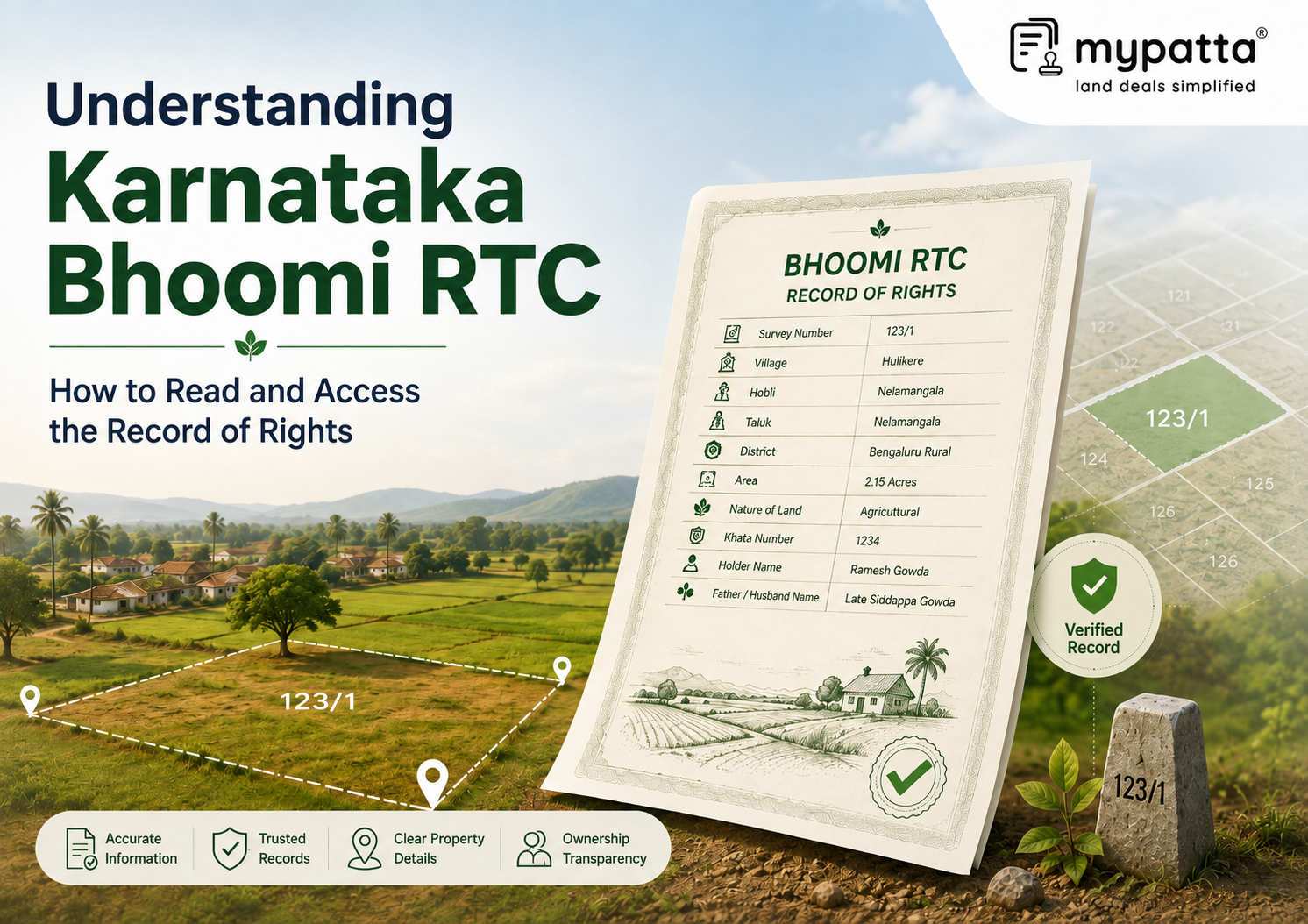
RTC stands for Record of Rights, Tenancy and Crops. It is also commonly referred to as Pahani in Karnataka.
It is a revenue record maintained for agricultural land and provides information about the land parcel, the persons whose rights are recorded against it and the manner in which the land is being used or cultivated.
A Bhoomi RTC may help identify:
- the person recorded as the landholder or occupant;
- the survey number and subdivision of the land;
- the extent and classification of the property;
- tenancy or cultivation-related entries; and
- mutation references through which changes were incorporated.
The RTC reflects the position recorded in the revenue system for the relevant period. It does not itself explain every legal transaction through which rights over the land were acquired.
For example, when agricultural land is sold, inherited, gifted or partitioned, the legal basis for the change comes from the registered deed, succession document, partition record or other underlying instrument. The RTC may subsequently be updated to reflect that change through mutation.
It should therefore be understood as an important land record, but not as a substitute for the documents that created or transferred the legal rights.
What Information Does a Karnataka RTC Contain?
The exact layout of an RTC may differ depending on its period and format. However, the record generally contains three broad categories of information.
Land-identification details
These details help locate and distinguish the property in the revenue records. They may include the district, taluk, hobli, village, survey number, surnoc, hissa number and subdivision particulars.
The subdivision or hissa is particularly important where a larger survey number has been divided into several smaller parcels. Merely matching the main survey number may not be sufficient to identify the specific property.
Rights and landholder details
This part may record the names of persons connected with the land and the nature or extent of their recorded interests.
It may include:
- the name of the recorded holder or occupant;
- the father’s or predecessor’s name;
- the share or extent recorded against each person;
- tenancy or mortgage-related entries; and
- mutation references connected with changes in the record.
The capacity in which a person is entered must be checked carefully. A holder, occupant, tenant and cultivator may have different relationships with the property.
Cultivation and revenue details
The RTC may also contain information regarding the agricultural use and revenue classification of the land. This may include the crop grown, cultivated area, irrigated or dry-land status, source of irrigation, land classification, assessment and other remarks.
Cultivation details may relate to a particular agricultural season and may not necessarily represent the present use of the land.
How to Read the Different Columns in a Bhoomi RTC
A Bhoomi RTC should be read as a connected record. Each section helps explain a different aspect of the land, and no single column should be relied upon in isolation.
| RTC section | What should be examined |
|---|
| Property identification | District, taluk, hobli, village, survey number, surnoc, hissa and subdivision |
| Extent and area | Total survey extent, holder’s individual share, cultivable area and uncultivable portion |
| Recorded rights | Name of the holder, occupant, tenant or other person and the nature of the recorded interest |
| Cultivation details | Name of the cultivator, crop particulars, agricultural use and irrigation details |
| Mutation references | Mutation number, basis of the change and whether the entry has been completed |
| Remarks | Disputes, restrictions, mortgages, government claims or other observations affecting the land |
Begin by confirming that the location and survey particulars correspond with the property being examined.
The village, survey number and subdivision should match the registered deed, mutation record and survey documents. A genuine RTC may still relate to the wrong parcel if an incorrect hissa or subdivision has been selected.
The total extent must then be distinguished from the extent recorded against the individual landholder. A survey parcel may be jointly held by several persons, and the seller may be entitled only to a particular share.
The nature of the recorded interest should also be identified. The person whose name appears in the cultivation section may not necessarily be the person recorded as the holder of the land.
Finally, the mutation references and remarks should be examined. These entries can indicate how the present record was created and whether any dispute, restriction or pending change affects it.
How Are Ownership, Possession and Cultivation Details Shown in an RTC?
Ownership, possession and cultivation are connected but legally distinct concepts. The same person may hold all three, but this is not always the case.
Recorded ownership or landholding
The rights section may show the person recognised as the landholder or occupant in the revenue records.
This entry is relevant because it indicates the person against whom the land is presently recorded. However, the entry should still be compared with the registered title documents and mutation history to understand how that person acquired the rights.
Possession or enjoyment
Possession refers to the person actually occupying, controlling or enjoying the land.
The person in possession may be:
- the recorded landholder;
- a family member;
- a co-owner;
- a tenant or lessee; or
- another person claiming an interest.
A possession-related entry can support the factual history of the land, but it does not automatically establish legal ownership.
Cultivation
Cultivation entries generally relate to the person using the land for agricultural purposes during the relevant period.
The cultivator may be the owner, a tenant, a family member or another person permitted to cultivate the property. Therefore, the appearance of a person’s name in the crop or cultivation section should not be treated as proof that the person owns the land.
For example, an RTC may record one person as the holder while another person appears as the cultivator. In such a case, the title documents, tenancy position and actual possession must be examined separately.
How to Access a Bhoomi RTC Online in Karnataka
A Karnataka Bhoomi RTC can be accessed through the State’s official land-record services by entering the relevant property particulars.
The applicant should ordinarily keep the following details available:
- district;
- taluk;
- hobli;
- village;
- survey number;
- surnoc or subdivision;
- hissa number; and
- relevant year, where an older RTC is required.
Only a brief portal process is involved: the correct location and survey particulars are selected, the relevant record is identified and the RTC is viewed or requested in the available format.
The main concern should be the accuracy of the property information entered during the search. An incorrect survey number, village or hissa may produce an RTC for a different parcel.
For land verification, the latest RTC should not always be examined alone. An earlier RTC may be required to understand when a name, extent or subdivision changed. The corresponding mutation record should also be checked to identify the basis on which the change was made.
Where a record is intended for submission before a bank, authority or another institution, the required format should be confirmed. An informational online copy and an authenticated or digitally signed copy may serve different practical purposes.
What Common Errors Should Be Checked in a Karnataka RTC?
An RTC may contain incorrect, incomplete or outdated information. The most common issues generally relate to the identity of the holder, parcel description, area, mutation status and cultivation particulars.
The following discrepancies require closer examination:
- Incorrect name or identity: Spelling variations may arise from transliteration, but a different father’s name, missing legal heir or continued appearance of an earlier owner may indicate a substantive error.
- Wrong survey or subdivision: The RTC may relate to the parent survey number instead of the specific hissa purchased or inherited.
- Incorrect extent or share: The total survey area may be confused with the individual holder’s share, or a partition may not have been reflected correctly.
- Mutation not updated: A sale, inheritance, gift or partition may have occurred, but the resulting mutation may remain pending, disputed or rejected.
- Missing co-owner or legal heir: Jointly held or inherited land may not reflect every person having an interest in the property.
- Outdated cultivation details: Crop and cultivation entries may relate to an earlier season and may not represent the current use or possession.
- Unexplained remarks: References to disputes, government restrictions, mortgages, court orders or conversion issues should be traced to the underlying record.
A mismatch does not always mean that the title is defective. It may result from a pending mutation, subdivision process, clerical mistake or delayed correction. However, the reason must be identified before the RTC is relied upon.
Why mypatta?
- Trusted by 7 Lakh+ Customers
- 1 Crore+ Documents Delivered
- mypatta Guarantee: Guaranteed delivery or a 100% refund
- 4.8-Star App Rating
Your money is safe with us: Guaranteed delivery or a 100% amount refund.
Frequently Asked Questions
- 1. Is Karnataka Bhoomi RTC the same as Pahani?+
Yes. RTC means Record of Rights, Tenancy and Crops and is commonly referred to as Pahani in Karnataka.
- 2. Does the name appearing in a Bhoomi RTC prove ownership?+
The name is an important revenue-record entry, but it should be compared with the registered deed, earlier title documents, mutation history and other supporting records.
- 3. Can an RTC show one person as the holder and another as the cultivator?+
Yes. The recorded holder, person in possession, tenant and cultivator may be different persons. Each entry should be understood according to the capacity stated in the RTC.
- 4. Why is the hissa or subdivision number important?+
A main survey number may contain several separately held parcels. The hissa or subdivision number helps identify the particular portion to which the RTC relates.
Shivangi
Real Estate Content Writer
Shivangi is a real estate content writer with 3+ years of experience helping readers understand property documentation, land records, and legal requirements through clear and actionable content.