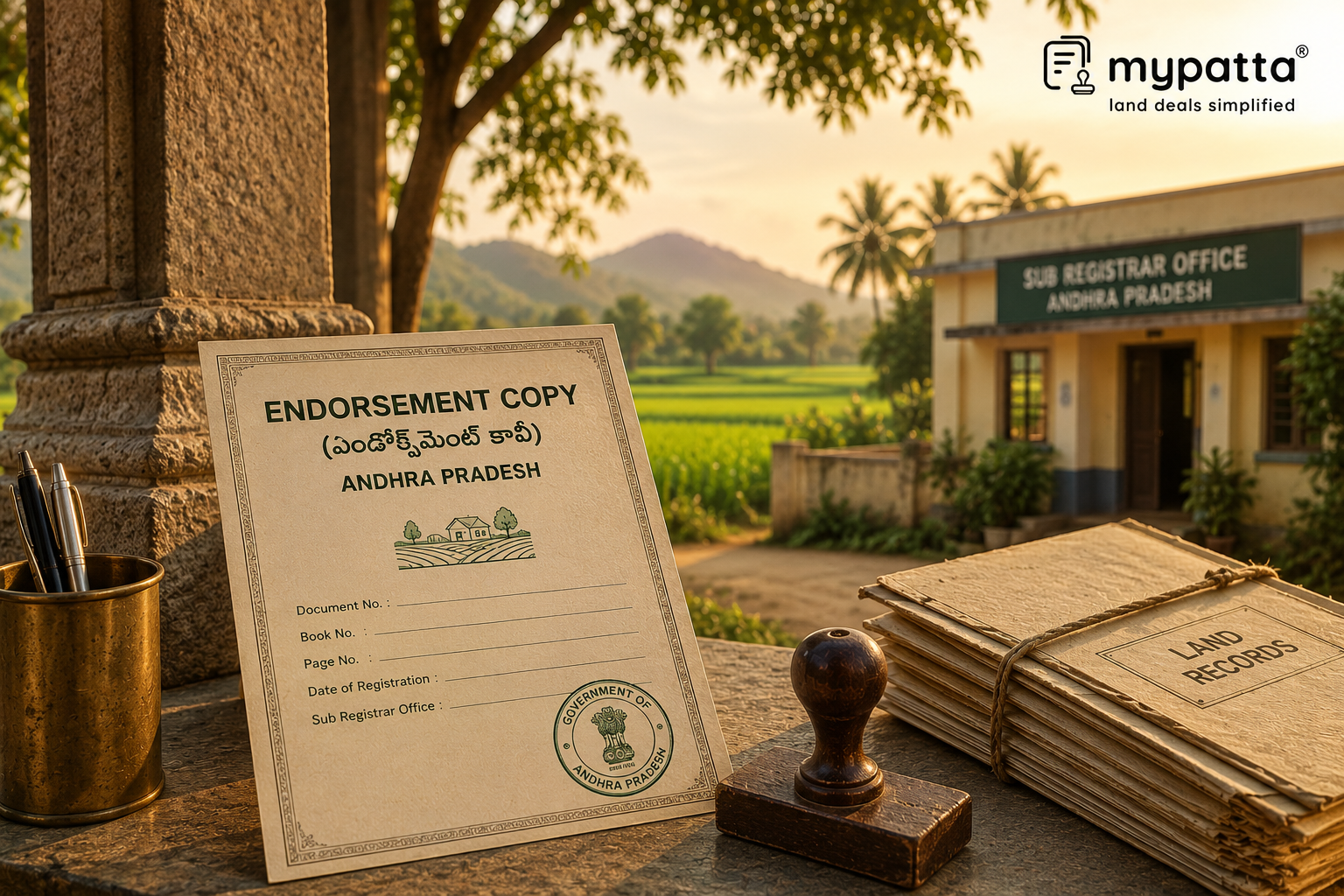
How to get Endorsement Copy in Andhra Pradesh
You can get the Endorsement Copy online easily via mypatta without visiting the Sub-Registrar office.
- Open mypatta and log in or sign up if needed.
- Go to property documents, ensure “Andhra Pradesh” is selected as the state, then tap the “Endorsement Copy” icon.
- Enter required information.
- Tap “Search”
- Once the Endorsement Copy is available to download, tap “View Document”. You can now save or share or download this document in PDF on your device.
What Does Ownership Proof Mean in a Land Transaction?
Ownership proof means evidence showing how a person legally acquired rights over a specific property and whether those rights continue to remain with that person.
A document may contain a person’s name or land details without being a title document. Different property records perform different functions:
- A registered sale deed records the transfer of property rights.
- A Mother Deed and link documents trace the earlier ownership chain.
- A partition or release deed records the division or relinquishment of rights.
- Succession documents explain how land passed after an owner’s death.
- Revenue records show how land is entered for administrative purposes.
- Survey records help identify the location, extent and boundaries of the property.
A complete ownership claim should therefore explain who held the land earlier, how it passed to the present claimant and whether any later transfer, mortgage, government restriction or competing claim affects it.
The identity of the property must also remain consistent. The village, survey number, sub-division, khata details, extent and boundaries appearing in the title documents should correspond with the current land and survey records.
An Endorsement Copy may help verify the official revenue or administrative position concerning the land. It does not ordinarily explain the complete legal transaction through which ownership was acquired.
Where Does Endorsement Copy Fit in the Ownership Evidence Chain?
Endorsement Copy fits into the ownership evidence chain as an official supporting record issued in relation to land or revenue matters.
Depending on the nature of the application and the authority issuing it, an Endorsement Copy may contain information or remarks relating to:
- recorded ownership or landholder details;
- possession or enjoyment-related particulars;
- legal heirship or inheritance-related observations;
- subdivision approval or land division remarks;
- survey number and land extent;
- land classification or revenue status;
- objections, rejections or clarifications issued by the authority; and
- other official remarks concerning the property.
Its primary value is that it records what the concerned authority has endorsed, certified, clarified or observed in relation to a specific land record or application.
For example, if a person applies for correction, subdivision, possession verification or legal-heir-related land entry, the Endorsement Copy may show the official response or recorded position on that application.
However, Endorsement Copy is not normally the instrument through which land is sold, gifted, partitioned or inherited. It does not itself create ownership. It supports the factual or administrative side of the ownership claim.
Endorsement Copy should therefore be viewed as a supporting link between the title documents and the government land record, rather than the legal source of ownership itself.
What Can Endorsement Copy Legally Establish?
Endorsement Copy can establish or support several factual matters depending on what the authority has recorded in it.
It may help show:
- that a particular application or request was made before the revenue authority;
- the official response or endorsement issued on that application;
- the land details considered by the authority;
- the person or persons whose names were referred to in the record;
- possession, enjoyment or inheritance-related remarks;
- subdivision, correction or mutation-related observations;
- whether the authority accepted, rejected or clarified a particular land-related request; and
- the revenue-record status of the land at the time of endorsement.
For example, if an Endorsement Copy records that a person’s name appears in connection with a particular survey number, it may support the factual claim that the person was recognised in the relevant revenue context.
It may also be useful where a buyer wants to understand why a mutation, correction, subdivision or legal-heir-related entry was allowed or refused. The endorsement may explain the authority’s reasoning or the official status of the request.
Its evidentiary value becomes stronger when it matches:
- the registered title deed;
- Mother Deed and link documents;
- ROR-1B;
- AP Adangal;
- mutation records;
- Pattadar Passbook;
- Encumbrance Certificate;
- FMB or LP Map; and
- physical possession of the property.
Endorsement Copy can therefore support the administrative and factual side of an ownership claim. Its value depends on whether the underlying title documents and current land records support the same person and property.
What Can Endorsement Copy Not Establish?
Endorsement Copy cannot independently establish that the person named or referred to in it has a complete, valid and marketable title.
By itself, it cannot conclusively prove:
- how the person acquired ownership;
- whether the earlier owner had valid and transferable title;
- whether a sale, gift, partition or inheritance was legally effective;
- whether all legal heirs or co-owners transferred their shares;
- whether the land was later sold, mortgaged or attached;
- whether an unregistered family dispute exists;
- whether a court case affects the land;
- whether the entire recorded extent remains available with the seller; or
- whether the property is free from government restrictions.
A person may receive an endorsement or official remark in their favour without having a complete title chain. Similarly, an endorsement may record a revenue position without deciding complicated questions of ownership between rival claimants.
An Endorsement Copy also cannot cure an invalid transaction. If the person claiming ownership does not have a valid registered deed, inheritance document, partition deed, government grant or court-recognised right, the endorsement will not automatically create ownership.
The record may also be limited to the specific application on which it was issued. For example, an endorsement issued for subdivision or possession verification may not answer all questions relating to title, encumbrances or later transfers.
Endorsement Copy should not be used as a substitute for examining the registered deeds and the legal source of the seller’s rights.
When Can Endorsement Copy Strengthen an Ownership Claim?
Endorsement Copy can significantly strengthen an ownership claim when it forms part of a clear and consistent documentary chain.
Its value is stronger when:
- the person mentioned in the endorsement is connected to the registered owner;
- the survey number and extent match the title deed;
- the endorsement is consistent with ROR-1B and AP Adangal;
- mutation followed a valid registered transfer or succession;
- the Pattadar Passbook shows matching particulars;
- the Encumbrance Certificate reveals no conflicting later transaction;
- FMB, LP Map and village records identify the same land;
- physical possession matches the records; and
- no court order or prohibited-property entry contradicts the claim.
For example, a purchaser holds a registered sale deed supported by earlier link documents. The mutation record, ROR-1B and AP Adangal reflect the purchaser’s name and the same survey number and extent. An Endorsement Copy issued by the revenue authority also supports the relevant land entry or administrative action. The Encumbrance Certificate shows no later sale or mortgage, and the FMB confirms the boundaries. In such a case, Endorsement Copy strengthens the ownership claim by showing consistency between title, revenue and survey records.
The position is weaker where the claimant relies only on Endorsement Copy but cannot produce the sale deed, inheritance papers, partition document, government grant or other source of title.
Which Documents Carry Greater Weight Than Endorsement Copy?
The following documents generally carry greater or more direct weight when legal ownership is being established:
| Document | Role in Ownership Verification |
|---|
| Registered Sale Deed | Records the legal transaction through which property rights were transferred |
| Mother Deed and Link Documents | Trace ownership from earlier holders to the present claimant |
| Gift, Partition, Settlement or Release Deed | Shows transfer, division or relinquishment of rights |
| Succession and Inheritance Documents | Explain how land passed after an owner’s death |
| Government Grant or Valid Patta | May establish the original source and nature of land rights |
| Court Decree or Order | May declare, divide or determine ownership rights |
| ROR-1B and Mutation Records | Support the current revenue-account position |
| AP Adangal | Supports land use, cultivation, recorded name and revenue-record details |
| Encumbrance Certificate | Helps identify registered transfers, mortgages and charges |
| FMB, LP Map and Survey Records | Help verify the land’s identity, measurements and boundaries |
| Prohibited-Property Records | Help determine whether the land can legally be transferred |
These records perform different functions. A registered deed may establish transfer, while Endorsement Copy supports the official or administrative position recorded by the authority. ROR-1B and mutation records show current revenue entries, while survey documents help identify the land physically.
The strongest ownership claim arises when the title documents, Endorsement Copy, AP Adangal, ROR-1B, registration history and survey records consistently refer to the same owner and land parcel.
Why mypatta?
- Trusted by 7 Lakh+ Customers
- 1 Crore+ Documents Delivered
- mypatta Guarantee – Your money is safe with us. Guaranteed delivery or a 100% amount refund.
- 4.8 Star App Rating
Your money is safe with us - guaranteed delivery or a 100% amount refund
FAQs
- 1. Can Endorsement Copy alone prove ownership in Andhra Pradesh?+
No. Endorsement Copy is a supporting official record. Ownership should be supported by a registered deed, succession document, partition deed, government grant or another valid title document.
- 2. Who issues an Endorsement Copy in Andhra Pradesh?+
It is generally issued by the concerned revenue authority or office dealing with the land-related application, depending on the nature of the request and the record involved.
- 3. Is Endorsement Copy useful if the original title deed is missing+
It may help support land-related facts, but it cannot replace the title deed. A certified copy of the registered deed should also be obtained from the registration records.
- 4. What if Endorsement Copy and ROR-1B show different details?+
The registered title documents, mutation history, Adangal, correction records and survey documents should be checked to understand the reason for the difference.
- 5. Which documents should be checked with Endorsement Copy?+
Check the registered sale deed, Mother Deed, link documents, ROR-1B, AP Adangal, mutation record, Pattadar Passbook, Encumbrance Certificate, FMB, LP Map and prohibited-property status.
Shivangi
Real Estate Content Writer
Shivangi is a real estate content writer with 3+ years of experience helping readers understand property documentation, land records, and legal requirements through clear and actionable content.