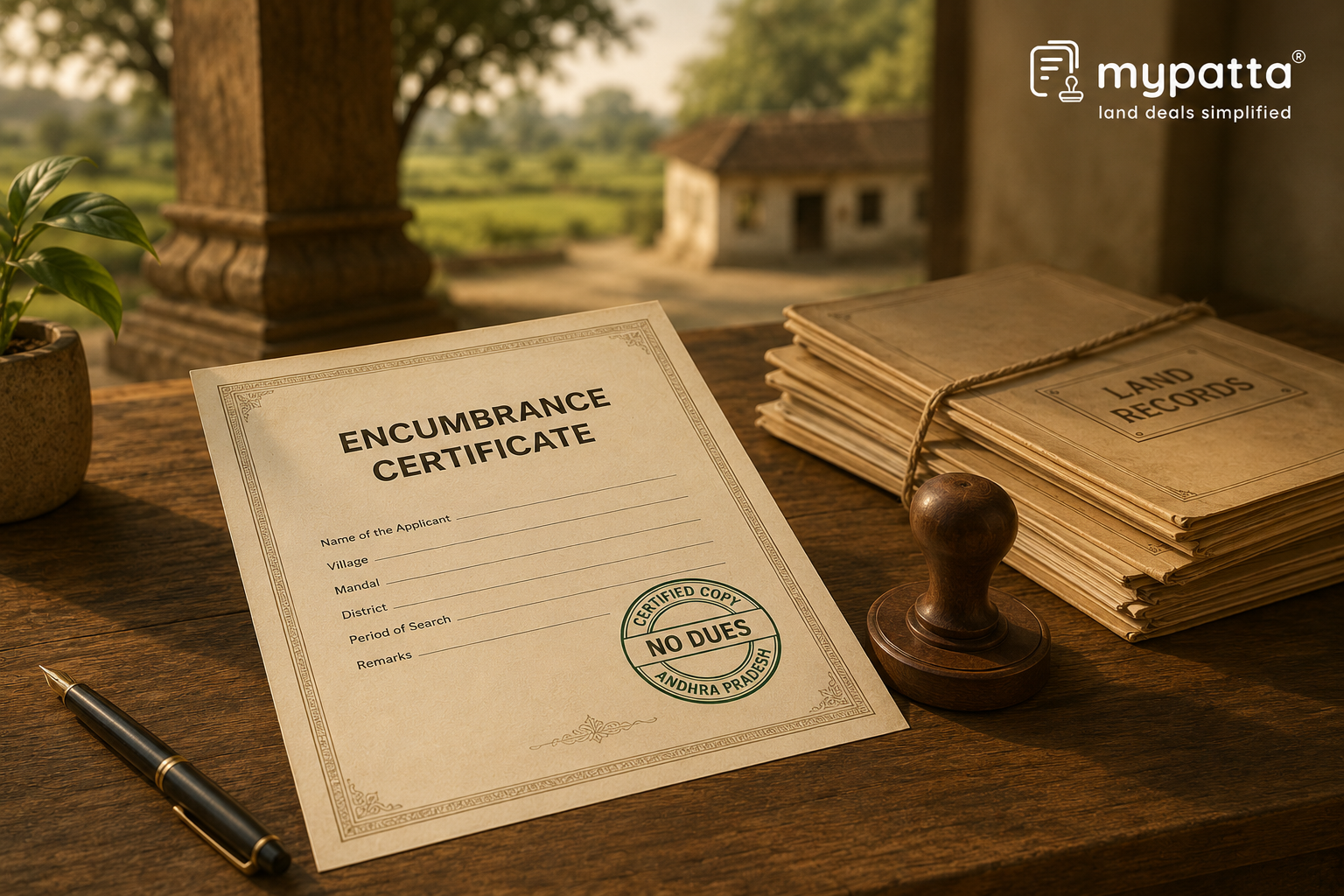
How to Download AP Encumbrance Certificate in Andhra Pradesh
You can get the AP Encumbrance Certificate online easily via mypatta without visiting the Sub-Registrar office.
- Open mypatta and log in or sign up if needed.
- Go to property documents, ensure “Andhra Pradesh” is selected as the state, then tap the “Encumbrance Certificate” icon.
- Enter required information.
- Tap “Search”
- Once Encumbrance Certificate is available to download, tap “View Document”. You can now save or share or download this document in PDF on your device.
What Is Encumbrance Certificate in Andhra Pradesh?
An Encumbrance Certificate, commonly called EC, is a registration-record document used to check whether a property has registered transactions or liabilities during a particular period. In Andhra Pradesh, buyers commonly use EC before buying land to verify whether the land has been sold, mortgaged, gifted, partitioned, released, settled or otherwise dealt with through registered documents.
The EC is especially important because land may appear clean in revenue records, but there may still be registered transactions affecting it. For example, the seller’s name may appear in Adangal or ROR 1B, but the land may have been mortgaged to a bank or already sold through a registered deed. EC helps identify such registered entries.
An EC usually works by searching registration records for a specific property and period. The buyer should check whether the details in the EC match the land being purchased, including district, sub-registrar office, survey number, village, property description and document references.
However, EC should be understood correctly. It is not the same as a title certificate. It only reflects registered transactions available in registration records for the period searched. It does not replace full legal and revenue-record due diligence.
Why Should Buyers Check Encumbrance Certificate Before Buying Land in Andhra Pradesh?
Buyers should check the Encumbrance Certificate before buying land in Andhra Pradesh because it helps identify whether the property has registered burdens or prior transactions. This is one of the most important checks before paying money to the seller.
The EC can help a buyer find out whether the land was previously sold, mortgaged, gifted, partitioned or released. It can also show if there are registered documents that the seller has not disclosed. If the seller provides only one sale deed, but the EC shows later transactions, the buyer must verify them carefully.
EC is also important for checking loans and mortgages. A landowner may have taken a loan by mortgaging the land. If the mortgage is still active, the buyer may face problems after purchase. The seller should clear the loan and provide proper release or discharge documents before sale.
Buyers should also check whether the EC period is sufficient. Checking only the last few years may not be enough if the title history is older. For safer verification, the EC should cover the relevant ownership period and link documents.
A buyer should treat EC as a warning document. If it shows an unexplained transaction, the buyer should pause and ask for supporting documents. If it shows no transaction, the buyer should still verify title, revenue records and physical possession separately.
Can Encumbrance Certificate Prove Ownership in Andhra Pradesh?
Encumbrance Certificate alone cannot prove ownership in Andhra Pradesh. It is an important registration-record document, but it does not by itself confirm that the seller has complete and marketable title.
An EC may show that a sale deed was registered in favour of the seller. That is useful, but the buyer must still check whether the earlier title chain was valid, whether the property description matches the land, whether mutation was completed, whether revenue records are updated and whether the land is free from disputes or restrictions.
Similarly, a “nil” or clean EC does not automatically mean the land is safe. Some claims may not appear in EC, such as unregistered family disputes, possession disputes, inheritance claims, boundary disputes, pending litigation, oral arrangements, government restrictions or revenue-record mismatches.
Ownership is usually verified through a combination of documents such as sale deed, link documents, partition deed, gift deed, succession documents, court decree, valid will where applicable, revenue records and survey records.
The correct approach is to treat EC as a major part of due diligence, but not the complete due diligence by itself.
Documents to Check Along With Encumbrance Certificate Before Buying Land
Before buying land in Andhra Pradesh, the Encumbrance Certificate should be checked with title, revenue, registration and survey records.
| Document | Why It Matters |
|---|
| Registered Sale Deed | Shows legal transfer of ownership |
| Link Documents / Mother Deed | Helps trace the full title chain |
| AP Adangal | Shows current land and cultivation-related revenue details |
| ROR 1B | Helps verify revenue-account and ownership-related details |
| Mutation Record | Shows whether revenue records were updated |
| Pattadar Passbook | Helps verify current pattadar details |
| FMB / Field Measurement Book | Helps verify measurements and boundaries |
| Village Map | Helps identify land location and surrounding survey numbers |
| Prohibited Property Check | Helps identify restricted or non-transferable land |
| Loan Release / Mortgage Discharge | Needed if EC shows a mortgage or charge |
The buyer should compare the EC with the title documents. If the EC shows a sale deed, the buyer should obtain and read that deed. If it shows a mortgage, the buyer should ask for loan-closure and release documents. If it shows a partition or gift deed, the buyer should check whether all parties had authority to transfer.
Practical Due Diligence Checklist Before Buying Land in Andhra Pradesh
- Before buying land in Andhra Pradesh, the buyer should first collect the basic property details from the seller. These include district, mandal, village, survey number, khata number, extent and deed number if available.
- The buyer should then obtain the Encumbrance Certificate for the relevant period. The EC should not be limited to a short period if the title chain is old. The buyer should check whether the EC covers the seller’s ownership period and earlier link-document period.
- Next, the buyer should read each entry in the EC carefully. If there are sale deeds, gift deeds, mortgages, release deeds, partition deeds or settlement deeds, the buyer should ask for copies and understand what each document means.
- The buyer should also compare the EC with the seller’s sale deed. The document number, date, parties and property schedule should match. If the EC shows a different survey number, different extent or another transaction not disclosed by the seller, the buyer should pause the transaction.
- Revenue records should also be checked. AP Adangal, ROR 1B, Pattadar Passbook and mutation details should match the seller’s title claim. If the seller has a registered deed but revenue records are not updated, the buyer should understand the reason.
- Survey verification is also necessary. FMB, village map and physical inspection help confirm whether the land shown on ground matches the land described in the deed and EC.
- Finally, the buyer should check whether the land is prohibited or restricted. Even a clean EC may not make assigned land, government land, dotted land, forest land or endowment land freely transferable.
Final Advice for Andhra Pradesh Land Buyers
Encumbrance Certificate is one of the most important documents to check before buying land in Andhra Pradesh. It helps buyers identify registered transactions, mortgages, charges and prior transfers affecting the property. It is especially useful for checking whether the seller has disclosed the full transaction history.
However, EC should not be treated as the only proof of ownership. A safe buyer should verify title, revenue record, registration history and boundary together. Title should be checked through sale deed, link documents, succession papers, partition documents or court orders. Revenue record should be checked through Adangal, ROR 1B, Pattadar Passbook and mutation entries. Registration history should be checked through EC and deed copies. Boundary should be checked through FMB, village map, survey records and physical inspection.
If the EC, title documents, revenue records and site details match, the buyer gets better clarity. If the EC shows a mortgage, earlier sale, unexplained deed or mismatch, the issue should be resolved before payment.
In land purchase, EC is a powerful safety check, but it works best when used along with full title and land-record verification.
Why mypatta?
- Trusted by 7 Lakh+ Customers
- 1 Crore+ Documents Delivered
- mypatta Guarantee – Your money is safe with us. Guaranteed delivery or a 100% amount refund.
- 4.8 Star App Rating
Your money is safe with us - guaranteed delivery or a 100% amount refund
FAQ Section
- 1. What is Encumbrance Certificate in Andhra Pradesh?+
An Encumbrance Certificate is a registration-record document that shows registered transactions or liabilities affecting a property during a selected period.
- 2. Can EC prove ownership in Andhra Pradesh?+
No. EC alone cannot prove ownership. It helps verify registered transaction history, but title must be checked through sale deed, link documents and other records.
- 3. Why should buyers check EC before buying land?+
Buyers should check EC to identify registered sale deeds, mortgages, charges, gifts, partitions, releases or other transactions affecting the land.
- 4. What if EC shows a mortgage on the land?+
The buyer should ask the seller to clear the mortgage and provide proper loan-closure, release or discharge documents before proceeding.
- 5. What documents should be checked with EC?+
Buyers should check sale deed, link documents, AP Adangal, ROR 1B, mutation record, Pattadar Passbook, FMB, village map and prohibited property details.
Shivangi
Real Estate Content Writer
Shivangi is a real estate content writer with 3+ years of experience helping readers understand property documentation, land records, and legal requirements through clear and actionable content.