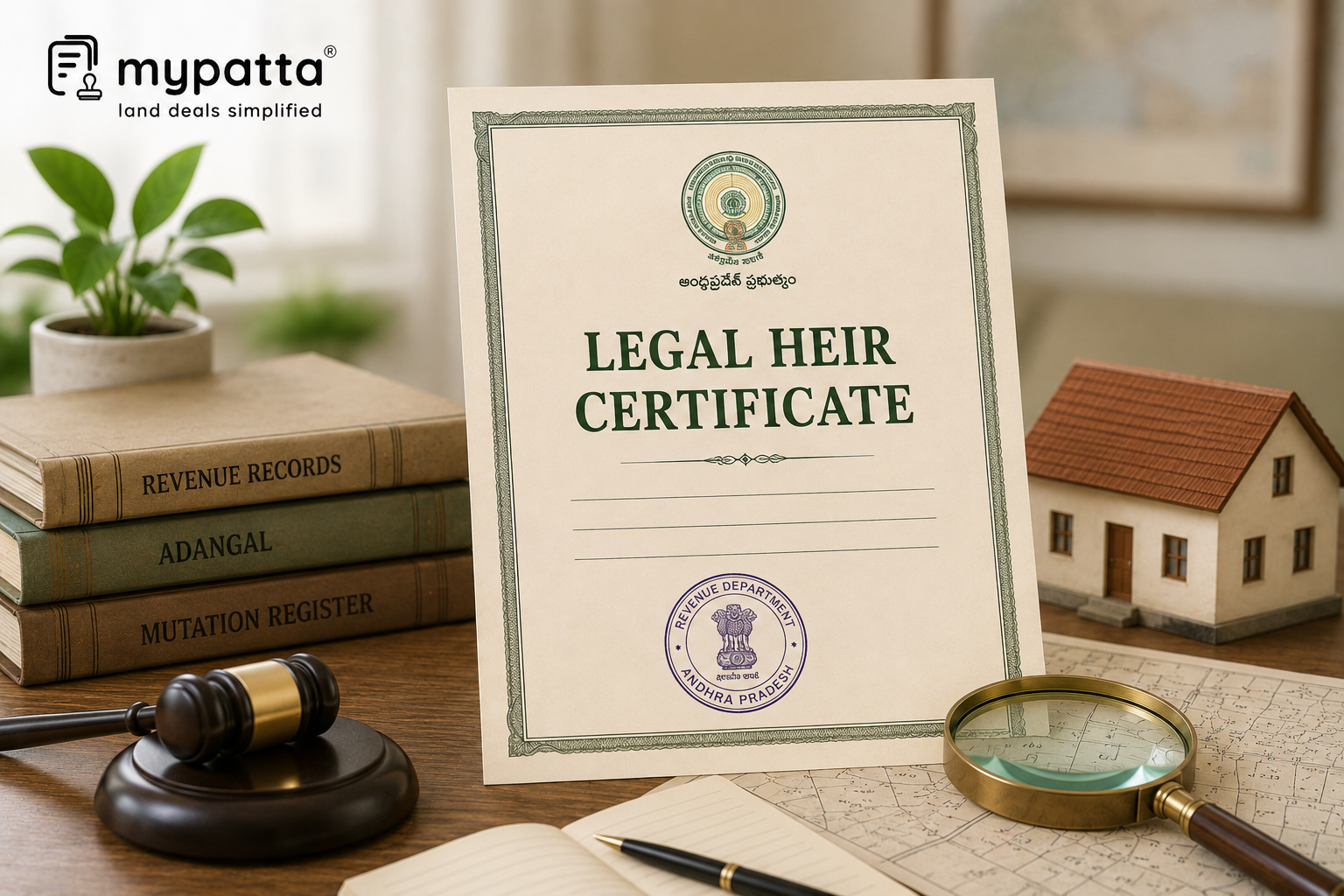
How to get Legal Heir Certificate in Andhra Pradesh
You can get the Legal Heir Certificate online easily via mypatta without visiting the Sub-Registrar office.
- Open mypatta and log in or sign up if needed.
- Go to property documents, ensure “Andhra Pradesh” is selected as the state, then tap the “Legal Heir Certificate” icon.
- Enter required information.
- Tap “Search”
- Once the Legal Heir Certificate is available to download, tap “View Document”. You can now save or share or download this document in PDF on your device
What Is Legal Heir Certificate in Andhra Pradesh?
A Legal Heir Certificate in Andhra Pradesh is a document used to identify the heirs or family members of a deceased person. In land transactions, it becomes important when the land is still connected to a deceased owner and the present seller claims the right to sell the land as a legal heir.
For example, if land was originally in the name of a deceased father, mother, spouse or grandparent, the seller may rely on a Legal Heir Certificate to show their relationship with the deceased person. This helps buyers understand who the surviving heirs are and whether the seller is one of them.
In Andhra Pradesh, the term Legal Heir Certificate is often used practically along with Family Member Certificate or Family Membership Certificate, depending on the purpose and issuing authority. For a buyer, the important point is not the name of the document alone, but what it proves. It usually helps identify family members or heirs. It does not automatically prove that one person alone owns the land.
This certificate is especially relevant in inherited land, ancestral land, family property, land still standing in the name of a deceased person, and land where mutation was done after the death of the original pattadar or landholder.
Why Should Buyers Check Legal Heir Certificate Before Buying Land in Andhra Pradesh?
Buyers should check the Legal Heir Certificate before buying land in Andhra Pradesh because inherited land can involve multiple heirs. If the original landholder has died, the buyer must know whether the seller is the only heir or whether other heirs also have a share.
The certificate helps identify the persons who may have a claim through succession. If the certificate shows more than one legal heir, the buyer should check whether all heirs are joining the sale. If only one heir is selling the land, the buyer should ask for a partition deed, release deed, gift deed, court order, will or consent document showing how that person got exclusive right to sell.
This check is important because many land disputes arise after purchase when another heir later claims that they never consented to the sale. A buyer may have paid money and completed registration, but if a necessary heir was left out, the transaction may become disputed.
Buyers should be careful where:
- the land is still recorded in the name of a deceased person;
- only one heir is selling the entire land;
- the certificate shows multiple heirs;
- mutation is pending or disputed;
- there is no partition deed or release deed;
- the seller cannot explain how they got exclusive right over the property.
In simple terms, the Legal Heir Certificate helps a buyer ask: “Are all heirs properly identified and accounted for before this land is sold?”
Can Legal Heir Certificate Prove Ownership in Andhra Pradesh?
Legal Heir Certificate alone cannot prove ownership in Andhra Pradesh. It may show who the heirs of a deceased person are, but it does not automatically transfer title to one heir or confirm that one person has full ownership of the land.
Ownership is usually verified through legally valid documents such as a registered sale deed, gift deed, partition deed, settlement deed, release deed, succession documents, court decree, valid will where applicable, or other recognized title documents. Revenue records such as AP Adangal, ROR 1B, Pattadar Passbook and mutation entries may support verification, but they cannot replace title documents.
This distinction is important. A seller may say, “I am a legal heir, so I can sell the land.” That may be partly true, but the buyer must check whether there are other heirs and whether their shares are also being transferred.
If there are several heirs, one heir may only have a share in the property unless the others have legally transferred or released their rights. Therefore, Legal Heir Certificate should be treated as a succession-support document, not as a final ownership document.
Documents to Check Along With Legal Heir Certificate Before Buying Land
Before buying land in Andhra Pradesh, the Legal Heir Certificate should be checked with title, succession, revenue, registration and survey documents.
| Document | Why It Matters |
|---|
| Death Certificate | Confirms death of the previous landholder |
| Registered Sale Deed | Shows legal transfer of ownership |
| Link Documents / Mother Deed | Helps trace the title chain |
| Partition Deed / Release Deed | Shows division or transfer of shares among heirs |
| Will / Court Order, if any | Important where inheritance is based on a special claim |
| AP Adangal | Shows current land and cultivation-related revenue details |
| ROR 1B | Helps verify present landholder and revenue-account details |
| Encumbrance Certificate | Helps check registered transactions, mortgages or charges |
| Mutation Record | Shows whether revenue records were updated after death or transfer |
| FMB / Village Map | Helps verify boundaries and land location |
The buyer should compare the names in the Legal Heir Certificate with the names in the sale deed, mutation record and ROR 1B. If some heirs are not part of the sale, the buyer should ask for proper documents explaining why their signature is not required.
Practical Due Diligence Checklist Before Buying Land in Andhra Pradesh
- Before buying inherited land in Andhra Pradesh, the buyer should first check whose name appears in the old title documents and current revenue records. If the land is still connected to a deceased person, the buyer should ask for the death certificate and Legal Heir Certificate.
- The buyer should then check how many legal heirs are shown in the certificate. If there are multiple heirs, the buyer should verify whether all of them are signing the sale deed. If only one heir is selling, the buyer should ask for documents showing exclusive ownership or authority to sell.
- Next, the buyer should compare the Legal Heir Certificate with AP Adangal, ROR 1B and mutation records. If mutation has already been completed in favour of the seller, the buyer should still check the basis of mutation. If mutation is pending, the buyer should understand why it has not been completed.
- The Encumbrance Certificate should also be checked for the relevant period. Inherited land may have old mortgages, previous sales, family settlements, release deeds or other registered transactions.
- Survey verification is equally important. FMB, village map and physical inspection should be used to confirm whether the land shown on ground matches the documents. This is especially important when family land has been divided informally.
- Before payment, the buyer should ensure that there is no missing heir, no unclear share, no family objection and no mismatch between succession documents, title documents and land records.
Final Advice for Andhra Pradesh Land Buyers
Legal Heir Certificate is useful before buying land in Andhra Pradesh when the seller is claiming the property through inheritance. It helps identify the heirs of the deceased landholder and supports succession-related verification.
However, it should not be treated as ownership proof by itself. A safe buyer should verify title, succession, revenue record and boundary together. Title should be checked through sale deed, link documents, partition deed, release deed, succession papers or court orders. Revenue record should be checked through AP Adangal, ROR 1B, Pattadar Passbook and mutation entries. Boundary should be checked through FMB, village map, survey records and physical inspection.
If the Legal Heir Certificate, title documents, mutation record and current land records match, the buyer gets better clarity. If there are missing heirs, disputed shares, pending mutation or unclear inheritance, the issue should be resolved before payment.
In land purchase, Legal Heir Certificate helps show who may have a succession claim. But safe purchase depends on whether those claims are properly converted into clear and marketable title.
FAQ Section
- 1. What is Legal Heir Certificate in Andhra Pradesh?+
Legal Heir Certificate is a document used to identify the legal heirs or family members of a deceased person for succession or claim-related purposes
- 2. Can Legal Heir Certificate prove land ownership?+
No. Legal Heir Certificate alone cannot prove ownership. It should be checked with sale deed, link documents, AP Adangal, ROR 1B, EC and mutation records.
- 3. Why should buyers check Legal Heir Certificate before buying inherited land?+
Buyers should check it to know whether all heirs of the deceased landholder are identified and whether all necessary persons are part of the sale.
- 4. What if only one legal heir is selling the land?+
The buyer should check whether that heir has a partition deed, release deed, court order, will or consent from other heirs before proceeding.
- 5. What documents should be checked with Legal Heir Certificate?+
Buyers should check death certificate, sale deed, link documents, partition or release deed, AP Adangal, ROR 1B, EC, mutation record, FMB and village map.
Shivangi
Real Estate Content Writer
Shivangi is a real estate content writer with 3+ years of experience helping readers understand property documentation, land records, and legal requirements through clear and actionable content.