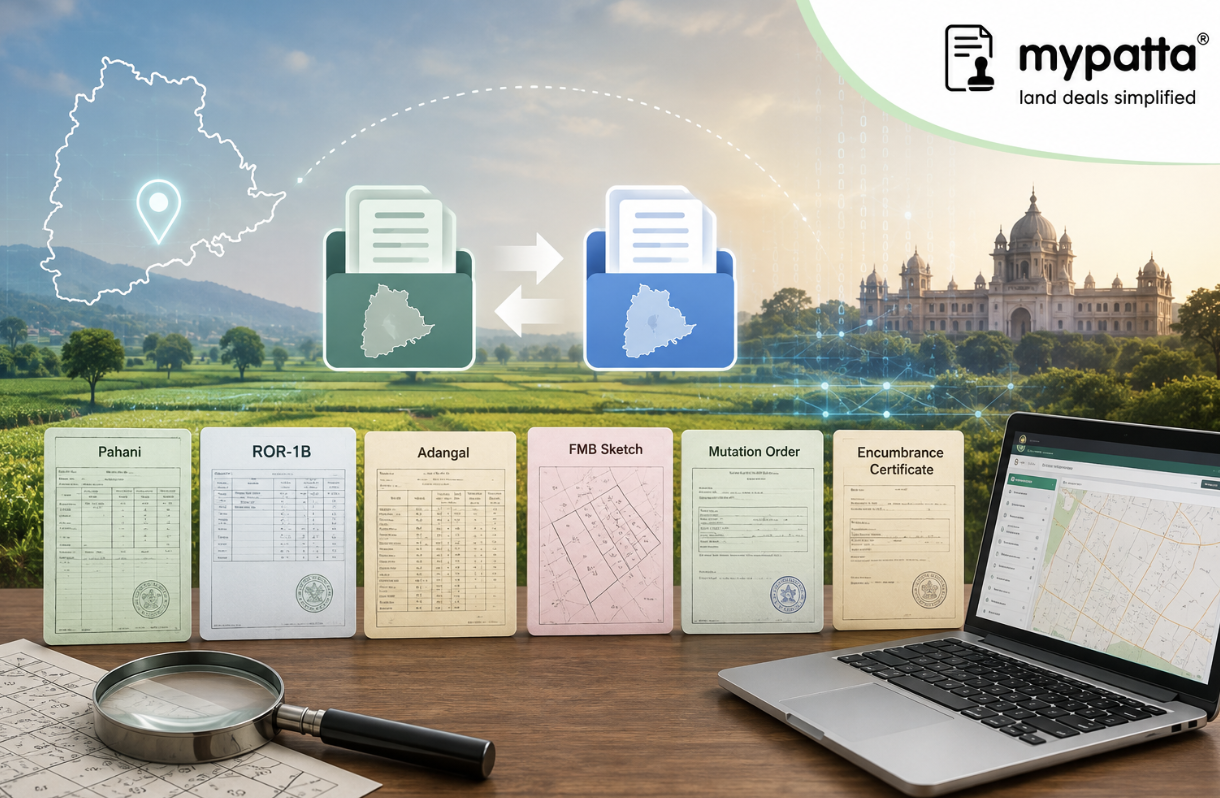
Which Old Dharani Details Should Be Compared With Bhu Bharathi Records?
The earlier Dharani record should be retained and compared with the latest land-status information available through Bhu Bharati. The Telangana Bhu Bharati (Record of Rights in Land) Act, 2025 provides that electronic Records of Rights maintained under the 2020 law continue to be treated as valid records until a new Record of Rights is prepared under the 2025 framework. This makes the earlier Dharani extract relevant for identifying changes made during migration or later proceedings.
The comparison should not be limited to whether the same pattadar’s name appears. The complete parcel and rights information should be examined.
Important details include:
- district, division, mandal and village;
- khata or Pattadar Passbook number;
- pattadar or recorded landholder’s name;
- father’s, spouse’s or predecessor’s name;
- survey and subdivision number;
- total extent and individual recorded share;
- nature and classification of the land;
- mutation and registered-document references;
- loan, mortgage or charge information;
- prohibited-property or court-related remarks; and
- Pattadar Passbook particulars.
The earlier record should also be checked for any unusual entry that has disappeared from Bhu Bharathi. For example, Dharani may have shown a co-pattadar, mortgage, pending mutation or disputed classification that does not appear in the current view. The disappearance of an entry should not be treated as proof that the underlying issue has been resolved.
Similarly, a new name, reduced extent or altered subdivision appearing in Bhu Bharati should be traced to an identifiable transaction, mutation order, succession proceeding, survey change or correction.
The following table can be used for a structured comparison:
| Detail | Earlier Dharani record | Current Bhu Bharati record | Further record required |
|---|
| Pattadar’s name | Name and relationship details previously displayed | Current recorded name and capacity | Registered deed, succession or correction order |
| Survey identity | Old survey and subdivision | Current survey, subdivision or parcel reference | Survey correlation or subdivision proceedings |
| Extent | Earlier total and individual extent | Present recorded extent and share | Mutation order, survey map or resurvey record |
| Mutation | Earlier mutation number or transaction entry | Present mutation status and reflected change | Certified mutation proceedings |
| Classification | Agricultural, assigned, government or other category | Present land nature and remarks | Grant, assignment or classification record |
| Restrictions | Prohibited, mortgage, dispute or court remark | Current restriction or grievance status | Departmental order, court record or discharge document |
A matching name with a different survey number or extent should not be treated as a successful match. The complete identity of the land must remain consistent.
How to Check Whether Earlier Mutation and Registration Entries Continue to Appear
Earlier registrations and mutations completed through Dharani do not automatically lose their legal or administrative effect after the introduction of Bhu Bharati. The 2025 Act preserves actions taken and decisions made under the Telangana Rights in Land and Pattadar Pass Books Act, 2020, treating them as valid and enforceable despite the repeal of the earlier legislation.
A buyer should nevertheless confirm that the effect of each transaction appears in the current Record of Rights.
For every sale, gift, partition, mortgage, exchange or succession event, examine:
- the registered-document number and year;
- registration date and Sub-Registrar or Tahsildar office;
- names of the transferor and transferee;
- mutation or application number;
- survey number and subdivision affected;
- extent transferred;
- certification or approval status; and
- resulting entry in the latest Bhu Bharathi record.
A registered transaction and its revenue consequence must be distinguished. Registration records the deed presented by the parties, whereas mutation updates the Record of Rights to reflect the claimed change.
For example, a registered sale may continue to appear in the registration database even though the corresponding mutation remains pending or was entered against the wrong subdivision. Conversely, a mutation entry may appear in the Record of Rights but still require examination of the deed or succession document on which it was based.
The current record should therefore show a traceable sequence:
Registered transaction or succession event → mutation proceeding → updated Record of Rights
If one of these links is missing, the reason should be identified before the land is purchased.
Particular caution is required where:
- the registered deed exists but the previous owner remains in Bhu Bharati;
- the purchaser’s name appears, but the extent differs from the deed;
- a mutation number is shown without the connected document details;
- only one of several transferred survey numbers has been updated;
- the mutation is recorded as pending or disputed; or
- the land was subsequently sold, mortgaged or partitioned.
The buyer should retain copies of both the old Dharani record and the latest Bhu Bharati record. These can help demonstrate when a discrepancy first appeared.
How to Verify Survey Number, Extent and Parcel Identity During the Transition
Survey and parcel identity require special attention because the same land may be described differently across an old deed, Dharani record, Bhu Bharati record and current map.
Begin with the oldest reliable title document and trace the land forward through each subsequent transaction. Note every change in:
- survey number;
- subdivision or hissa;
- khata number;
- recorded extent;
- boundaries;
- village or mandal description; and
- land classification.
The 2025 Act provides that when a survey or resurvey is conducted, a new Record of Rights may be prepared according to the survey records. It also permits survey numbers to be divided into subdivisions and survey maps to be updated when rights are amended.
Bhu Bharathi also provides a map-based Record of Rights service through which available parcel information can be viewed after selecting the district, division, mandal and village. The map is useful for preliminary identification but should not be treated as a substitute for an official survey where boundaries or possession are disputed.
The extent should be read according to the capacity in which it appears. Different figures may represent:
- the total area of the parent survey;
- the pattadar’s undivided share;
- the extent transferred under a particular deed;
- the balance remaining after earlier transfers;
- the area measured after subdivision; or
- the extent available after road widening, acquisition or resurvey.
A buyer should be cautious where the deed transfers a specific physical portion but the revenue record shows only an undivided share. Until the parcel is properly subdivided and identified, the exact land being sold may remain uncertain.
The title deed’s boundary schedule should also be compared with the cadastral or survey map and physical possession. A survey-number match alone does not confirm that the seller is occupying the exact portion described in the deed.
An official measurement may be necessary where:
- the land is part of a larger survey number;
- the current subdivision is absent from an older deed;
- neighbouring owners dispute the boundary;
- the extent on the ground is smaller than the record;
- access to the land is unclear; or
- the map and physical occupation do not correspond.
What Pending Corrections, Applications or Disputes Should Buyers Check?
A current-looking Bhu Bharathi entry may still be affected by an unresolved application or dispute. Buyers should therefore examine both the visible land record and the status of pending proceedings.
The Bhu Bharati portal presently includes services for application-status tracking and modules relating to pending mutation, pending NALA, passbook-data correction, court-case passbooks, prohibited-property grievances and specific land matters.
The following should be checked:
- pending mutation based on sale, gift, partition or succession;
- request for correction of the pattadar’s name or extent;
- pending passbook issuance, duplicate passbook or data correction;
- khata-merging application;
- subdivision or survey request;
- NALA conversion or pending conversion application;
- grievance against inclusion in the prohibited-property list;
- court-case or court-order-related passbook request;
- appeal or revision against a Revenue order;
- government, endowment, wakf or assigned-land claim; and
- civil litigation concerning title, possession or boundaries.
A pending application is not always adverse. It may have been filed by the seller to correct a genuine mistake. However, its subject matter and likely effect on the property must be understood.
For instance, a pending correction seeking reduction of the seller’s extent is directly relevant to the proposed sale. A prohibited-property grievance may indicate that registration is presently restricted. A succession application may reveal that other legal heirs have not yet been entered.
The buyer should obtain the application number, acknowledgement, supporting documents, notices, hearing details and latest status. The seller’s oral description of the application should not be treated as sufficient.
Which Title and Survey Documents Should Be Examined Outside the Portal?
Neither Dharani nor Bhu Bharathi provides a complete title investigation. The portal records must be supported by documents establishing the legal source, registration history and physical identity of the property.
Title and registration documents
The following should ordinarily be examined:
- current registered sale, gift, settlement or partition deed;
- mother deed and earlier link documents;
- registered release or family-partition documents;
- succession papers, will and probate where applicable;
- government grant, assignment or occupancy-right certificate;
- Encumbrance Certificate for an appropriate period;
- certified copies of relevant registered transactions;
- mortgage, release and cancellation deeds; and
- court decrees affecting title or possession.
The Registration and Stamps Department acts as a record keeper for registered documents and enables the public to examine recorded rights and obligations affecting immovable property. The existence of a current Bhu Bharati entry does not replace this registration search.
Revenue and survey documents
The buyer should also obtain, where relevant:
- old Pahani or historical Record of Rights;
- mutation proceedings;
- Sethwar or settlement record;
- Faisal Patti;
- Tippan or Tippani;
- village or cadastral map;
- subdivision and resurvey proceedings;
- official measurement sketch;
- correlation statement connecting old and new survey numbers; and
- assignment, classification or prohibited-property records.
The CCLA exercises supervision over Revenue, Survey, Settlement and Land Records administration in Telangana, while survey authorities deal with initial surveys, resurveys and supplementary or revision surveys.
A complete due-diligence conclusion should establish consistency across four layers:
- Title documents: How the seller acquired the property.
- Registration history: What registered transfers and encumbrances affect it.
- Revenue records: Whether Dharani and Bhu Bharati correctly reflect those rights.
- Survey identity: Whether all documents relate to the same land on the ground.
Why mypatta?
- Trusted by 7 Lakh+ Customers
- 1 Crore+ Documents Delivered
- mypatta Guarantee: Guaranteed delivery or a 100% refund
- 4.8-Star App Rating
Your money is safe with us: Guaranteed delivery or a 100% amount refund.
FAQs
- 1. Do old Dharani land records remain valid after the launch of Bhu Bharati?+
Existing electronic Records of Rights have not automatically become invalid. The 2025 Act carries them forward until new records are prepared or the entries are lawfully amended.
- 2. What should a buyer do if Dharani and Bhu Bharati show different owners?+
The registered title deed, mutation proceedings, succession records and correction orders should be checked to determine which entry reflects the lawful and current position.
- 3. Does a registered sale completed through Dharani need to be registered again?+
No. A valid completed registration does not require fresh registration merely because the portal changed. The buyer should confirm that the corresponding mutation and current Bhu Bharati entry are correct.
- 4. Can the Bhu Bharati map confirm the exact boundary of the property?+
The map can assist with preliminary parcel identification, but an official survey or measurement may be required where the boundary, extent or ground possession is uncertain.
Shivangi
Real Estate Content Writer
Shivangi is a real estate content writer with 3+ years of experience helping readers understand property documentation, land records, and legal requirements through clear and actionable content.