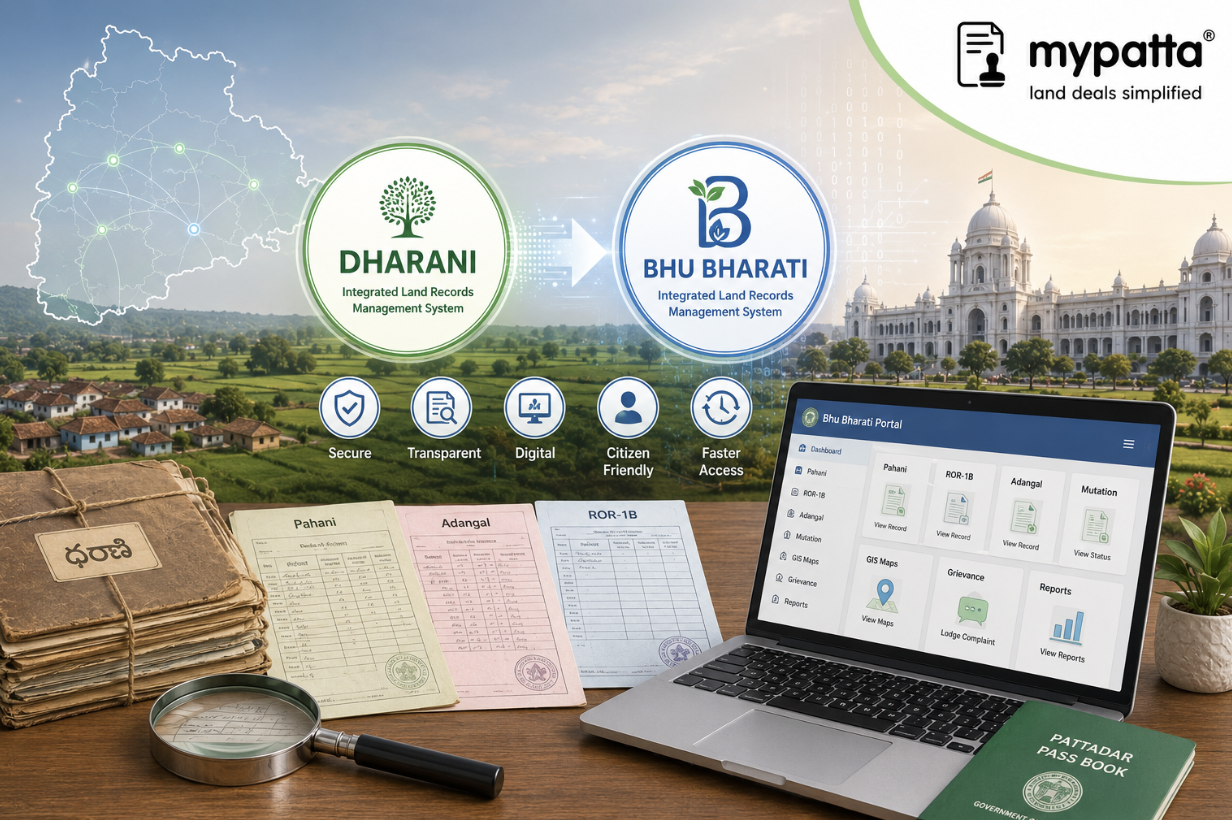
What Was the Dharani Portal in Telangana?
Dharani was Telangana’s integrated agricultural land-record and property-registration platform. It brought land records, registration, mutation and certain revenue services into a common digital system.
The portal operated principally under the Telangana Rights in Land and Pattadar Pass Books Act, 2020. That legislation was designed around electronic Records of Rights and an integrated registration process for agricultural land. A person intending to register an agricultural land transaction was required to use the portal, pay the applicable charges and book a time slot for presentation of the document.
Dharani was used for services such as:
- viewing agricultural land details;
- registration of sale, gift and certain other transactions;
- automatic or transaction-linked mutation;
- succession-related applications;
- Pattadar Passbook services;
- checking prohibited-property information; and
- tracking applications connected with agricultural land.
The portal sought to connect registration and revenue mutation so that a transfer recorded through registration could also be reflected in the Record of Rights.
However, Dharani was not itself the legal source of ownership. It was the digital system through which records and transactions were managed. The legal rights reflected on the portal depended on the underlying deed, succession, government grant, court order or other recognised source of title.
The Revenue Department’s responsibility remained the preparation, updating and protection of village revenue records. The Chief Commissioner of Land Administration continued to exercise control over revenue, survey, settlement and land-record administration in the State.
What Is the Bhu Bharathi Land Records System?
Bhu Bharathi is Telangana’s current integrated Record of Rights and land-management platform. It operates under the Telangana Bhu Bharati (Record of Rights in Land) Act, 2025 and the rules issued under that legislation.
The 2025 Act was enacted to consolidate and amend the law relating to Records of Rights in Telangana. It provides for electronically maintained land records, registration-linked mutation, succession, correction of entries, appeals, revision, survey updates, Pattadar Passbooks and parcel-based identification through Bhudhaar.
The official Bhu Bharathi portal currently brings together information and transactional services relating to:
- Record of Rights and land-status searches;
- registration of agricultural land transactions;
- mutation applications;
- succession, including certain assigned-land cases;
- Pattadar Passbook issuance and correction;
- pending mutations and pending NALA applications;
- prohibited-property grievances;
- court-case-related passbook applications;
- non-agricultural land conversion;
- registration through powers of attorney;
- khata merging; and
- tracking of applications and transactions.
Bhu Bharati is therefore more than a new website name. It represents the portal through which Telangana is implementing the legal framework introduced by the 2025 Act.
The Act also provides for a Bhudhaar, which is intended to function as a unique identification number for each land parcel. A temporary Bhudhaar may be used before geo-referencing is completed, while a permanent Bhudhaar is connected with the parcel’s geographical location, shape and coordinates.
The portal also provides a map-based Record of Rights interface through which users can select the district, division, mandal and village and examine available parcel information.
Why Was Dharani Replaced or Integrated Into Bhu Bharathi?
Dharani was replaced as the governing portal framework because Telangana enacted a new Record of Rights law in 2025. The new Act repealed the Telangana Rights in Land and Pattadar Pass Books Act, 2020, under which the Dharani system had operated.
The 2025 Act specifically provides that references to “Dharani” or “Dharani Portal” appearing in State legislation are to be replaced with the expression “RoR Portal”. Bhu Bharati now functions as that integrated portal.
The official legal changes indicate that the transition was intended to create a broader and more structured framework for land-record administration. The important changes include:
- preparation and maintenance of Records of Rights for all covered lands;
- a separate framework for abadi and non-agricultural lands when notified;
- applications for correction of incorrect entries;
- applications where a person claims lawful possession but has no corresponding entry;
- notice and enquiry before contested amendments;
- mutation through succession, wills and other modes;
- survey and subdivision integration;
- statutory appeals and second appeals;
- Land Tribunals for specified matters; and
- parcel identification through Bhudhaar.
The transition should not be understood as a complete deletion of Dharani data followed by creation of an entirely new database. The Bhu Bharati Act expressly preserves existing electronic Records of Rights until a new record is prepared under the 2025 framework.
The practical objective is therefore both replacement and continuity: Dharani as the earlier legal and portal framework has been replaced, while existing records and valid actions are carried forward into the Bhu Bharati system.
What Are the Main Differences Between Dharani and Bhu Bharathi?
Dharani and Bhu Bharati both integrate land records with registration and mutation, but they operate under different legislation and provide different procedural safeguards and record-management features.
| Point of comparison | Dharani framework | Bhu Bharati framework |
|---|
| Governing law | Telangana Rights in Land and Pattadar Pass Books Act, 2020 | Telangana Bhu Bharati (Record of Rights in Land) Act, 2025 |
| Main record coverage | Principally structured around agricultural land | Record of Rights for covered lands, with provision for separate records for abadi and non-agricultural lands |
| Correction of entries | Corrections were handled through the available modules and administrative processes | The Act expressly permits affected persons to seek rectification or a new entry after enquiry |
| Registration and mutation | Integrated registration and mutation for agricultural land | Continues integrated registration and mutation with updated statutory procedures |
| Survey connection | Revenue entries and parcel particulars were digitised | Greater statutory emphasis on survey, subdivision maps and updated records following resurvey |
| Parcel identification | Survey and subdivision-based identification | Provision for temporary and permanent Bhudhaar numbers |
| Appeals | Limited remedies under the earlier statutory structure | Detailed appellate hierarchy involving the RDO, Collector and Land Tribunal |
| Existing records | Maintained under the 2020 Act | Earlier electronic records remain valid until replaced under the new Act |
The 2025 Act also requires that registration proceed where the pattadar and property particulars in the proposed document agree with the electronic Record of Rights and the land is not prohibited from transfer under applicable law. After registration, the corresponding change is to be made in the Record of Rights.
For certain applications, survey or subdivision maps may become compulsory from the date prescribed by the Government. This makes parcel identity and survey correspondence more central to the mutation process.
Bhu Bharati also introduces a clearer appellate framework. Depending on the nature of the order, an appeal may lie to the Revenue Divisional Officer, District Collector or Land Tribunal, with specific periods prescribed under the Act.
These differences do not mean that every Bhu Bharati record has already been resurveyed or assigned a permanent Bhudhaar. Several provisions depend on notifications, prescribed procedures and phased implementation.
What Happens to Land Records and Applications Previously Available on Dharani?
Existing Dharani land records do not become invalid merely because the portal framework has changed.
The Bhu Bharathi Act states that Records of Rights prepared and electronically maintained under the 2020 legislation are deemed to have been prepared and maintained under the new Act until a fresh Record of Rights is prepared.
The Act also preserves Pattadar Passbook-cum-Title Deeds issued under the 2020 law. Such passbooks are deemed to have been issued under the corresponding provision of the Bhu Bharati Act.
Further, any valid action taken or decision made while the 2020 Act was in force continues to be valid and enforceable. This means that completed registrations, mutations, orders and other lawful decisions are not automatically reopened solely because Dharani has been replaced.
The position can be summarised as follows:
- Existing electronic RoR entries: Continue until replaced or amended under the new framework.
- Earlier Pattadar Passbooks: Continue to be recognised.
- Completed registrations and mutations: Remain valid unless altered through a lawful correction, appeal or court proceeding.
- Earlier administrative orders: Continue to be enforceable.
- Incorrect or disputed entries: May require correction or appeal under the Bhu Bharati process.
- Pending applications: Should be checked through the current application-status and relevant pending-service modules.
The official Bhu Bharathi portal currently provides modules for pending mutation, pending NALA and application-status tracking. However, the treatment of an individual Dharani application depends on its type, stage and whether any fresh information or authentication is required.
A landowner should retain the earlier Dharani application number, transaction ID, payment receipt, acknowledgement and supporting documents. These details can help trace the application within the new system or before the Revenue authority.
How Can Landowners Check Their Current Records Under Bhu Bharathi?
Landowners should use the official Bhu Bharati land-status service to examine the current Record of Rights connected with their property. The portal provides land-status searches and map-based parcel information using the relevant location and survey particulars.
Before searching, keep the following details available:
- district;
- division;
- mandal;
- village;
- khata or Pattadar Passbook number;
- survey and subdivision number;
- earlier Dharani application number; and
- registered-document details where a transaction has occurred.
Only a brief portal check is required. The focus should be on whether the current information matches the landowner’s documents rather than on the individual portal steps.
The following particulars should be reviewed carefully:
- recorded owner or pattadar;
- father’s, spouse’s or predecessor’s name;
- survey and subdivision number;
- recorded extent and share;
- land nature and classification;
- mutation or registration details;
- passbook particulars;
- loan or mortgage entry;
- prohibited-property status; and
- pending applications or court-related remarks.
Where the Bhu Bharathi record differs from an earlier Dharani entry, the landowner should first determine whether the change arose from a registered transaction, succession, correction order, resurvey, subdivision or government proceeding.
The earlier Dharani extract, current Bhu Bharati record, registered deed, mutation order and survey map should be compared together. A difference should not be treated automatically as either a portal error or proof that the earlier record was correct.
The 2025 Act allows a person affected by an RoR entry to seek rectification through the prescribed authority and procedure. It also permits a person in lawful possession who claims rights but has no corresponding entry to apply for a new entry or correction, subject to enquiry.
Why mypatta?
- Trusted by 7 Lakh+ Customers
- 1 Crore+ Documents Delivered
- mypatta Guarantee: Guaranteed delivery or a 100% refund
- 4.8-Star App Rating
Your money is safe with us: Guaranteed delivery or a 100% amount refund.
- 1. Is Bhu Bharati simply the new name for Dharani?+
Not entirely. Bhu Bharati is the current integrated land-record portal, but it also operates under a new law that repealed the 2020 legislation and introduced additional procedures for corrections, appeals, survey integration and Bhudhaar.
- 2. Are land records downloaded earlier from Dharani still valid?+
Earlier records are not automatically invalid. The 2025 Act preserves existing electronic Records of Rights until they are replaced or amended under the new framework. A current Bhu Bharati record should still be obtained for present verification.
- 3. Will an old Dharani Pattadar Passbook remain recognised?+
Yes. The Bhu Bharati Act states that Pattadar Passbook-cum-Title Deeds issued under the 2020 Act are deemed to have been issued under the new Act.
- 4. What should a landowner do if Dharani and Bhu Bharati show different details?+
The earlier record, current RoR, registered deed, mutation order and survey documents should be compared. Where the current entry is incorrect, the appropriate rectification, mutation or appeal process should be used.
Shivangi
Real Estate Content Writer
Shivangi is a real estate content writer with 3+ years of experience helping readers understand property documentation, land records, and legal requirements through clear and actionable content.