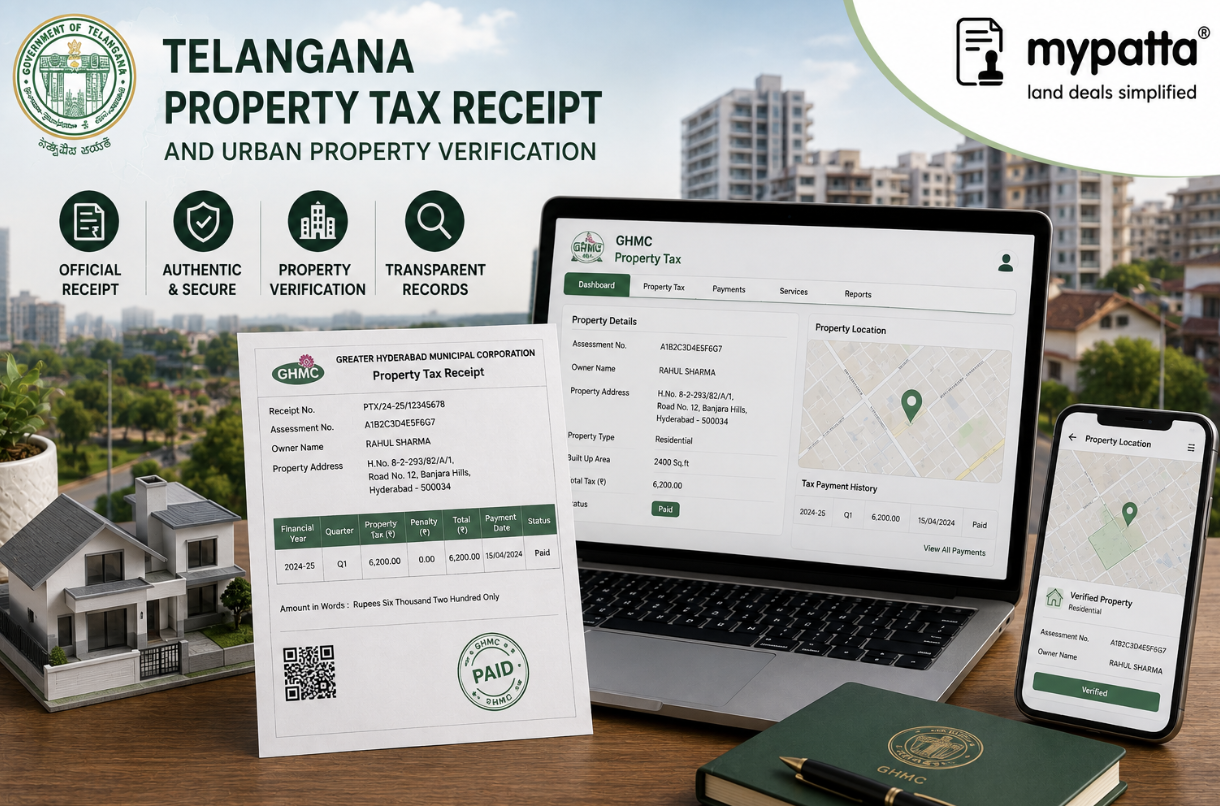
How to Download Telangana CDMA property tax receipt
You can get the Telangana CDMA property tax receipt online easily via mypatta without visiting the Sub-Registrar office.
- Open mypatta and log in or sign up if needed.
- Go to property documents, ensure “TELANGANA” is selected as the state, then tap the “Telangana CDMA property tax receipt” icon.
- Enter required information.
- Tap “Search”
- Once Telangana CDMA property tax receipt is available to download, tap “View Document”. You can now save or share or download this document in PDF on your device.
Does a CDMA Property Tax Receipt Prove Ownership?
A Telangana CDMA property tax receipt does not, by itself, prove legal ownership of an urban property.
The receipt primarily shows that a payment was made against a municipal property-tax assessment. It may identify the assessee, Property Tax Identification Number or PTIN, door number, Urban Local Body and period for which tax was paid. These details can support the connection between a person and the municipal account, but they do not explain how ownership was legally acquired.
The person whose name appears on the receipt may be:
- the present owner;
- a previous owner whose name has not been changed;
- one of several co-owners;
- an occupier or tenant paying the tax;
- a family member paying on the owner’s behalf; or
- a purchaser whose municipal mutation remains pending.
Ownership must ordinarily be traced through a valid source of title, such as a registered sale deed, gift deed, partition deed, settlement deed, release deed, succession documents, court decree or government grant.
This distinction is reflected in Telangana’s municipal system itself. Property-tax assessment, payment and mutation are available as separate services. The CDMA service requirements for property-tax assessment refer to underlying documents such as a registered document, court decree or patta certificate, along with property photographs and relevant building records. This indicates that the municipal entry is based on supporting documents rather than being the source of ownership.
The Supreme Court has also reiterated the broader principle that entries in government-maintained holdings or revenue registers do not necessarily confer title and that disputed ownership must be adjudicated on the strength of the legal title. The same caution applies when a property-tax entry is relied upon as if it were a conveyance document.
A receipt becomes useful supporting evidence when the following records consistently identify the same person and property:
- registered title deed;
- municipal mutation certificate;
- current assessment certificate;
- latest tax receipt;
- building approval; and
- physical property particulars.
A receipt carrying the seller’s name cannot cure an invalid sale deed, missing title link or unauthorised transfer.
What Evidentiary Value Does a Property Tax Receipt Have?
A property tax receipt has evidentiary value for the limited municipal facts recorded in it.
It can help establish that:
- a particular municipal assessment exists;
- tax was demanded or paid against that assessment;
- the municipal account carried a stated assessee’s name;
- the premises were associated with a particular door number or locality;
- payment was made on a particular date; and
- the stated amount was processed under an identifiable transaction.
The receipt may also support a person’s claim of connection with or management of the property. For example, a series of receipts over several years may indicate that the person was paying municipal dues and dealing with the property as an owner, occupier or representative.
However, the evidentiary value depends on what issue is being examined.
For municipal payment
The receipt is direct evidence that a stated payment was made, subject to confirmation that the transaction was successful and credited to the correct PTIN.
For possession or occupation
Repeated payment may form part of the surrounding evidence of occupation or enjoyment. It does not conclusively prove who was physically possessing every portion of the property.
For ownership
The receipt is only corroborative. It may support a registered deed or succession claim, but it cannot substitute for the document through which title was created or transferred.
For building legality
The receipt has very limited value. Municipal assessment and collection of tax do not necessarily prove that the building, additional floor, change of use or subdivision was lawfully approved.
The Telangana CDMA portal separately provides property-tax assessment, mutation, reassessment, revision, unauthorised-construction penalty, assessment cancellation and building-permission services. The existence of separate processes demonstrates that tax payment does not automatically resolve ownership, assessment or construction-related issues.
A buyer should therefore use the receipt to confirm municipal consistency, not as the sole basis for concluding that the seller has a clear and transferable title.
How to Match the Receipt With the Sale Deed and Municipal Assessment
The property tax receipt, registered sale deed and municipal assessment should be compared together because each performs a different function.
| Point to verify | Registered sale deed | Municipal assessment | Property tax receipt |
|---|
| Person named | Seller, purchaser and other executing parties | Person recorded as owner or assessee | Assessee or taxpayer linked to the payment |
| Property identity | Survey number, plot, extent, boundaries, unit and schedule | PTIN, door number, locality, property type and assessed area | PTIN, door number and basic account particulars |
| Main purpose | Records the transfer of property rights | Records the property for municipal taxation | Confirms payment against the assessment |
| Relevant date | Execution and registration dates | Assessment or mutation effective date | Tax period and payment date |
| Area and use | Land, built-up area and property description | Assessed plot or plinth area and usage category | May contain only limited area or use details |
| Legal limitation | Must still be checked against earlier title and later dealings | Does not independently create title | Does not establish title or building legality |
Begin with the PTIN or assessment number. It should match the current assessment certificate, earlier receipts and municipal mutation record.
Next, compare the address and property description. Depending on the type of property, this may include:
- municipal corporation or municipality;
- ward and locality;
- old and new door numbers;
- survey and subdivision number;
- plot or house number;
- apartment, floor or unit number;
- building or project name;
- plot and built-up area; and
- residential, commercial or mixed use.
The sale deed may describe the property through a detailed schedule and four boundaries, while the receipt may show only the PTIN and door number. The assessment certificate should be used to connect these two descriptions.
The owner’s name must also be checked. Where the sale deed is in the seller’s name but the receipt continues to show an earlier owner, the buyer should examine whether municipal mutation was completed. The CDMA portal provides services for mutation applications, mutation status, payment receipts and downloading mutation certificates.
The effective date of the assessment or mutation should correspond reasonably with the purchase date. A person who acquired the property several years ago but never updated the municipal account should be asked to explain the delay.
Where the property falls within an apartment or multi-unit development, confirm that the receipt belongs to the precise unit being sold. A receipt for the entire building, an adjoining flat or the developer’s original assessment should not be accepted as the purchaser’s unit-level record.
What Property-Description and Assessee-Name Discrepancies Should Be Investigated?
Minor spelling or formatting differences may occur, but material discrepancies require supporting documents and official clarification.
Previous owner still shown
This usually indicates that municipal mutation was not completed or was completed incorrectly. The buyer should obtain the mutation application, registered deed, acknowledgement, status and final certificate.
Seller’s name absent from the assessment
The seller may have acquired the property recently, but the buyer should not rely only on that explanation. The registration date, mutation status and current municipal account must be checked.
Only one co-owner recorded
A tax account may show one person even though the title deed records several co-owners. Every person having a transferable interest should be identified, and all necessary owners must participate in the sale.
Difference in door number
The deed may carry an old door number while the assessment uses a new number. Municipal renumbering records, previous receipts and assessment history should establish that both numbers refer to the same premises.
Different plot, survey or unit particulars
A matching owner’s name cannot compensate for an incorrect property description. A receipt may relate to another property owned by the same person.
Difference in plot or built-up area
The municipal assessment may show an area larger or smaller than the deed or sanctioned plan. This may result from:
- later construction;
- unauthorised additions;
- reassessment;
- inclusion of common areas;
- demolition or alteration;
- subdivision of the property; or
- data-entry error.
Incorrect use classification
A building used commercially may remain assessed as residential, or a residential property may carry a commercial assessment. The correct planning, trade and change-of-use approvals should be checked independently.
Wrong Urban Local Body
Municipal boundaries can change. The authority presently administering the property must be identified because the latest assessment may have shifted to a different municipal system. The CDMA portal currently directs properties in municipalities merged into GHMC from 13 December 2025 to GHMC’s citizen-service platform.
A discrepancy should be treated as resolved only when the correct position is supported by the municipal record, not merely by a handwritten correction on an old receipt or an oral statement from the seller.
How Do Tax Arrears and Incorrect Assessments Affect a Buyer?
Tax arrears can create a direct financial and procedural problem for the buyer, even where the seller’s legal title is otherwise valid.
The latest receipt may show only the most recent payment. It does not necessarily confirm that earlier arrears, penalties, interest or other linked municipal dues have been cleared.
The CDMA portal permits property-tax dues to be checked through the PTIN and also provides a Bill One facility for viewing linked municipal dues. A buyer should compare the seller’s receipts with the current online demand rather than treating the most recent receipt as a no-dues certificate.
Outstanding amounts may include:
- current property tax;
- arrears from earlier periods;
- penalty or interest;
- revised assessment demand;
- unauthorised-construction penalty;
- water or other linked municipal charges; and
- payments made but not credited to the assessment.
The Telangana Municipalities Act, 2019 permits recovery of municipal revenue, and official CDMA assessment documents warn that municipal arrears may be recovered through the statutory process applicable to recovery of land revenue.
An incorrect assessment creates a separate risk. For example, the property may be:
- assessed at a smaller area than the actual building;
- recorded under the wrong usage category;
- carrying an old owner’s name;
- split across multiple PTINs;
- linked with an incorrect door number; or
- subject to a pending reassessment or appeal.
A lower tax demand should not automatically be treated as an advantage. It may indicate that additions, change of use or reassessment have not been disclosed to the municipality.
Before purchase, the buyer should obtain:
- latest dues statement;
- recent and earlier receipts;
- assessment certificate;
- mutation certificate;
- reassessment or revision orders, if any; and
- proof of resolution of disputed payments.
Where arrears remain, the sale agreement should clearly allocate responsibility. As a practical safeguard, the seller should ordinarily clear the dues and produce the updated municipal record before completion.
What Other Documents Should Be Checked Before Purchasing the Property?
A property tax receipt should be part of a wider urban property-verification exercise.
Title and registration records
The buyer should examine:
- current registered sale or conveyance deed;
- mother deed and earlier link documents;
- gift, settlement, partition or release deeds;
- succession and inheritance documents;
- Encumbrance Certificate for an appropriate period;
- certified copies of relevant registered documents;
- mortgage and release deeds;
- development agreement or power of attorney, where applicable; and
- pending cancellation or rectification deeds.
The Telangana Registration and Stamps Department provides Encumbrance Search, Certified Copy, Prohibited Properties, GPA Search, Registered Document Details and related property-registration services. Its online EC system covers registered transactions from 1 January 1983 onward, while earlier searches may require approaching the concerned Sub-Registrar’s Office.
Municipal records
The following should be compared with the receipt:
- current property-tax assessment;
- mutation or title-transfer certificate;
- latest statement of dues;
- reassessment and revision orders;
- old and new door-number records;
- water and other municipal account records; and
- any assessment cancellation, exemption or penalty proceeding.
Building and planning records
For a constructed property, verify:
- sanctioned building plan;
- building permission;
- completion or occupancy certificate, where applicable;
- layout approval;
- land-use or change-of-use approval;
- permission for additional floors or alterations;
- unauthorised-construction proceedings; and
- applicable TG-bPASS or local planning records.
The CDMA service charter itself links property-tax assessment with supporting property photographs, building-permission records and occupancy documentation, showing why the tax account and building records must be checked together.
Physical and association records
For apartments and developed properties, also check:
- actual unit, floor and boundaries;
- parking allocation;
- common-area rights;
- society or association dues;
- maintenance arrears;
- electricity and water connections;
- physical possession; and
- pending disputes with neighbours, the developer or association.
The buyer should be able to establish consistency across five layers:
- Title: How the seller acquired the property.
- Registration: What registered transactions and encumbrances affect it.
- Municipal assessment: How the premises and assessee are recorded.
- Building legality: Whether the existing construction and use are authorised.
- Physical property: Whether the premises on the ground match the documents.
Why mypatta?
- Trusted by 7 Lakh+ Customers
- 1 Crore+ Documents Delivered
- mypatta Guarantee: Guaranteed delivery or a 100% refund
- 4.8-Star App Rating
Your money is safe with us: Guaranteed delivery or a 100% amount refund.
FAQs
- 1. Does a Telangana property tax receipt establish that the seller owns the property?+
A Mutation Certificate is an official document that records the transfer of property ownership in government records. It is issued by the municipal corporation or revenue department after property ownership changes hands through sale, inheritance, or gift.
- 2. What should a buyer do if the receipt shows the previous owner’s name?+
The processing time for a GHMC Mutation Certificate typically ranges from 7 to 15 working days, depending on the completeness of your application and the verification process.
- 3. Does a recent tax receipt mean that no arrears remain?+
Not necessarily. It may cover only one period or part of the demand. The latest dues statement and linked municipal charges should be checked through the correct PTIN.
- 4. Can payment of property tax regularise an unauthorised building?+
No. Assessment and collection of tax do not replace building permission, occupancy approval, layout sanction or other planning requirements.
Shivangi
Real Estate Content Writer
Shivangi is a real estate content writer with 3+ years of experience helping readers understand property documentation, land records, and legal requirements through clear and actionable content.