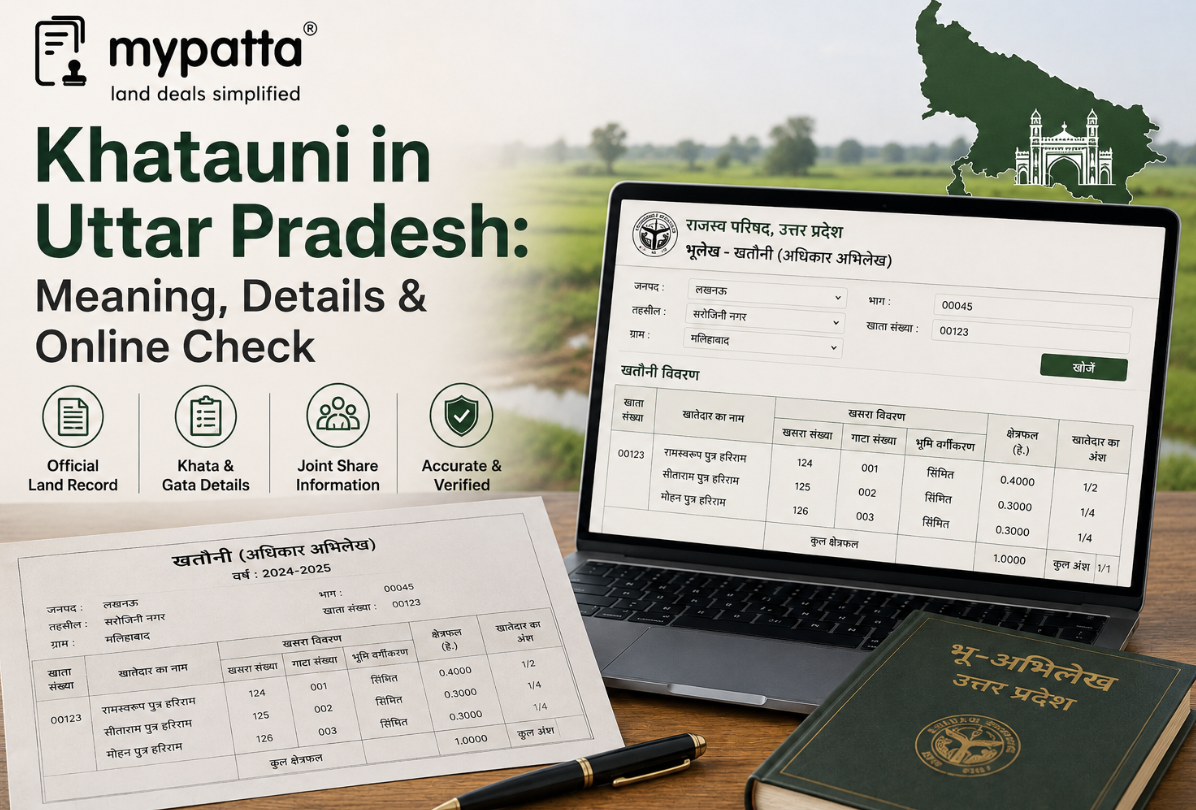
How to download Khatauni Land Records in Uttar Pradesh
You can get the Khatauni Land Records in Uttar Pradesh online easily via mypatta without visiting the Sub-Registrar office.
- Open mypatta and log in or sign up if needed.
- Go to property documents, ensure “Uttar Pradesh” is selected as the state, then tap the “Khatauni Land Records” icon.
- Enter required information.
- Tap “Search”
- Once the Khatauni Land Records is available to download, tap “View Document”. You can now save or share or download this document in PDF on your device.
Can Khatauni Be Used as Conclusive Ownership Proof?
A Khatauni cannot ordinarily be used as conclusive ownership proof by itself.
Under the Uttar Pradesh Revenue Code, the Khatauni is the village Record of Rights. It records tenure holders, the survey or plot numbers held by them, the area, the nature and extent of their interests, their shares and any conditions or liabilities attached to those interests.
The Code gives entries prepared in accordance with its provisions a presumption of correctness until the contrary is proved. This makes the Khatauni an important piece of evidence, but the presumption is rebuttable rather than final.
A person’s name may appear in the Khatauni because of:
- a registered sale or gift;
- succession after the death of a tenure holder;
- partition among co-tenure holders;
- a Revenue Court order;
- government allotment;
- correction of an earlier entry; or
- another mutation proceeding.
The entry does not by itself establish that the underlying transaction or succession claim was legally valid.
The Revenue Code itself clarifies that the correction process for a Khatauni, Khasra or map cannot be used to decide a dispute involving title. It also permits a person affected by certain revenue orders to establish their rights through a declaratory suit under Section 144.
The Supreme Court has similarly reiterated that mutation proceedings are summary and that a mutation entry does not confer title because its primary purpose is fiscal and administrative.
Accordingly, Khatauni can help establish the current revenue-record position, but ownership must be traced through the legal source from which the seller claims rights, such as:
- registered sale deed;
- gift or settlement deed;
- partition deed;
- inheritance and succession records;
- court decree;
- government grant; or
- another legally recognised title document.
A buyer should distinguish between two questions:
- Who is presently recorded in the revenue account?
- Who has a legally valid and transferable title?
Khatauni directly assists with the first question. The second requires examination of the title chain and supporting records.
How to Compare Khatauni With the Registered Deed and Mutation Records
The Khatauni, registered deed and mutation order should describe the same transaction and property, but each performs a different function.
| Record | Main purpose | Important details to compare |
|---|
| Registered deed | Records the transfer and its complete terms | Parties, Gata numbers, area, share, boundaries and rights transferred |
| Mutation order | Determines whether the resulting change should be entered in the revenue record | Applicant, previous holder, basis of mutation, affected plots and final direction |
| Khatauni | Shows the resulting account-wise revenue position | Current tenure holders, shares, Gata numbers, area and liabilities |
| Khasra | Shows plot-wise field particulars | Plot area, classification, cultivation and possession-related entries |
| Village map | Shows the physical arrangement of plots | Location, shape, adjoining Gatas, roads and natural features |
Compare the names and capacities of the parties
The seller named in the registered deed should correspond with the person recorded in the Khatauni.
Where the deed was executed through another person, check whether that person acted as:
- power-of-attorney holder;
- guardian;
- authorised company representative;
- karta or family representative; or
- representative under a court or government order.
The seller’s appearance in the Khatauni does not cure a defect in the authority under which the deed was executed.
Match every Gata number
Each Gata or Khasra number stated in the deed should be matched with the plots recorded in the Khatauni.
Check whether:
- all plots covered by the deed appear in the seller’s account;
- the seller is recorded against the exact Gata being sold;
- a Gata from another khata has been wrongly included;
- the deed covers an entire plot or only part of it; and
- the village, tehsil and district are identical.
A matching name is insufficient where the seller holds several properties in the same village.
Compare the area and share
The Khatauni may show the total area of the Gata or entire joint account. The deed may transfer only a fractional share or a smaller identified portion.
For example, if a seller owns a one-fourth undivided share in a Gata measuring four hectares, the seller cannot represent the entire four hectares as their exclusive holding merely because the full plot area appears in the Khatauni.
The following figures must be kept separate:
- total Gata area;
- total khata area;
- seller’s recorded fractional share;
- area corresponding to that share; and
- precise area proposed to be transferred.
Verify the mutation order
A registered document affecting title or a charge over land for which a Khatauni is maintained is communicated by the registering authority to the concerned Tahsildar. The mutation process then determines whether the Khatauni should be amended.
The buyer should obtain the mutation order and verify:
- case or application number;
- names of the transferor and transferee;
- registered-document number and date;
- Gata numbers and area;
- objections, if any;
- final order; and
- whether the amendment was correctly incorporated.
The Uttar Pradesh Board of Revenue presently provides separate online services for mutation applications, status checks and orders under Section 34.
A deed may be registered while the corresponding mutation remains pending. Conversely, an old or defective revenue entry may continue to show the seller despite a later transfer. Both the registration and mutation history must therefore be examined.
What Can Khatauni Not Reveal About the Property?
Khatauni is an important revenue record, but it cannot independently reveal the complete legal and physical status of the property.
Complete title chain
It does not ordinarily reproduce every earlier deed, grant, partition or succession document through which title moved to the present seller.
Validity of the seller’s title
It does not conclusively establish that the deed, will, partition or mutation underlying the entry is legally valid.
Registered mortgages and later transactions
A mortgage, sale agreement, lease, release or subsequent transfer may require a separate registration search and examination of the relevant deed.
The Uttar Pradesh Stamp and Registration Department currently provides property searches, registered-deed information, certified-copy services and Non-Encumbrance Certificate facilities.
Exact physical boundaries
Khatauni identifies plots and areas but does not fix each boundary point on the ground. The village map, Gata boundary details and official demarcation must be examined separately.
Actual possession
The person recorded as a tenure holder may not have vacant or exclusive possession. A tenant, co-owner, cultivator, encroacher or neighbouring landholder may occupy the property.
Current cultivation and field condition
These matters are more appropriately examined through the Khasra and physical inspection.
Every court dispute
A pending civil, revenue, consolidation or acquisition proceeding may not be evident merely from the Khatauni. The Board of Revenue separately provides plot-dispute and Revenue Court search services.
Every statutory transfer restriction
The tenure category and remarks may provide clues, but the Khatauni alone may not establish that every necessary permission was obtained.
The Board of Revenue separately provides services concerning:
- agricultural-to-non-agricultural land-use conversion under Section 80;
- permission for transfer by certain Scheduled Caste bhumidhars under Section 98; and
- permission relating to acquisition of more than 5.0586 hectares or 12.5 acres under Section 89.
Financial and institutional charges
A bank or institutional security interest may require examination of the loan records, registered mortgage and CERSAI information. The State’s integrated property-search service separately includes CERSAI details.
Which Records Should a Buyer Check Along With Khatauni?
A buyer should build the due-diligence record around the precise Gata and the seller’s stated share.
Title and registration records
Check:
- current registered sale, gift or partition deed;
- mother deed and earlier link documents;
- certified copies of missing deeds;
- registered release or relinquishment deeds;
- powers of attorney;
- mortgage and release deeds;
- Non-Encumbrance Certificate or Barah Sala search;
- subsequent property-deed search; and
- rectification or cancellation deeds.
The IGRSUP portal currently offers property searches, certified copies of deeds and Non-Encumbrance Certificate services.
Revenue records
Obtain:
- latest certified Khatauni;
- previous Khatauni copies;
- Khasra;
- mutation order;
- succession order;
- share or name-correction order;
- Kisan Bahi, where relevant; and
- government allotment or Revenue Court order forming the basis of the entry.
Survey and boundary records
Check:
- revenue-village map or Shajra;
- Gata boundary details;
- consolidation map and records;
- minjumla division record;
- official demarcation order;
- acquisition map, where applicable; and
- physical measurement of the site.
Litigation and restriction records
Search for:
- Revenue Court proceedings;
- civil-court cases;
- consolidation disputes;
- injunctions and attachments;
- acquisition or reservation proceedings;
- land-use conversion orders;
- permissions under Sections 89 and 98, where applicable; and
- Gram Sabha or government-land claims.
The official Uttar Pradesh property-search platform currently brings together registered-deed information, the Record of Rights, cadastral maps, Revenue Court cases, civil-court information and CERSAI details for available properties.
Physical verification
Finally, confirm that:
- the seller is in possession;
- the correct Gata is shown at the site;
- the area available matches the records;
- boundaries and adjoining plots correspond;
- road access exists and is legally usable;
- no encroachment is visible;
- cultivation and land use are consistent; and
- local occupation does not conflict with the documentary position.
A reliable agricultural-land review should establish consistency across the title deed, mutation order, Khatauni, Khasra, village map and ground possession.
Why mypatta?
- Trusted by 7 Lakh+ Customers
- 1 Crore+ Documents Delivered
- mypatta Guarantee: Guaranteed delivery or a 100% refund
- 4.8-Star App Rating
Your money is safe with us: Guaranteed delivery or a 100% amount refund.
- 1. Does the seller’s name in the Khatauni prove that they have a clear title?+
No. It supports the current revenue-record position, but the seller’s title must be verified through the registered deed, earlier title chain, mutation orders and other relevant records.
- 2. Can one co-tenure holder sell the entire land recorded in a joint Khatauni?+
Not merely because their name appears in the account. Their recorded and legally acquired share must be identified, and the rights of the other co-tenure holders must be respected.