How to download Khatauni Land Records in Uttar Pradesh
You can get the Khatauni Land Records in Uttar Pradesh online easily via mypatta without visiting the Sub-Registrar office.
- Open mypatta and log in or sign up if needed.
- Go to property documents, ensure “Uttar Pradesh” is selected as the state, then tap the “Khatauni Land Records” icon.
- Enter required information.
- Tap “Search”
- Once the Khatauni Land Records is available to download, tap “View Document”. You can now save or share or download this document in PDF on your device.
What Is a Khatauni in Uttar Pradesh?
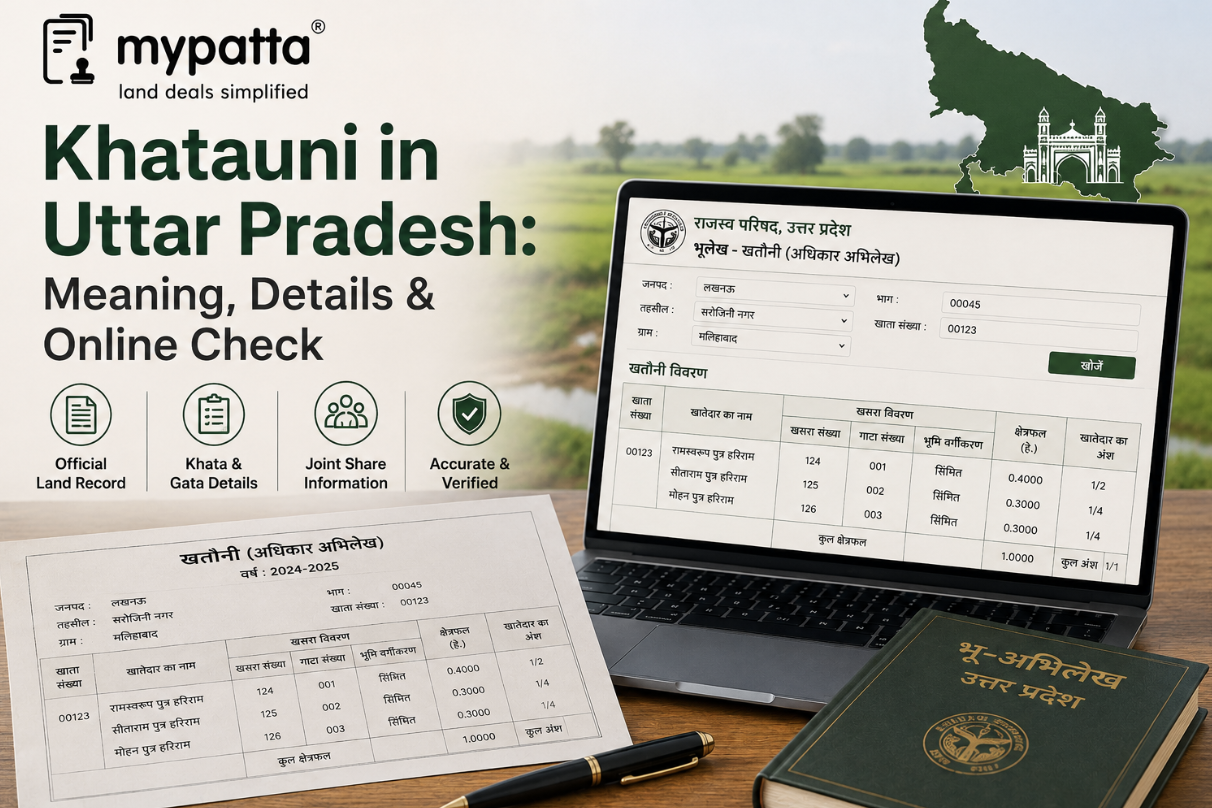
A Khatauni is the Record of Rights maintained for agricultural land in a revenue village in Uttar Pradesh. It records the persons recognised in the revenue system as tenure holders and connects them with the plots entered under their land account.
The Uttar Pradesh Revenue Code refers to Khatauni as the record of rights. Revenue authorities are required to record changes affecting the Khatauni, Khasra and map, including transactions that affect the rights or interests already entered in those records.
A Khatauni is generally organised around a khata, or revenue account. One khata may contain:
- one recorded landholder and several plots;
- several co-tenure holders and one plot;
- several co-tenure holders and multiple plots; or
- different recorded shares in the land included under the account.
The record is mainly used for revenue administration and maintenance of landholding particulars. It helps show how agricultural land is presently entered in the village records, but it is not the same as the registered deed, Khasra or revenue map.
The distinction can be understood as follows:
- Khatauni: Shows the account-wise landholding and recorded rights.
- Khasra: Contains plot-wise field and cultivation particulars.
- Revenue map or Shajra: Shows the spatial location and boundaries of plots.
- Mutation order: Explains the legal or administrative basis on which a name, share or interest was changed.
- Registered deed: Records the transaction through which rights were purportedly transferred.
The current Uttar Pradesh Board of Revenue portal separately provides services for Khatauni, Khasra, revenue maps, mutation, succession and demarcation. This separation reflects the different purpose served by each record.
What Information Does a Khatauni Contain?
The exact layout may differ according to the village, record period and whether the document is an older or real-time Khatauni. Official public Khatauni reports broadly organise the information under landholder details, commencement of tenure and land particulars.
| Khatauni component | What it generally indicates | What should be checked |
|---|
| District, tehsil and village | Revenue jurisdiction in which the record is maintained | Whether the correct village and tehsil were selected |
| Khata number | Revenue account under which the holding is recorded | Whether it matches earlier Khatauni and mutation records |
| Landholder details | Name, parent or spouse details, guardian and residence | Whether every necessary holder is correctly identified |
| Tenure particulars | Nature or commencement of the recorded holding | Whether the entry corresponds with the mutation or title event |
| Gata or Khasra number | Individual agricultural plot linked with the account | Whether every plot intended to be verified is included |
| Plot area | Recorded area of each Gata or the relevant share | Whether it matches the deed, Khasra and map |
| Recorded share | Fractional interest of each co-tenure holder | Whether shares are complete and total correctly |
| Mutation or order details | Orders through which names or interests were changed | Whether the order is current and relates to the same land |
| Remarks or special entries | Restrictions, corrections or other revenue information | Whether any entry requires supporting documents |
Landholder details
The Khatauni may identify the recorded holder through:
- name;
- father’s or husband’s name;
- guardian’s name, where applicable;
- address or residence; and
- other identifying particulars available in the revenue record.
Official UP Bhulekh reports use fields for the account holder’s name, parent, spouse or guardian and residence.
A name appearing in the Khatauni should be read as a revenue entry. It may have resulted from a registered transfer, succession, allotment, partition, court order or another mutation proceeding.
Land particulars
Each account may be connected with one or more Gata or Khasra numbers. The record may show the individual plot number and its recorded area.
The Gata number identifies the specific land parcel within the village revenue system. The same numerical Gata can exist in another village, so it must always be read with the district, tehsil and village.
Orders and changes
A Khatauni may contain references to orders affecting the names, shares or plots entered in the account. These can include mutation, succession, correction or Revenue Court orders.
The Uttar Pradesh Revenue Code provides that where a succession or transfer mutation is accepted, the Khatauni may be directed to be amended accordingly.
How to Read Khata Number, Account Holder and Plot Details
A Khatauni should be read from the wider location details towards the individual plots and shares.
Confirm the revenue village
Begin with:
- district;
- tehsil;
- pargana, where shown;
- village name; and
- village code.
Selecting the wrong village may produce a genuine Khatauni for an entirely different property.
Identify the khata number
The khata number is the account number under which the recorded holding is organised. It is not necessarily the same as:
- Gata number;
- Khasra number;
- registered-deed number;
- mutation case number; or
- property-registration number.
One khata can contain several plots. Similarly, one larger plot may be associated with several co-tenure holders recorded under the same account.
The khata number should be compared with:
- earlier Khatauni copies;
- mutation or succession applications;
- registered deed schedule;
- Kisan Bahi, where available; and
- connected Khasra details.
Read every account holder’s entry
Do not examine only the first name appearing in the Khatauni. Check whether the account contains:
- one tenure holder;
- several co-tenure holders;
- heirs of a deceased holder;
- holders with different shares;
- a guardian-related entry; or
- persons whose names were added or removed through different orders.
A seller whose name appears among several co-tenure holders may not be entitled to transfer the entire holding.
Match each Gata number
Every Gata or plot listed under the khata should be identified separately.
For each plot, note:
- Gata or Khasra number;
- recorded area;
- share attributed to the concerned holder;
- connected mutation entry; and
- any special remark.
The complete account area should not be confused with the area of one individual Gata or with the seller’s fractional interest.
Check the tenure commencement details
Official Khatauni reports may separately show information concerning the commencement or basis of the recorded tenure.
This portion may help connect the current holder with:
- an earlier mutation;
- succession;
- transfer;
- allotment;
- court or Revenue order; or
- another recognised change.
The referenced order should be obtained where the entry is material to the property’s history.
How to Access a Khatauni Record Online in Uttar Pradesh
The Uttar Pradesh Board of Revenue provides Khatauni services through the official UP Bhulekh system.
The current Board of Revenue portal provides options to:
- view an uncertified Khatauni copy;
- download a certified Khatauni copy;
- check the sale status of a plot;
- check whether a plot is involved in litigation;
- identify the unique code of a Gata; and
- apply for correction of names or shares.
The UP Bhulekh platform identifies itself as the State’s land-record computerisation and real-time Khatauni system.
The record can ordinarily be located by selecting the relevant:
- district;
- tehsil;
- village; and
- khata number, Gata number or landholder details available through the search.
Only a brief retrieval process is necessary: identify the correct village and account, review the matching record and obtain the appropriate copy.
Informational and certified copies
The ordinary public view is useful for preliminary checking. Where the document is required for an authority, bank, court or formal transaction, the certified-copy service should be used.
The State portal expressly distinguishes between viewing an uncertified copy and downloading a certified Khatauni.
Older Khatauni records
A present real-time Khatauni may not explain every historical entry. Older records can be important where the property has passed through several transfers, inheritances or corrections.
The official Uttar Pradesh e-Abhilekh system lists several historical Khatauni series, previous 12-year Khatauni records and handwritten records from before computerisation among the tehsil records managed through the platform.
Older copies may therefore need to be obtained where:
- a previous landholder must be traced;
- an old share or area is disputed;
- the current account arose from a subdivision;
- an earlier mutation is missing online; or
- the title document refers to an older Khatauni period.
How to Check Whether the Khatauni Is Current and Correct?
A Khatauni should be treated as current only after checking that later mutations, succession entries, corrections and orders have been incorporated.
Check the latest holder names
Compare the current Khatauni with:
- the latest registered deed;
- mutation order;
- succession or Varasat order;
- partition order;
- court decree; and
- previous Khatauni.
The Revenue Code requires changes and transactions affecting recorded rights to be entered in the Khatauni, Khasra and map.
Verify recent mutation and succession orders
Where land was recently sold or inherited, confirm whether the resulting amendment has reached the current Khatauni.
The Board of Revenue portal separately provides online services for:
- succession under Section 33;
- mutation under Section 34;
- application status; and
- copies of relevant orders.
A registered deed can exist even though the purchaser’s name has not yet been entered in the Khatauni. Conversely, a person’s name may continue in the record after death or transfer if the change has not been processed.
Compare every plot and area
Check whether:
- every Gata in the deed appears in the Khatauni;
- no unrelated Gata has been included;
- the recorded area is accurate;
- the seller’s share is correctly stated;
- the total account area is not being represented as the seller’s individual area; and
- later subdivisions or corrections have been incorporated.
Review share and name corrections
The official correction service permits action concerning errors in share, name, guardian and address.
Under Section 38 of the Uttar Pradesh Revenue Code, an application can be made for correction of an error or omission in the map, Khasra or Khatauni. The Code also permits undisputed errors or omissions to be corrected after the prescribed enquiry, while clarifying that this correction power does not include deciding a dispute involving title.
Check whether the land is disputed or already sold
The Board of Revenue’s current online services include separate facilities for checking:
- the sale status of a plot; and
- whether a plot is involved in a revenue dispute.
These checks do not replace a complete title or court search, but they can identify concerns that are not obvious from the landholder names alone.
Understand the evidentiary position
The Revenue Code provides a rebuttable presumption that entries in a Khatauni prepared in accordance with the Code are true until the contrary is proved. It also permits a person to establish their rights through the appropriate legal proceeding despite certain revenue orders.
Accordingly, a Khatauni should be treated as an important current revenue record, but not as an unquestionable statement of title.
The record is more reliable when:
- it is the latest certified copy;
- the names match the mutation orders;
- the recorded shares are complete;
- the Gata numbers and areas match the deed;
- the Khasra and village map identify the same land; and
- no later correction, dispute or transfer remains pending.
Why mypatta?
- Trusted by 7 Lakh+ Customers
- 1 Crore+ Documents Delivered
- mypatta Guarantee: Guaranteed delivery or a 100% refund
- 4.8-Star App Rating
Your money is safe with us: Guaranteed delivery or a 100% amount refund.
Frequently Asked Questions
- 1. Is the khata number the same as the Gata or Khasra number?+
No. The khata number identifies the revenue account, while a Gata or Khasra number identifies an individual land parcel. One khata may contain several Gata numbers.
- 2. Can several people appear in one Khatauni account?+
Yes. Joint holdings may contain several co-tenure holders. Their respective shares should be checked carefully, especially before any sale or partition.
- 3. What is a real-time Khatauni in Uttar Pradesh?+
It is the current computerised Khatauni maintained through the UP Bhulekh system, reflecting changes incorporated into the live revenue record.
- 4. What should be done if a name or share is incorrect in the Khatauni?+
The supporting deed, mutation, succession or court order should be checked, and the appropriate correction process should be used for the name, share or other incorrect entry.
Shivangi
Real Estate Content Writer
Shivangi is a real estate content writer with 3+ years of experience helping readers understand property documentation, land records, and legal requirements through clear and actionable content.