How to Download Encumbrance Check Report in Maharashtra
You can get the Encumbrance Check Report online easily via mypatta without visiting multiple offices.
- Open mypatta and log in or sign up if needed.
- Go to property documents, ensure “Maharashtra” is selected as the state, then tap the “Encumbrance Check Report” icon.
- Enter required information.
- Tap “Search”.
- Once Encumbrance Check Report is available to download, tap “View Document”. You can now save or share or download this document in PDF on your device.
Why Should an Encumbrance Check Use Multiple Records?
Different property records answer different questions.
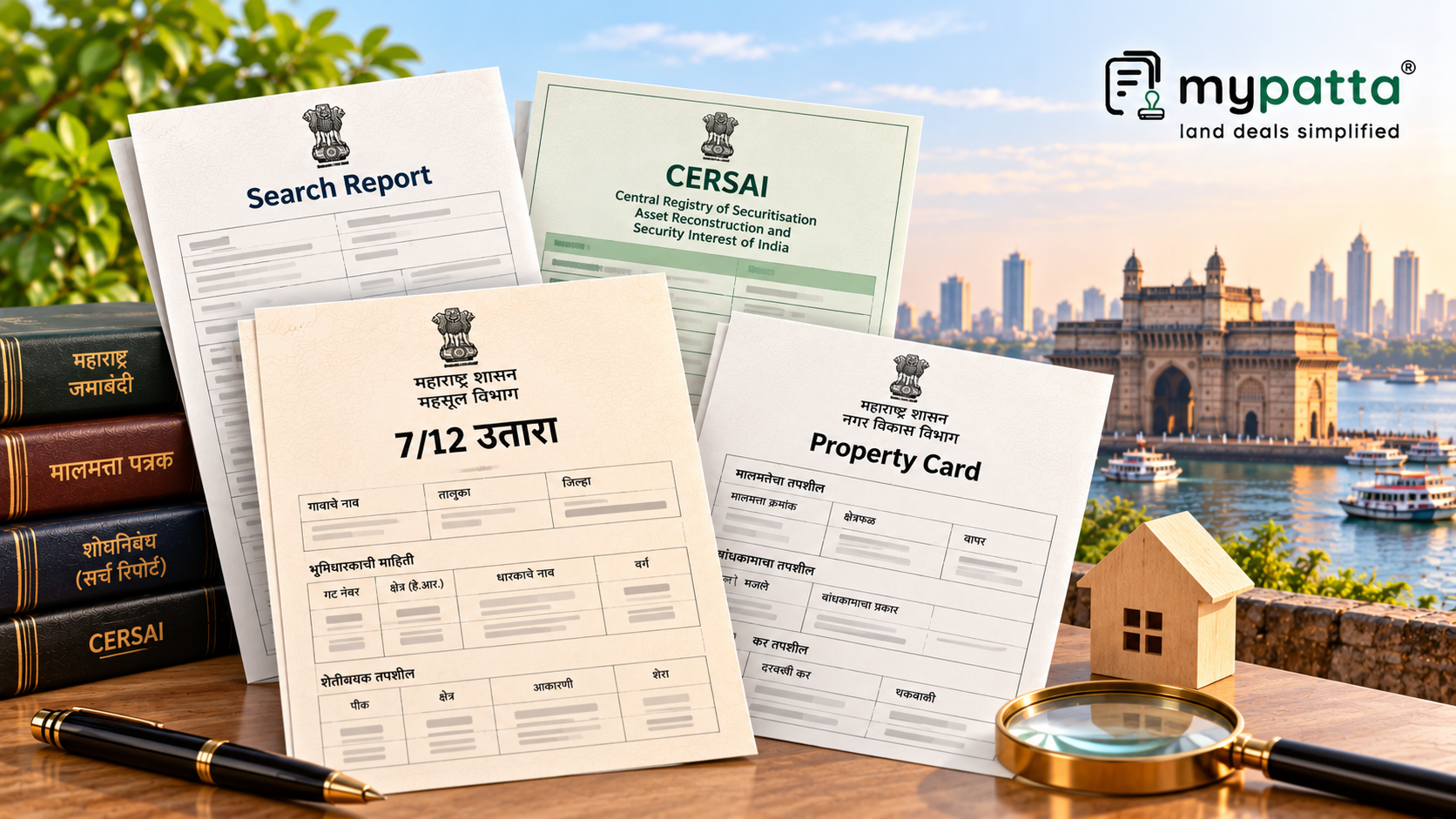
A Search Report focuses on registered transaction history. CERSAI focuses on registered security interests and mortgage-related information. The 7/12 reflects parcel-level rural land particulars, while the Property Card records relevant urban or city-survey property details.
MyPatta's Maharashtra Encumbrance Check Report currently reviews records including the Search Report/EC, latest Title Deed, Index II, Bhunaksha, 7/12 or Property Card, Ferfar, Property Tax Receipt and CERSAI mortgage information.
The objective is not merely to collect these documents. It is to determine whether they support the same ownership, property identity and encumbrance position.
What Should You Check in the Search Report?
The Maharashtra Search Report or EC is used to trace registered property transactions and identify available registered encumbrances over the searched period. MyPatta describes it as containing transaction history including sales, mortgages and loans linked to the property.
Check the Search Report for:
- sale transactions;
- mortgages;
- gift or settlement transactions;
- releases;
- transfers between owners;
- registered liabilities;
- document numbers;
- transaction dates; and
- property identifiers.
The ownership sequence should correspond with the title deeds and Index II records available for the property.
A person appearing as the present seller should be capable of being connected with the earlier registered ownership chain.
What Should CERSAI Add to the Check?
CERSAI is particularly important for detecting available security-interest information relating to property used for borrowing.
The Central Registry framework was established partly to reduce the risk of multiple lending against the same immovable property. RBI material confirms that records concerning mortgages and security interests are filed with the Central Registry and can assist in identifying financing created against property.
During due diligence, check whether CERSAI information indicates:
- an existing mortgage;
- creation of a security interest;
- modification of an earlier security interest; or
- satisfaction or closure of the security interest.
A property may therefore require both a Search Report review and a CERSAI check.
They should not automatically be treated as interchangeable.
Why Should Search Report and CERSAI Be Compared?
The Search Report examines registered property transactions, while CERSAI provides an additional check for security interests created in favour of lenders.
Cross-verification helps determine whether:
- a mortgage appearing in the transaction history has been released;
- a security interest remains active;
- lender-related information requires further documentation;
- the seller has disclosed existing borrowing against the property; or
- additional closure or satisfaction records should be obtained.
The absence of an obvious mortgage in one record should not be used as the sole reason to skip the other check.
Where a financial encumbrance is found, the buyer should obtain satisfactory evidence concerning its present status before completing the purchase.
What Should You Check in the 7/12 Extract?
For relevant rural and agricultural land, the 7/12 Extract should be compared with the transaction and title records.
Check:
- recorded holder name;
- survey or Gat number;
- subdivision or Hissa details;
- land area;
- nature or classification of land;
- other recorded rights; and
- relevant land particulars.
The 7/12 is parcel-focused and is intended to show important details concerning the particular agricultural land being examined.
MyPatta's Maharashtra records also distinguish the 7/12 as a key rural land record used in property and loan verification.
The seller's title deed and the 7/12 should therefore identify the same land or contain a documented explanation for any difference.
What Should You Check in the Property Card?
For applicable urban and city-survey properties, the Property Card becomes an important cross-verification record.
Check:
- owner or holder name;
- CTS or city-survey number;
- property area;
- mutation particulars;
- land or property description; and
- other rights reflected in the record.
MyPatta distinguishes the Property Card from rural records such as the 7/12 and identifies it as a record relevant to urban property verification.
The Property Card should be compared directly with the registered title deed and Index II.
A different CTS number, area or holder name should be investigated before relying on the seller's property description.
7/12 or Property Card: Which One Should Be Used?
The correct record depends upon the property.
| Property / Check | Record to Cross-Verify |
|---|
| Rural or agricultural land | 7/12 Extract |
| Applicable urban / city-survey property | Property Card |
| Registered transaction history | Search Report / EC |
| Mortgage or security-interest check | CERSAI |
| Registered ownership transaction | Title Deed |
| Registration summary | Index II |
| Mutation history | Ferfar |
A buyer should not mechanically demand both 7/12 and Property Card where only one record system properly applies to the particular property.
The aim is to identify the current record relevant to that parcel and compare it with the title.
Cross-Check the Owner Name Across Records
One of the most important encumbrance checks is ownership consistency.
Compare the seller's name across:
- latest Title Deed;
- Index II;
- Search Report;
- 7/12 or Property Card; and
- Ferfar or mutation history.
A difference does not automatically mean the title is defective.
It may arise from mutation delay, inheritance, spelling variation, partition or another documented change.
However, there should be a reliable document trail explaining why the names differ.
An unexplained ownership mismatch should be resolved before purchase.
Cross-Check the Property Identifiers
The records should also relate to the same property.
Check:
- survey number;
- Gat number;
- CTS number;
- Hissa or subdivision;
- plot number;
- property area; and
- other identifying particulars.
A clear transaction history is of limited value if it concerns a different parcel from the one physically being purchased.
Where older and current identifiers differ, mutation, subdivision, survey or other records should connect them.
Cross-Check Mortgages Against the Seller's Title
Where the Search Report or CERSAI indicates borrowing, determine:
- which property was offered as security;
- who created the mortgage;
- whether the seller acquired the property subject to it;
- whether the liability has been discharged; and
- whether satisfaction or release has been properly recorded.
RBI guidance explains that the Central Registry system is intended, among other things, to help identify security interests and reduce risks such as multiple lending against the same property.
The buyer should therefore treat mortgage verification as a separate due-diligence exercise rather than simply asking whether the seller currently has a loan.
What Are the Main Red Flags?
Further investigation is required where the cross-verification reveals:
- mortgage without clear satisfaction or release;
- seller name inconsistent with current property records;
- unexplained ownership change;
- missing title link;
- different survey, Gat or CTS number;
- unexplained area variation;
- pending or disputed mutation;
- transaction appearing in the Search Report but missing from the seller's title papers; or
- financial security information inconsistent with the seller's disclosures.
MyPatta's Encumbrance Check Report is specifically designed to identify ownership mismatches, mortgage issues, mutation gaps and discrepancies across multiple property records.
Does Cross-Verification Prove Perfect Title?
No.
Cross-verification is a strong due-diligence process, but it cannot automatically resolve every possible title issue.
Separate examination may still be required for:
- succession disputes;
- competing co-owner rights;
- missing link documents;
- boundary disputes;
- possession issues;
- validity of an underlying transfer; or
- pending litigation affecting the property.
The purpose of an encumbrance check is to identify whether the available records are consistent and whether any issue requires deeper legal investigation before purchase.
Why mypatta?
- Trusted by 7 Lakh+ Customers
- 1 Crore+ Documents Delivered
- mypatta Guarantee – guaranteed delivery or 100% refund
- 4.8 Star App Rating
- 1. Is a Maharashtra Search Report enough to check all property encumbrances?+
No. It should be cross-checked with mortgage information, title documents and the applicable land or Property Card records.
- 2. Why should buyers check CERSAI?+
CERSAI can help identify available mortgage or security-interest information relating to property used as security for borrowing
- 3. Should I check 7/12 or Property Card?+
Use the 7/12 for relevant rural or agricultural land and the Property Card for applicable urban or city-survey property.
- 4. What if the seller's name differs across these records?+
Check the title deed and mutation history to establish the reason for the difference before proceeding
Shivangi
Real Estate Content Writer
Shivangi is a real estate content writer with 3+ years of experience helping readers understand property documentation, land records, and legal requirements through clear and actionable content.