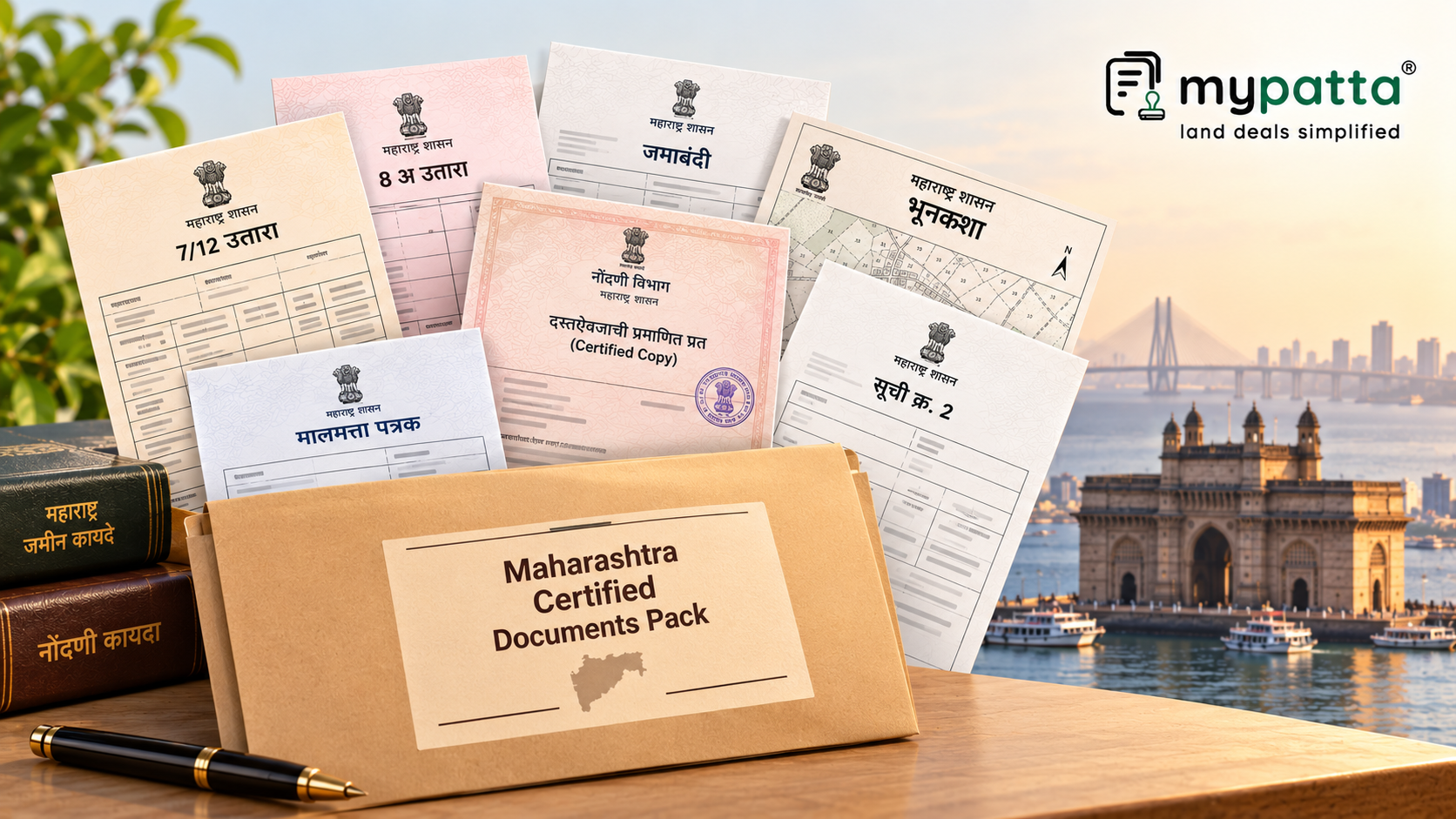
How to Download Certified Documents Pack in Maharashtra
You can get the Certified Documents Pack online easily via mypatta without visiting multiple offices.
- Open mypatta and log in or sign up if needed.
- Go to property documents, ensure “Maharashtra” is selected as the state, then tap the “Certified Documents Pack” icon.
- Enter required information.
- Tap “Search”.
- Once Certified Documents Pack is available to download, tap “View Document”. You can now save or share or download these documents on your device.
What Is Included in the Maharashtra Certified Documents Pack?
MyPatta's Maharashtra Certified Documents Pack currently brings together digitally signed versions of four important property records:
- 7/12 Extract or Satbara;
- Ferfar;
- 8A Extract; and
- Property Card.
These documents cover different aspects of the land-record position.
They should not be treated as four versions of the same information.
The 7/12 is parcel-focused, the 8A is account or holder-focused, Ferfar records mutations and changes, while the Property Card is particularly relevant to land recorded through the city-survey system.
The correct combination depends heavily on whether the property is rural, agricultural or urban.
Which Certified Records Should You Collect for Rural Property?
For rural property, particularly agricultural land, the principal certified records are usually the 7/12 Extract, 8A Extract and Ferfar.
Certified 7/12 Extract
The 7/12 Extract is one of the most important records for rural agricultural land.
It can help verify:
- survey or Gat number;
- recorded holder;
- area;
- land type;
- cultivation details;
- crop-related information; and
- other rights or remarks concerning the parcel.
Because it is parcel-focused, buyers should compare the 7/12 directly with the property description contained in the registered title deed.
The name, survey number, extent and subdivision particulars should be capable of being reconciled.
Certified 8A Extract
The 8A Extract provides an account-wise view of the khatedar's landholding within the village.
It is particularly useful for checking:
- khata details;
- recorded holder;
- survey numbers associated with the holding;
- total land reflected against the account; and
- revenue-related particulars.
The 8A can therefore help determine whether the land being purchased forms part of a larger holding and whether the seller's account-wise details correspond with the parcel shown in the 7/12.
Certified Ferfar
Ferfar provides the mutation history.
It helps explain how the name, share or landholding particulars appearing in the current revenue records came to be recorded.
Ferfar should be checked where the land has undergone:
- sale;
- inheritance;
- partition;
- gift;
- release;
- subdivision; or
- another change affecting the recorded landholding.
A current 7/12 may show the present position, while Ferfar helps explain the sequence of changes behind that position.
Which Records Should You Collect for Urban Property?
For applicable urban property, the Property Card becomes particularly important.
A Property Card may contain details relating to:
- CTS or city-survey number;
- holder or occupant name;
- property area;
- tenure or rights;
- mutation entries; and
- other city-survey particulars.
The Property Card should be compared with the registered deed to verify whether the CTS number, area and recorded holder correspond with the property being purchased.
In urban due diligence, the buyer may also need to examine the mutation history affecting the Property Card and the registered transaction documents through which ownership changed.
The Maharashtra document catalogue separately lists Property Card alongside 7/12, Ferfar, 8A, title deeds and transaction-related records because different properties require different verification records.
Rural vs Urban Certified Documents
| Due-Diligence Requirement | Rural / Agricultural Property | Urban Property |
|---|
| Parcel-level land record | Certified 7/12 | Property Card |
| Owner/account-wise holding | Certified 8A | Property Card / applicable urban record |
| Mutation history | Certified Ferfar | Relevant mutation entries |
| Survey identifier | Survey/Gat/Hissa number | CTS/City Survey number |
| Registered ownership transaction | Title Deed / Certified Copy | Title Deed / Certified Copy |
| Transaction summary | Index II | Index II |
| Wider transaction check | Search Report / Encumbrance Check | Search Report / Encumbrance Check |
The classification should be determined from the actual record system applicable to the property rather than simply from whether the location appears physically developed.
Why Is the Title Deed Still Necessary?
The Certified Documents Pack provides important land and mutation records, but it does not replace the registered title deed.
The title deed establishes the legal transaction through which the seller claims to have acquired rights.
Depending on the property history, the relevant deed may be a:
- sale deed;
- conveyance deed;
- gift deed;
- partition deed;
- release deed;
- settlement deed; or
- another registered instrument.
Certified land records help establish whether the current recorded position corresponds with that title.
A buyer should therefore ask two separate questions:
What document gave the seller the property rights?
and
Do the present land records consistently reflect those rights?
Both need to be answered.
Why Should You Also Check Index II?
Index II gives a concise summary of a registered transaction and can help confirm:
- buyer and seller;
- document number;
- registration details;
- transaction type;
- property description; and
- transaction value.
MyPatta describes Index II as a transaction-summary record used for checking registration details and ownership history.
It is useful for connecting the certified land records with the seller's registered transaction.
However, because Index II is a summary, the underlying deed should still be examined where the complete property schedule, ownership share or transaction terms matter.
Why Should Rural Buyers Pay Special Attention to Mutation?
Agricultural land often has a long history involving changes that may not arise solely from conventional sales.
The current 7/12 and 8A may therefore need to be understood through the Ferfar history.
Check whether the mutation sequence explains:
- change in recorded holder;
- division between co-owners;
- inherited shares;
- subdivision of the land;
- transfer of a portion of a larger holding; and
- changes in the recorded area.
The current certified record becomes more useful when the historical changes leading to it can also be explained.
What Should Urban Buyers Cross-Check With the Property Card?
The Property Card should be matched against the registered deed and Index II.
Pay particular attention to:
- CTS number;
- recorded area;
- seller or holder name;
- mutation history;
- building or plot description; and
- ownership share.
Where the urban property is a flat or constructed property, land records alone will not complete the verification.
Relevant building, society, tax, occupancy and project records may also need to be checked depending on the property.
Do Certified Documents Prove Clear Title?
Not by themselves.
Certification authenticates the record being relied upon. It does not convert a revenue or survey record into the instrument that created ownership.
A complete title review should generally examine:
- seller's current title deed;
- earlier link documents;
- Index II;
- appropriate certified rural or urban land records;
- mutation history;
- Search Report or relevant encumbrance checks; and
- survey or property-identification records where required.
MyPatta's Maharashtra Encumbrance Check Report similarly reviews records including the Search Report, latest Title Deed, Index II, 7/12 or Property Card, Ferfar, Bhunaksha and mortgage-related checks when assessing ownership and transaction risks.
Which Pack Should You Choose Before Buying?
For rural or agricultural land, focus on the certified 7/12, 8A and Ferfar, and then connect those records with the registered title and survey details.
For urban property, focus on the applicable Property Card and mutation history, while verifying the CTS details against the registered deed and Index II.
The purpose of a Certified Documents Pack is not simply to collect more records. It is to ensure that the title document, transaction history, mutation record and current property particulars consistently identify the same owner and property.
Why mypatta?
- Trusted by 7 Lakh+ Customers
- 1 Crore+ Documents Delivered
- mypatta Guarantee – guaranteed delivery or 100% refund
- 4.8 Star App Rating
- 1. Which certified documents should I collect for rural land in Maharashtra?+
Certified 7/12, 8A and Ferfar are particularly relevant, together with the registered title deed and transaction records.
- 2. Which certified record is important for urban property?+
The Property Card is particularly important for applicable urban and city-survey properties.
- 3. Do I need both 7/12 and 8A for agricultural land?+
They are useful together because 7/12 is parcel-focused while 8A provides an account-wise view of the holder's land.
Shivangi
Real Estate Content Writer
Shivangi is a real estate content writer with 3+ years of experience helping readers understand property documentation, land records, and legal requirements through clear and actionable content.