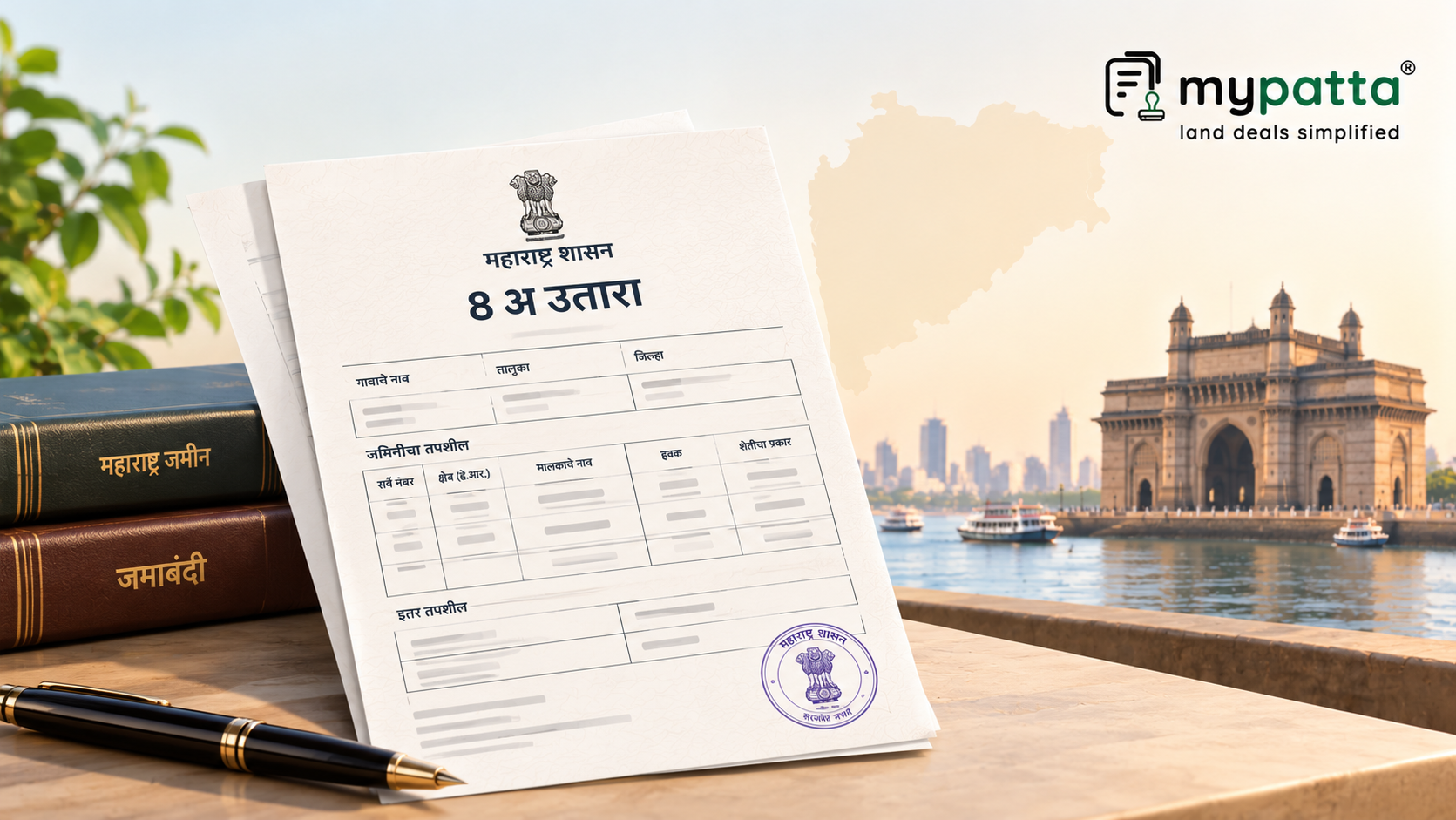
How to Download 8A Extract in Maharashtra
You can get the 8A Extract online easily via mypatta without visiting the concerned office.
- Open mypatta and log in or sign up if needed.
- Go to property documents, ensure “Maharashtra” is selected as the state, then tap the “8A Extract” icon.
- Enter required information.
- Tap “Search”.
- Once 8A Extract is available to download, tap “View Document”. You can now save or share or download this document in PDF on your device.
Why Can the Name in the 8A Extract Be Different?
The 8A Extract records land holdings connected with a khatedar or account holder within a particular village. It contains information such as owner name, khata details, survey numbers, land holdings and revenue particulars.
A name mismatch can therefore arise when the revenue record and the underlying title documents have not moved together.
The difference may relate to:
- mutation not being completed after a sale;
- inheritance not yet being fully reflected;
- partition or release between family members;
- spelling or initials recorded differently;
- change in the name of the recorded holder;
- an older owner continuing in the revenue record; or
- a disputed or pending Ferfar entry.
The buyer should identify the documentary reason for the difference instead of assuming that either the 8A Extract or the sale deed must automatically be wrong.
What Should You Check if the Seller's Name Does Not Match?
Check the Registered Title Deed
Begin with the document under which the seller claims ownership.
Confirm:
- seller's full name;
- nature of the transaction;
- survey or Gat number;
- property extent;
- date of acquisition; and
- ownership share.
The title deed should explain the legal source of the seller's rights.
Check Ferfar or Mutation Entries
Ferfar records help explain how changes in ownership or landholding were entered into the revenue record.
Check whether a mutation was recorded after the transaction through which the seller acquired the land.
Also verify whether the entry is:
- certified;
- pending;
- disputed; or
- rejected.
A pending or disputed mutation may explain why the seller's name has not been consistently reflected across all land records.
Compare the Current 7/12 Extract
The 7/12 Extract provides parcel-specific information and should be compared with the account-wise 8A Extract.
Check whether the same seller, survey number and land extent appear in both records.
A name appearing in 7/12 but not correctly reflected in 8A, or vice versa, requires examination of the mutation and account history.
Why Can the Land Area in 8A Be Different?
Area discrepancies can arise from several land-record and survey issues.
These may include:
- subdivision of a larger survey number;
- partition of jointly held land;
- correction of an earlier revenue entry;
- survey or measurement changes;
- consolidation or reorganisation of land parcels;
- transfer of only part of an earlier holding; or
- inconsistencies between recorded and measured area.
Area mismatches should be taken seriously because the buyer must establish exactly how much land the seller owns and can legally transfer.
In April 2026, the Bombay High Court dealt with a situation involving discrepancies between the area recorded in a 7/12 Extract and survey-related records, noting that such differences require resolution through the appropriate land-record process rather than being assumed away.
What Should You Check if the Land Area Does Not Match?
Compare the 8A and 7/12
The first step is to determine whether the area difference exists only in the 8A Extract or also appears in the 7/12.
The records should be checked for:
- total holding;
- survey or Gat number;
- subdivision number;
- cultivable area;
- recorded share; and
- present land extent.
Check the Registered Deed
The registered deed should state the extent of land actually transferred.
Do not rely solely on a larger area appearing in the 8A Extract if the seller acquired a smaller extent under the title deed.
Revenue records cannot enlarge the rights transferred under the underlying ownership document merely because a different area is recorded.
Check the Mutation History
Ferfar entries may explain whether part of the land was:
- sold;
- gifted;
- partitioned;
- released;
- inherited; or
- subdivided.
The current 8A figure should make sense when read together with these earlier changes.
Check Survey and Measurement Records
Where the disagreement concerns the physical extent or boundaries of land, survey records become especially important.
The Bombay High Court has recognised that differences can arise between the area reflected in revenue records and the area determined through actual survey or measurement records.
The buyer should therefore verify the land's measured identity rather than relying only on one area figure.
Does a Mismatch Mean the Seller Has No Title?
Not automatically.
A mismatch is a verification issue, not an automatic conclusion regarding title.
The legal significance depends on what caused the difference.
A record may simply be outdated, or a valid transfer may not yet have been fully reflected in the revenue account.
On the other hand, a discrepancy may reveal a more serious issue involving:
- competing ownership;
- excess area being claimed;
- an incomplete partition;
- unresolved inheritance;
- incorrect subdivision;
- conflicting mutation entries; or
- a boundary or survey dispute.
The buyer should determine which situation applies before proceeding.
Can 8A Area Be Treated as Proof of the Exact Land Being Sold?
No.
The 8A Extract is useful for understanding the holder's recorded landholding, but exact property identity should be established through the title and parcel-specific records.
MyPatta describes 8A as an owner or khata-focused record containing total land holdings, survey numbers and revenue-related information, and recommends using it alongside the 7/12 for broader land verification.
For a purchase, the land should therefore be identified through consistent:
- title-deed particulars;
- survey or Gat number;
- subdivision;
- 7/12 entries;
- Ferfar history;
- area details; and
- measurement or boundary records where required.
Which Document Should Prevail if the Areas Differ?
There is no safe rule that buyers should simply choose whichever document shows the larger or more favourable area.
The reason for the discrepancy must first be identified.
A registered title document is central to establishing what rights and extent were transferred. Revenue records help establish how those rights are reflected administratively, while survey records help establish the measured land parcel.
Maharashtra courts have also recognised that 7/12 and mutation records have evidentiary significance but are not themselves title documents.
The records should therefore be reconciled rather than ranked in isolation.
When Should the Buyer Pause the Purchase?
Further verification should be completed before registration where:
- the seller's name cannot be connected with the title chain;
- the mutation supporting the seller is disputed;
- the seller claims more land than the title deed records;
- 8A and 7/12 show materially different extents;
- subdivision history is unclear;
- survey measurement does not match the recorded extent;
- another person appears against the same holding; or
- the documentary reason for the mismatch cannot be established.
The buyer should not assume that registration of a new sale deed will automatically correct these earlier inconsistencies.
Which Records Should Be Verified Together?
For agricultural-land due diligence, compare:
- registered title deed;
- earlier link deeds;
- Index II;
- e-Ferfar and earlier mutation entries;
- current 8A Extract;
- current 7/12 Extract; and
- relevant survey, subdivision and measurement records.
The strongest position is where the seller's name, ownership share, survey number and land extent can be consistently traced across the title, mutation, revenue and survey records.
Why mypatta?
- Trusted by 7 Lakh+ Customers
- 1 Crore+ Documents Delivered
- mypatta Guarantee – guaranteed delivery or 100% refund
- 4.8 Star App Rating
Shivangi
Real Estate Content Writer
Shivangi is a real estate content writer with 3+ years of experience helping readers understand property documentation, land records, and legal requirements through clear and actionable content.