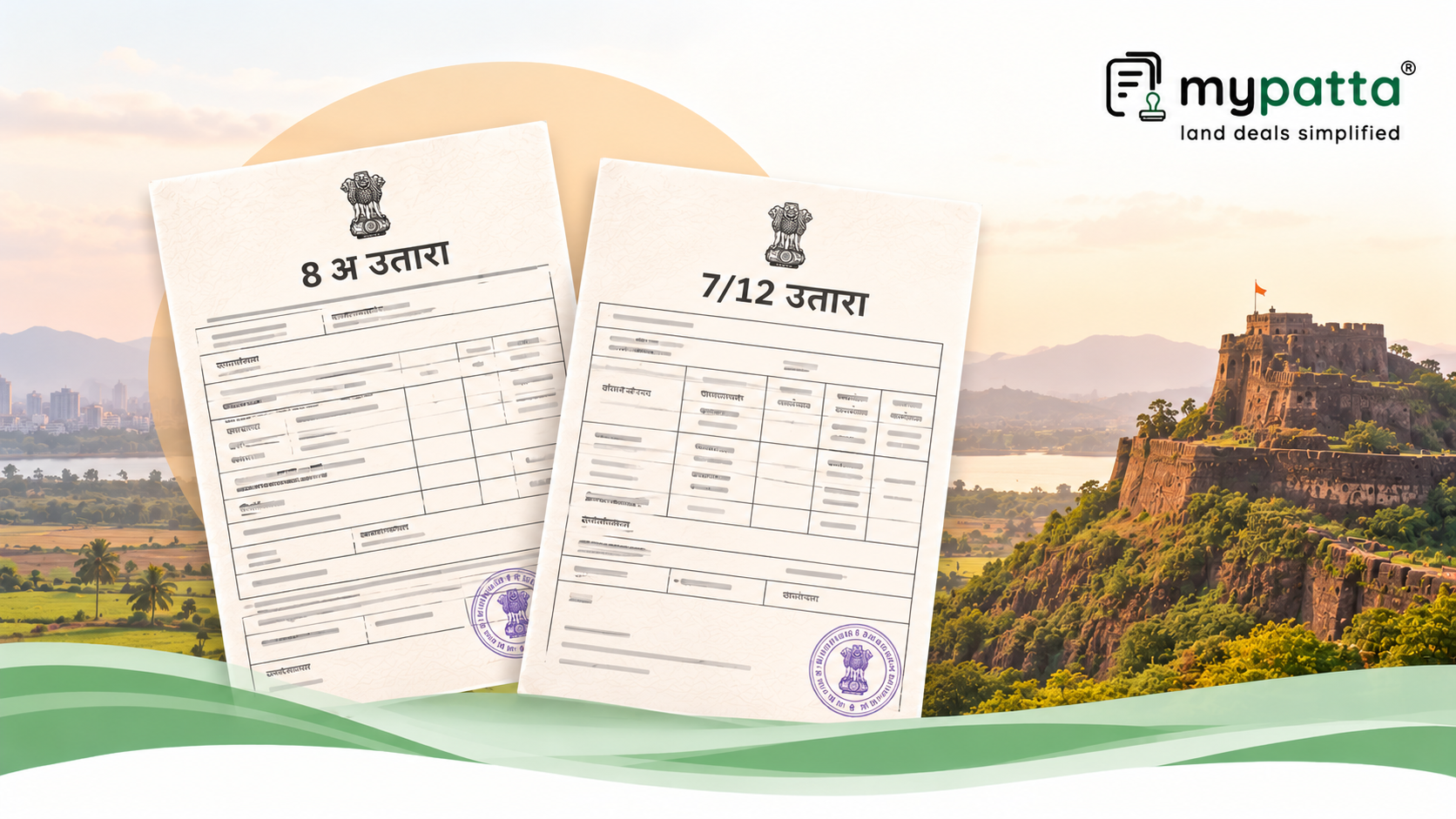
How to Download 8A Extract and 7/12 in Maharashtra
You can get the 8A Extract and 7/12 online easily via mypatta without visiting the concerned office.
- Open mypatta and log in or sign up if needed.
- Go to property documents, ensure “Maharashtra” is selected as the state, then tap the “8A Extract” or “7/12 Satbara” icon.
- Enter required information.
- Tap “Search”.
- Once the document is available to download, tap “View Document”. You can now save or share or download this document in PDF on your device.
What Is Maharashtra 8A Extract?
Village Form 8A is an account-wise land record.
Maharashtra land-record guidance describes Village Form 8A as recording, for every khatedar in a village, the agricultural land held at different locations in that village on a survey-number-wise basis, together with land-revenue and area-related information.
It may contain information relating to:
- khatedar or account-holder name;
- khata number;
- survey numbers connected with that account;
- total land holdings;
- cultivable area;
- non-cultivable area;
- land-revenue particulars; and
- other account-related information.
MyPatta similarly describes the 8A Extract as providing a summary of the total land holdings of a khatedar within a particular village, along with land-revenue details.
Its main advantage is therefore consolidation.
Instead of examining one survey parcel in isolation, the 8A Extract helps identify the different agricultural lands recorded under the same khata within that village.
What Is Maharashtra 7/12 Extract?
The 7/12 Extract, commonly known as Satbara, combines information from Village Forms 7 and 12.
Maharashtra land-record guidance states that Village Form 7 is the Record of Rights, while Village Form 12 contains crop-related information. These complementary records are presented together as the 7/12 Extract.
The 7/12 may contain details such as:
- survey or Gat number;
- holder or occupant name;
- land area;
- nature of rights;
- land type;
- cultivation details;
- crop information; and
- other rights or remarks affecting the parcel.
MyPatta also identifies owner name, survey number, land area, crop details and land type among the key components of Maharashtra Satbara.
The 7/12 is therefore more useful when the buyer wants to investigate a specific parcel of agricultural land.
8A Extract vs 7/12: What Is the Main Difference?
The easiest way to understand the distinction is:
8A follows the landholder or khata.
7/12 follows the land parcel or survey number.
| Record | Primary Focus | Useful For |
|---|
| 8A Extract | Khatedar/account-wise holdings | Checking different lands recorded under one holder within a village |
| 7/12 Extract | Survey/Gat or parcel-wise land details | Checking ownership, area, rights, cultivation and crop details of a particular parcel |
This difference makes the two documents complementary rather than interchangeable.
Which Record Shows Owner-Wise Land Holdings?
The 8A Extract is the more appropriate record where the objective is to understand a person's recorded landholding within a particular village.
Maharashtra guidance also describes the 8A khata as the village record containing all agricultural lands of the relevant farmer or khatedar in that village.
This can help buyers check:
- whether the seller is associated with more than one survey number;
- the khata under which the land is recorded;
- the total land reflected against the holder;
- whether the land being sold forms part of a larger recorded holding; and
- whether the area claimed by the seller is consistent with the account-wise record.
However, 8A should not be treated as an independent title deed.
Which Record Should You Check for a Particular Survey Number?
For a particular survey or Gat number, the 7/12 Extract is generally more informative.
It allows the buyer to focus on the specific agricultural parcel being purchased and examine its:
- recorded holder;
- area;
- survey particulars;
- land type;
- cultivation information;
- crop details; and
- other recorded rights.
The 7/12 should then be compared with the registered title deed and mutation history to determine whether the parcel description and recorded holder are consistent.
Why Should Buyers Check Both 8A and 7/12?
Checking both records gives two different views of the same landholding position.
The 8A helps answer:
What agricultural land is recorded under this khatedar within the village?
The 7/12 helps answer:
What does the land record say about this particular survey or Gat number?
Using both can help identify:
- owner-name inconsistencies;
- area mismatches;
- missing survey numbers;
- changes in khata details;
- subdivision issues; and
- discrepancies between account-wise and parcel-wise records.
A discrepancy should be investigated rather than ignored.
Does 8A Carry More Weight Than 7/12?
Not simply because it consolidates land holdings.
Each record performs a different function.
The 8A is particularly useful for understanding the account-wise holding and revenue position, while the 7/12 provides more detailed information about the specific parcel and its agricultural use.
Neither should be considered a substitute for the other where comprehensive land due diligence is required.
More importantly, neither revenue record should automatically be treated as conclusive proof of legal ownership.
Can 8A or 7/12 Replace the Sale Deed?
No.
Revenue records can support an ownership claim and show how land is presently recorded, but the underlying legal source of ownership should still be established.
For a purchase, buyers should ordinarily examine:
- registered sale deed or other title document;
- previous link deeds;
- Index II;
- Ferfar or mutation records;
- 8A Extract;
- 7/12 Extract;
- Search Report or relevant encumbrance checks; and
- survey or boundary records where necessary.
The title documents explain how rights were acquired.
The 8A and 7/12 help determine how those rights and land particulars are reflected in the revenue records.
What Should You Match Between 8A and 7/12?
Before buying agricultural land, compare the records for consistency in:
Holder Name
The person recorded against the relevant holding should correspond with the title and mutation history.
Khata Details
Check whether the khata number and holder information connect properly with the relevant parcel.
Survey or Gat Number
The survey number being purchased should appear consistently across the relevant records.
Area
Check whether the area reflected in 8A corresponds with the individual parcel information appearing in the 7/12.
Mutation History
Where ownership has changed, the Ferfar records should explain how the present entries arose.
A mismatch does not automatically invalidate the title, but the documentary reason for the difference should be established before purchase.
Which Record Should Buyers Finally Rely On?
For owner-wise landholding verification, start with the 8A Extract.
For parcel-specific verification, examine the 7/12 Extract.
For complete property due diligence, use them together and cross-check both against the registered title and mutation records.
The strongest verification comes from consistency between the:
- registered title documents;
- Ferfar history;
- 8A account-wise holding;
- 7/12 parcel details; and
- survey and property identity records.
Why mypatta?
- Trusted by 7 Lakh+ Customers
- 1 Crore+ Documents Delivered
- mypatta Guarantee – guaranteed delivery or 100% refund
- 4.8 Star App Rating
- 1. Which Maharashtra record shows owner-wise land holdings?+
The 8A Extract is more useful because it consolidates agricultural land recorded under a khatedar within a particular village.
- 2. What is the main difference between 8A and 7/12?+
8A is primarily account or holder-wise, while 7/12 is primarily survey or parcel-wise and also contains cultivation and crop information.
- 3. Should I check both 8A and 7/12 before buying agricultural land?+
Yes. Together they help verify both the owner's wider recorded holding and the particulars of the specific parcel being purchased.
Shivangi
Real Estate Content Writer
Shivangi is a real estate content writer with 3+ years of experience helping readers understand property documentation, land records, and legal requirements through clear and actionable content.