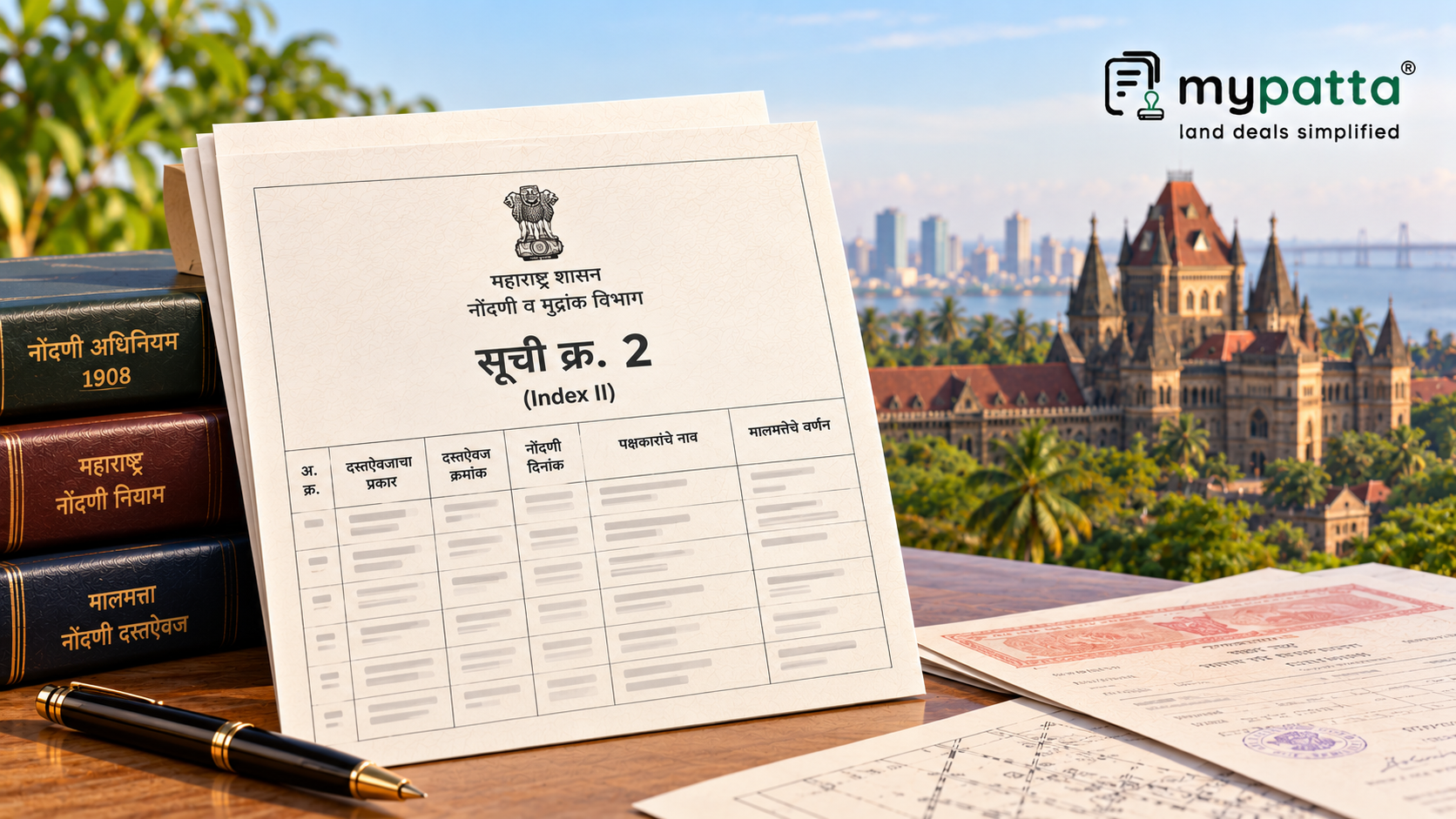
How to Download Index II in Maharashtra
You can get the Index II online easily via mypatta without visiting the Sub-Registrar office.
- Open mypatta and log in or sign up if needed.
- Go to property documents, ensure “Maharashtra” is selected as the state, then tap the “Index 2” icon.
- Enter required information.
- Tap “Search”.
- Once Index II is available to download, tap “View Document”. You can now save or share or download this document in PDF on your device.
Why Is Index II Useful for Lawyers Conducting Title Due Diligence?
A title file may contain several registered transactions spread across many years.
Reading each document separately without first organising the registration history can make it difficult to identify:
- missing ownership links;
- repeated transfers;
- mortgages;
- releases;
- partitions;
- gifts;
- cancellations;
- rectification documents; and
- changes in property identifiers.
Index II provides a structured summary of the registered transaction. It can contain particulars such as the parties, document number, registration year, property description and recorded consideration.
For a lawyer, its real value is therefore not simply proving that one document was registered. It is building an initial transaction map that determines what needs deeper examination.
Step 1: Decide the Period of the Title Search
Before building the timeline, determine how far back the review needs to go.
The appropriate period should depend upon:
- age of the property;
- available root-of-title document;
- seller's existing title papers;
- earlier ownership history;
- lender or client requirements; and
- gaps identified during initial document review.
A fixed number of years should not be applied mechanically if the title relied upon begins earlier.
The timeline should ideally start from a sufficiently reliable earlier ownership document and continue without unexplained breaks to the proposed transaction.
Step 2: Create a Standard Index II Timeline
Do not maintain Index II records as unrelated PDFs.
Extract the same core information from every relevant entry and place it into one chronology.
| Timeline Field | What the Lawyer Should Record |
|---|
| Date / Year | Registration chronology |
| Document Number | Identifier for retrieving the underlying deed |
| Document Type | Sale, gift, mortgage, partition, release, etc. |
| Transferor / Executant | Person creating or transferring the right |
| Transferee / Claimant | Person receiving the right |
| Property Identifier | Survey, Gat, CTS, Hissa, plot or flat details |
| Area / Share | Extent or interest reflected in the entry |
| Consideration | Recorded transaction value where applicable |
| Follow-Up Required | Certified Copy, mutation check, mortgage release, clarification, etc. |
This converts a collection of Index II records into a working title-analysis tool.
Step 3: Separate Ownership Changes From Other Transactions
Not every registered document changes ownership in the same way.
Lawyers should classify entries into categories.
Ownership-Changing Transactions
These may include:
- sale;
- conveyance;
- gift;
- settlement;
- partition;
- release of ownership rights; and
- other transfers affecting proprietary interests.
These documents form the principal ownership chain.
Encumbrance-Related Transactions
These may include:
- mortgage;
- charge;
- release of mortgage;
- reconveyance; and
- other registered security-related instruments.
These should be tracked separately because an owner may continue to hold title while the property remains financially encumbered.
Corrective or Subsequent Documents
These may include:
- rectification deeds;
- supplemental deeds;
- cancellations; and
- other documents modifying an earlier registered transaction.
They should be linked directly to the original document they affect.
Step 4: Track the Parties Across the Entire Period
The timeline should establish continuity between the person acquiring rights and the person subsequently transferring them.
Review:
- full names;
- initials;
- spelling variations;
- company or entity names;
- family relationships where relevant; and
- capacity in which the person executed the document.
A name appearing repeatedly does not itself establish continuity if the property, share or legal capacity differs.
Where the ownership changes without a registered instrument appearing in the timeline, determine whether the change resulted from succession, court proceedings or another legally recognised event requiring separate documentation.
Step 5: Track Property Identifiers Across Years
A multi-year search becomes unreliable if the lawyer traces only names and ignores property identifiers.
Record and compare:
- Survey Number;
- Gat Number;
- CTS Number;
- Hissa Number;
- subdivision;
- plot number;
- flat number;
- area;
- village or locality; and
- other identifying particulars.
MyPatta's current Maharashtra Index II guidance specifically recommends tracing historical property identifiers where the property description has changed over time.
Where an older number changes into a new subdivision or CTS reference, the title file should contain records explaining that transition.
Step 6: Identify Gaps in the Timeline
Once the transactions are placed chronologically, check whether every material change can be explained.
Important gaps include:
- ownership moving between persons without a supporting document;
- a seller transferring a larger share than the timeline shows they acquired;
- unexplained changes in survey or CTS details;
- mortgage appearing without corresponding release;
- cancellation without review of the affected document;
- missing registration year;
- inconsistent property areas; or
- a later transfer apparently overlapping with an earlier transaction.
The purpose of the timeline is to make these issues visually apparent before a title opinion is finalised.
Step 7: Retrieve the Full Deed for Material Transactions
Index II should not replace deed review.
It is a summary record. The complete deed may contain matters that cannot be fully understood from the Index II, including:
- detailed property schedule;
- recitals of earlier title;
- precise ownership share;
- covenants;
- easements;
- reserved rights;
- conditions;
- boundaries; and
- rights retained by another party.
Where a transaction materially affects title, retrieve the relevant Maharashtra Certified Copy.
A lawyer should use Index II to determine which registered documents need to be read in full, not as a substitute for those documents.
Step 8: Cross-Check the Timeline With Mutation Records
Registered transactions and revenue mutations should tell a consistent story.
For rural land, review relevant:
- Ferfar entries;
- 7/12 Extract;
- 8A Extract; and
- subdivision records.
For applicable urban property, compare the timeline with:
- Property Card;
- mutation entries; and
- relevant city-survey particulars.
The mutation history may help explain changes in holder name, share or property description that are not immediately clear from Index II alone.
Step 9: Run a Separate Encumbrance Review
A transaction timeline focused only on ownership transfers is incomplete.
Cross-check the property against:
- Search Report;
- available mortgage records;
- CERSAI information where relevant;
- mortgage release documents; and
- other registered encumbrances.
MyPatta's Maharashtra Encumbrance Check Report combines records such as the Search Report, Title Deed, Index II, Ferfar, 7/12 or Property Card and mortgage-related checks for this broader review. (mypatta.in)
The lawyer should therefore maintain both an ownership timeline and an encumbrance timeline before reaching a title conclusion.
Step 10: Update the Timeline Close to the Transaction Date
A historical title review can become outdated if a new transaction is registered after the search was completed.
Before finalising the legal opinion or completing the transaction, confirm that the search remains current.
The closing review should determine whether:
- a later sale has appeared;
- a fresh mortgage has been created;
- a release has been registered;
- a mutation has changed;
- a corrective document has been executed; or
- another transaction affects the proposed purchase.
The final timeline should clearly state the period up to which the registration history has been reviewed.
What Should a Lawyer Flag in the Final Due-Diligence Note?
The Index II timeline should ultimately identify:
- root of title relied upon;
- sequence of ownership transfers;
- missing link documents;
- material property-description changes;
- mortgages and releases;
- partition or release affecting shares;
- cancellations and rectifications;
- mutation inconsistencies;
- documents requiring Certified Copies; and
- issues requiring further legal clarification.
The timeline itself is not the legal opinion.
It is the structured factual foundation on which the lawyer can conduct the deeper title analysis.
Why mypatta?
- Trusted by 7 Lakh+ Customers
- 1 Crore+ Documents Delivered
- mypatta Guarantee – guaranteed delivery or 100% refund
- 4.8 Star App Rating
- 1. Can lawyers conduct Maharashtra title due diligence using Index II alone?+
No. Index II helps trace registered transactions, but material deeds, mutation records and other title documents must also be examined.
- 2. How should multiple Index II records be organised?+
Arrange them chronologically and record the document number, parties, transaction type, property identifier, area and required follow-up.
- 3. What should a lawyer do when one ownership link is missing from the timeline?+
Investigate the missing period and identify whether a registered deed, succession document, court record or another title document explains the change.
- 4. Should mortgage entries be included in the Index II timeline?+
Yes. Mortgage and release transactions should be tracked alongside ownership changes because they can materially affect the property.
Shivangi
Real Estate Content Writer
Shivangi is a real estate content writer with 3+ years of experience helping readers understand property documentation, land records, and legal requirements through clear and actionable content.