
Passbook Corrections cannot independently be used as ownership proof in Telangana. An approved correction may show that the Revenue Department has updated details such as the pattadar’s name, survey particulars, extent or land classification in the Pattadar Passbook and Bhu Bharati records. However, the correction does not itself create or transfer ownership. Title must still be established through a registered sale deed, gift deed, partition deed, succession documents, court order, government grant or another legally valid source of ownership.
Can Passbook Corrections Be Used as Ownership Proof in Telangana?
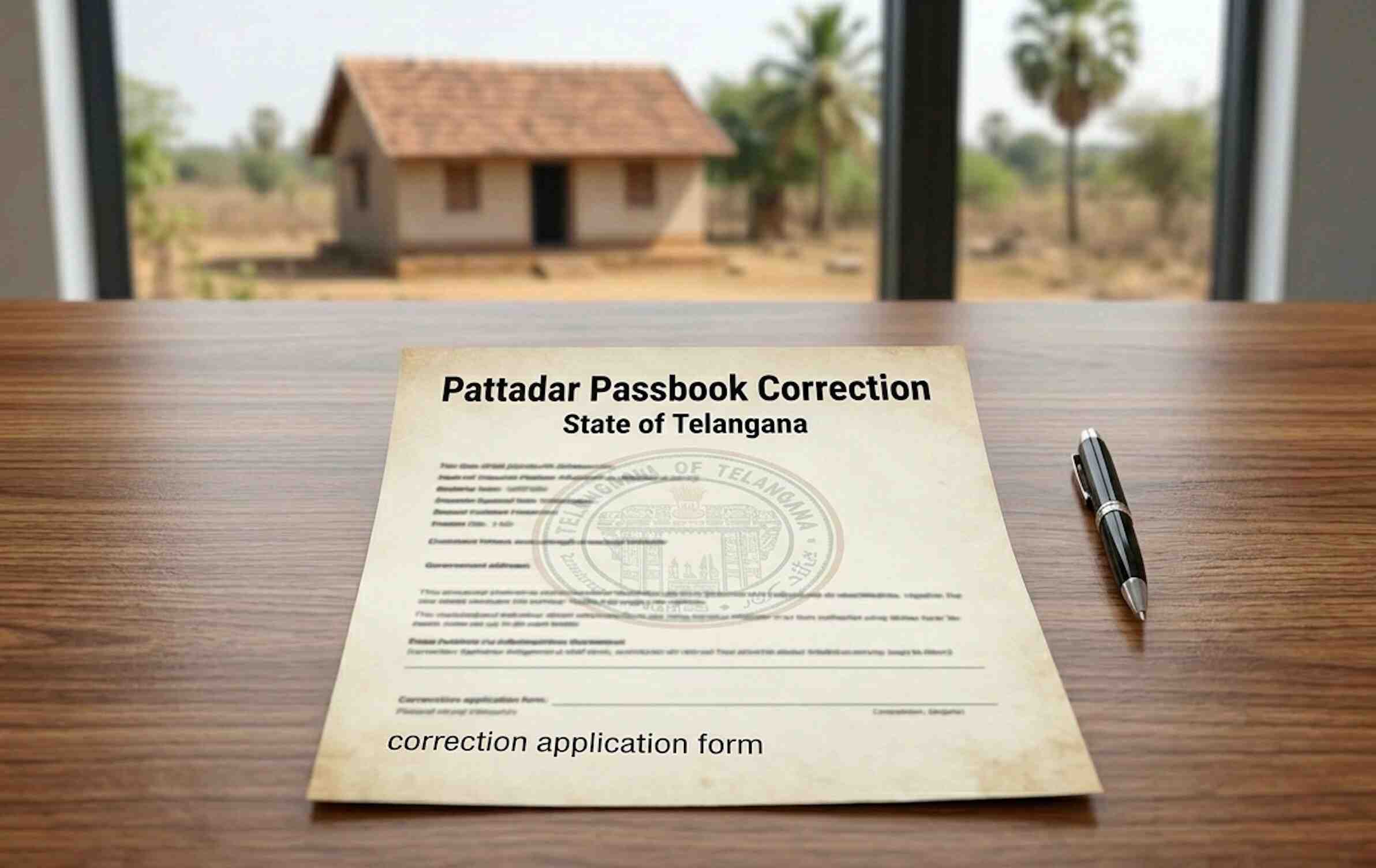
You can get the Passbook Corrections easily via mypatta without visiting the Sub-Registrar office.
- Open mypatta and log in or sign up if needed.
- Go to property documents, ensure “Telangana” is selected as the state, then tap the “Passbook Corrections” icon.
- Enter required information.
- Tap “Search”
- Once Passbook Corrections is available to download, tap “View Document”. You can now save or share or download this document in PDF on your device.
What Does Ownership Proof Mean in a Land Transaction?
Ownership proof means evidence showing how a person legally acquired rights over a particular land parcel and whether those rights continue to remain with that person.
Different property documents serve different purposes. A registered sale deed records a transfer of rights. A partition deed divides jointly held property. Succession documents explain how land passed after the death of an owner. Revenue records, including the Pattadar Passbook, generally record land particulars for administration and revenue purposes.
A reliable ownership claim should establish:
- the original or earlier source of title;
- every transfer leading to the present owner;
- the seller’s legal authority to deal with the land;
- the exact survey number, sub-division and extent; and
- the absence of later transfers or competing claims.
A corrected entry may make the revenue record more accurate, but it does not explain the entire ownership history. For example, correcting a spelling mistake in the pattadar’s name does not prove how that person acquired the land. Similarly, correcting the extent does not establish that the corrected extent was validly transferred through a title document.
Passbook correction is therefore part of record accuracy, while ownership proof depends on the legal source and continuity of title.
Where Do Passbook Corrections Fit in the Ownership Evidence Chain?
Passbook Corrections fit into the ownership evidence chain as a process for updating or rectifying revenue-record particulars.
Corrections may be required where Bhu Bharati or the Pattadar Passbook contains an error relating to:
- the pattadar’s name or spelling;
- survey or sub-division details;
- extent of land;
- land nature or classification;
- manner in which the land was acquired;
- land type;
- khata-related information; or
- another revenue-record particular.
After an application is examined and approved, the corrected information may appear in the relevant land records or updated passbook. This can be important because inaccurate entries may create confusion during registration, mutation, financing or future transfer.
However, a correction proceeding does not ordinarily involve a final determination of every possible title dispute. The authority may verify the documents relevant to the requested correction, but that does not necessarily establish that the applicant has an undisputed and marketable title against all other persons.
Passbook Corrections therefore help align revenue records with supporting documents. They do not replace the documents from which ownership legally originates.
What Can Passbook Corrections Legally Establish?
An approved Passbook Correction may establish that the competent revenue authority examined a particular discrepancy and allowed the corresponding revenue entry to be updated.
Depending on the correction, it may support the following facts:
- the pattadar’s name has been corrected in the revenue record;
- the recorded extent has been updated after verification;
- the land nature or classification has been modified;
- the manner of acquisition has been corrected;
- the survey or khata particulars have been rectified; or
- the corrected details are now reflected in Bhu Bharati and the Pattadar Passbook.
The correction may be useful where an otherwise valid title document contains details that were inaccurately entered in the digital revenue record. For example, if a registered deed correctly identifies the purchaser but the passbook contains a spelling error, an approved correction can align the revenue record with the deed.
Similarly, if an officially recognised survey or acquisition proceeding changes the extent, the corrected passbook may reflect the updated position.
Its evidentiary value is stronger when the corrected details match:
- the registered title deed;
- mutation proceedings;
- survey and sub-division records;
- the current ROR;
- Encumbrance Certificate details; and
- the physical land parcel.
In such cases, the correction supports consistency between the legal documents and the revenue record.
What Can Passbook Corrections Not Establish?
Passbook Corrections cannot, by themselves, establish a complete and legally valid title.
They do not automatically prove:
- how the applicant originally acquired the land;
- whether the transferor had valid ownership;
- whether all co-owners or legal heirs consented;
- whether a sale, gift, partition or succession was legally effective;
- whether the property was later transferred or mortgaged;
- whether litigation or an unregistered family claim exists;
- whether the applicant owns the entire corrected extent;
- whether the land is physically in the applicant’s possession; or
- whether the title is free from fraud, forgery or competing claims.
For example, a person may obtain correction of their name in the passbook on the basis of documents placed before the authority. If another legal heir later establishes a valid share in the property, the corrected entry cannot extinguish that heir’s rights merely because the passbook shows only one name.
Likewise, correcting land classification does not prove ownership. It only changes the way the land is described in the revenue record. The applicant must separately establish the legal source of title.
An approved correction also cannot validate an invalid deed. If the person who transferred the land lacked ownership or authority, correcting the purchaser’s passbook entry will not cure the underlying defect.
When Can Passbook Corrections Strengthen an Ownership Claim?
Passbook Corrections can strengthen an ownership claim when they remove genuine clerical or record-based discrepancies and make the revenue record consistent with valid title documents.
Their evidentiary value is stronger when:
- the correction is based on a registered deed or valid succession document;
- the corrected name matches the title holder’s identity;
- the extent matches the deed and official survey records;
- the survey and sub-division details are consistent;
- mutation followed a legally valid transfer;
- the current ROR and Pattadar Passbook show the same particulars;
- the Encumbrance Certificate does not reveal a conflicting transfer; and
- no court order or government restriction contradicts the correction.
Consider a purchaser whose registered sale deed correctly records the name, survey number and extent, but whose passbook contains a typographical error in the surname. After verification, the name is corrected in Bhu Bharati. The sale deed, mutation record, ROR, EC and survey details all match. In that situation, the approved correction strengthens the ownership claim by removing inconsistency.
The position is weaker where a person relies only on a corrected passbook but cannot produce the registered deed, inheritance papers or other document through which ownership was acquired.
Which Documents Carry Greater Weight Than Passbook Corrections?
The following documents generally carry greater or more direct weight when legal ownership is being established:
| Document | Role in Ownership Verification |
|---|---|
| Registered Sale Deed | Records the transaction through which ownership rights were transferred |
| Mother Deed and Link Documents | Trace title from earlier owners to the present claimant |
| Gift, Partition or Release Deed | Shows transfer, division or relinquishment of property rights |
| Succession and Inheritance Documents | Explain how land passed after an owner’s death |
| Government Grant or Valid Patta | May establish the original source and nature of land rights |
| Court Decree or Order | May declare, divide or determine ownership rights |
| Current ROR and Mutation Records | Support the present revenue-record position |
| Encumbrance Certificate | Helps identify registered transfers, mortgages and charges |
| Survey and Sub-Division Records | Help verify the land’s extent, identity and boundaries |
| Passbook Correction Order | Shows the basis on which a particular revenue entry was corrected |
A correction order and corrected passbook should be read with the document that formed the basis of the correction. The strongest ownership claim arises when the title documents, corrected revenue records, registration history and survey particulars consistently refer to the same owner and land parcel.
Why mypatta?
- Trusted by 7 Lakh+ Customers
- 1 Crore+ Documents Delivered
- mypatta Guarantee – Your money is safe with us. Guaranteed delivery or a 100% amount refund.
- 4.8 Star App Rating
Your money is safe with us - guaranteed delivery or a 100% amount refund
FAQs
- 1. Can an approved Passbook Correction alone prove ownership in Telangana?
No. It may confirm that a revenue entry was corrected after verification, but ownership must be established through valid title documents.
- 2. What legal value does a corrected Pattadar Passbook have?
It supports the current revenue-record position and may confirm corrected details such as name, extent, survey particulars or land classification.
- 3. Does correcting a name in the passbook transfer ownership?
No. A name correction only rectifies the revenue entry. It does not create or transfer ownership rights.
- 4. Can an extent correction prove that the pattadar owns the corrected area?
Not by itself. The corrected extent should also match the title deed, survey records, mutation proceedings and other supporting documents.
- 5. Which documents should be checked with Passbook Corrections?
Check the correction order, registered title deed, Mother Deed, link documents, current ROR, mutation record, Encumbrance Certificate, survey records and succession or partition documents where applicable.