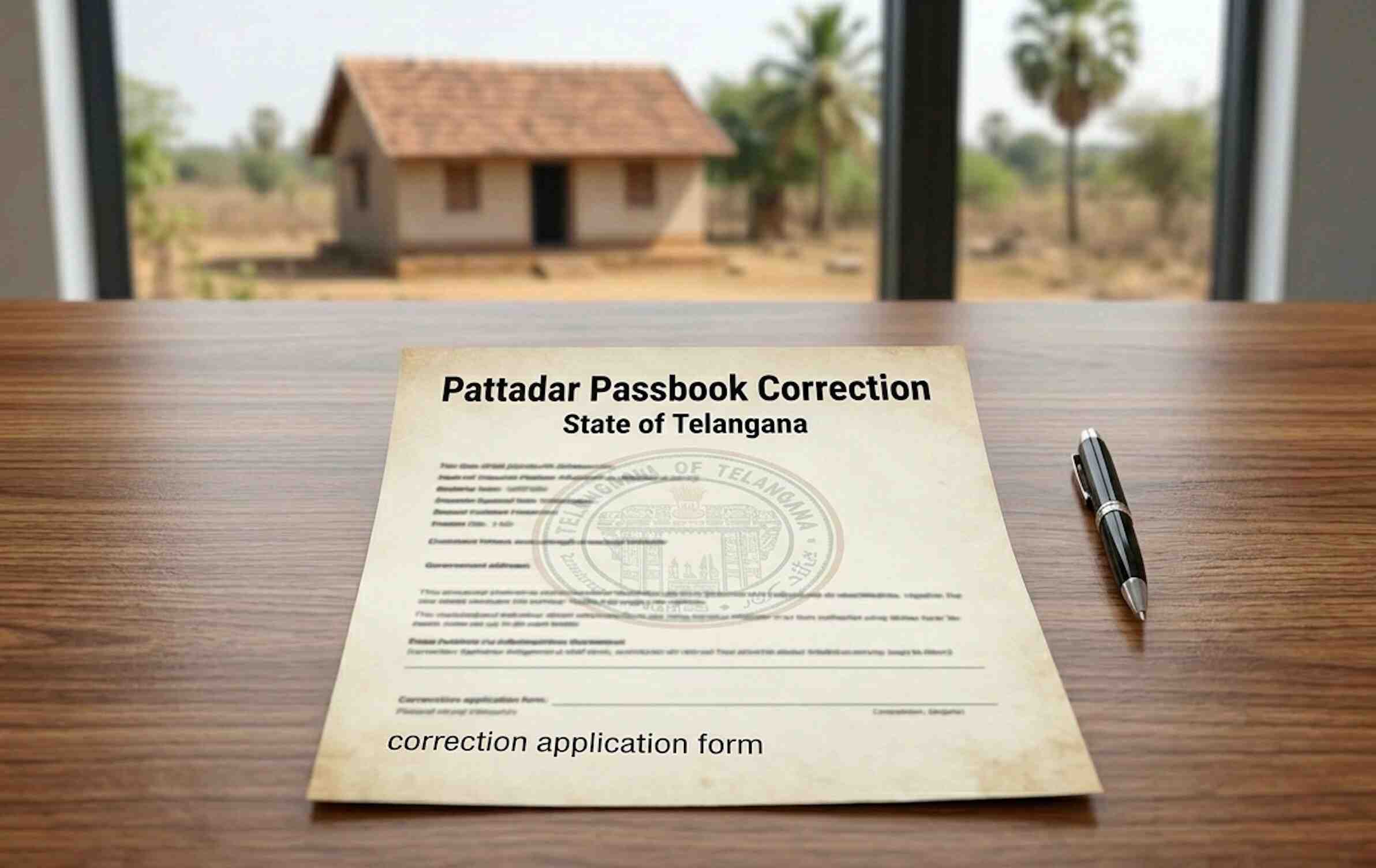
How to get Mutation/ Khata transfer in Telangana
You can get the Passbook Corrections easily via mypatta without visiting the Sub-Registrar office.
- Open mypatta and log in or sign up if needed.
- Go to property documents, ensure “Telangana” is selected as the state, then tap the “Passbook Corrections” icon.
- Enter required information.
- Tap “Search”
- Once Passbook Corrections is available to download, tap “View Document”. You can now save or share or download this document in PDF on your device.
What Are Passbook Corrections in Telangana?
Passbook Corrections in Telangana refer to the process of correcting wrong or incomplete details in the Pattadar Passbook or related land record. A Pattadar Passbook generally reflects important land details such as pattadar name, khata number, survey number, extent and other revenue-record information.
Corrections may be required when there is an error in the name of the landholder, wrong survey number, incorrect extent, mismatch in khata details, wrong land nature, missing entry, duplicate issue or incorrect classification. These errors can happen due to old manual records, data migration, mutation mistakes, survey changes, inheritance updates or clerical mistakes.
For a land buyer, passbook correction is important because the Pattadar Passbook is often shown by the seller as a current land record. If the passbook is wrong, the buyer may face difficulty during registration, mutation, loan processing, boundary verification or future resale.
However, a corrected passbook should still be treated as one part of document verification. It supports the revenue-record side of due diligence, but it does not replace the registered title chain.
Why Should Buyers Check Passbook Corrections Before Buying Land in Telangana?
Buyers should check Passbook Corrections before buying land in Telangana because a wrong passbook entry can create serious confusion about the land being sold. If the seller’s passbook shows incorrect details, the buyer may not know whether the mistake is only clerical or whether it points to a deeper title or survey problem.
For example, if the sale deed shows 2 acres but the passbook shows 1.20 acres, the buyer should not assume it is a small mistake. The difference may be due to acquisition, partition, survey correction, family dispute, earlier sale, mutation issue or incorrect entry. The reason must be verified before purchase.
Similarly, if the seller’s name is not properly reflected in the passbook, the buyer should ask how the seller acquired the land and whether the mutation was completed. If the land came through inheritance, the buyer should check legal heir documents, family settlement, partition documents or court orders where applicable.
Passbook correction is also important where land classification is wrong. If land is shown as assigned, government, prohibited, acquired, ceiling, inam or restricted land, the buyer should verify whether the land is legally transferable.
In simple terms, passbook correction helps buyers answer an important question: “Are the current land record details clean and consistent before I buy this land?”
Can Passbook Corrections Prove Ownership in Telangana?
Passbook Corrections cannot prove ownership in Telangana by themselves. A corrected Pattadar Passbook is an important revenue record, but it should not be treated as the only proof of title.
Ownership is usually verified through legally valid title documents such as registered sale deed, gift deed, partition deed, succession documents, court decree, valid will where applicable, or other recognized title documents. Revenue records such as Pattadar Passbook, ROR, Pahani and mutation entries may support the title claim, but they cannot replace the title chain.
This is important because many buyers rely heavily on the passbook. A seller may say, “My passbook is corrected, so the land is safe.” That statement is not enough. The buyer must still check how the seller acquired the land, whether the link documents are complete, whether the EC is clean, whether there are disputes, and whether the land shown on ground matches the records.
A corrected passbook is useful when it matches the title documents, current Bhu Bharati record, mutation details and survey records. If it does not match, the correction itself needs to be examined carefully.
Documents to Check Along With Passbook Corrections Before Buying Land
Before buying land in Telangana, Passbook Corrections should be checked along with title, revenue, registration and survey documents.
| Document | Why It Matters |
|---|
| Registered Sale Deed | Shows legal transfer of ownership |
| Link Documents / Mother Deed | Helps trace the title chain |
| Current Bhu Bharati ROR | Shows present land record details |
| Pattadar Passbook | Helps verify present pattadar and land details |
| Passbook Correction Application / Status | Shows whether correction is pending, approved or rejected |
| Encumbrance Certificate | Shows registered transactions, loans or charges |
| Mutation Record | Shows whether revenue records were updated after transfer |
| Old Pahani / Old ROR | Helps trace older revenue history |
| Tippan / FMB / Village Map | Helps verify survey, extent and boundaries |
| Prohibited Property Check | Helps identify restricted or non-transferable land |
A buyer should compare the corrected passbook details with all these records. If the correction relates to land extent, the buyer should also check survey records. If the correction relates to name, the buyer should verify the title chain and mutation history. If the correction relates to land classification, the buyer should check whether the land is legally transferable.
Practical Due Diligence Checklist Before Buying Land in Telangana
- Before buying land in Telangana, the buyer should first collect the seller’s Pattadar Passbook details and compare them with current Bhu Bharati land details. The buyer should check the district, mandal, village, survey number, sub-division number, khata number, pattadar name and extent.
- The buyer should then ask whether any passbook correction was ever applied for. If yes, the buyer should check whether the correction was approved, pending or rejected. A pending correction should be treated carefully because the land record may still be uncertain.
- Next, the buyer should identify the type of correction. A spelling correction in name may be less serious than a correction in extent or survey number. A correction in land classification may be more sensitive because it can affect transferability and land use.
- The buyer should also compare passbook details with the title documents. If the sale deed and passbook do not match, the seller should provide a clear explanation supported by documents. If the seller cannot explain the mismatch, the buyer should not proceed blindly.
- The Encumbrance Certificate should be checked separately. A passbook may show the seller’s name, but the EC may reveal registered mortgages, earlier sale deeds, agreements, attachments or other charges.
- Boundary verification is also necessary. If the passbook shows a certain extent, the buyer should verify whether the same extent exists on ground. Tippan, FMB, village map, survey records and physical inspection can help reduce boundary-related risk.
- Before registration, the buyer should ensure that major errors are corrected or properly explained. Buying land with unresolved passbook errors can create problems during mutation, resale, loan approval or future dispute resolution.
Final Advice for Telangana Land Buyers
Passbook Corrections are important before buying land in Telangana because they help identify whether the current Pattadar Passbook details are accurate. A wrong name, survey number, extent, khata number or land classification should not be ignored. Even if the seller says it is a small mistake, the buyer should verify the reason.
At the same time, buyers should remember that a Pattadar Passbook is not the only document for land purchase. A safe buyer should check title, revenue record and boundary together. Title should be checked through sale deed, link documents, succession papers, partition documents or court orders. Revenue record should be checked through Bhu Bharati ROR, Pattadar Passbook, Pahani, mutation and correction records. Boundary should be checked through Tippan, FMB, village map, survey records and physical inspection.
If the passbook correction is approved and all other documents match, the buyer gets better clarity. If the correction is pending, rejected or disputed, the buyer should pause the transaction and verify the issue before payment. In land purchase, unresolved record errors can become expensive problems later.
Why mypatta?
- Trusted by 7 Lakh+ Customers
- 1 Crore+ Documents Delivered
- mypatta Guarantee – Your money is safe with us. Guaranteed delivery or a 100% amount refund.
- 4.8 Star App Rating
Your money is safe with us - guaranteed delivery or a 100% amount refund
FAQ Section
- 1. What are Passbook Corrections in Telangana?+
Passbook Corrections are changes made to wrong or incomplete Pattadar Passbook details, such as name, survey number, extent, khata number or land classification.
- 2. Can a corrected Pattadar Passbook prove ownership?+
No. A corrected Pattadar Passbook is an important revenue record, but ownership should be verified through title documents such as sale deed, link documents and other supporting records.
- 3. Why should buyers check passbook correction status before buying land?+
Buyers should check passbook correction status to know whether the seller’s land record is accurate, pending correction, rejected or disputed.
- 4. What if the passbook shows wrong land extent?+
The buyer should verify the sale deed, survey records, Tippan, FMB, village map and current Bhu Bharati record before proceeding with the purchase.
- 5. Should I buy land if passbook correction is still pending?+
A pending correction should be treated carefully. The buyer should understand the reason for the correction and verify all title, revenue and survey documents before making payment or registration.
Shivangi
Real Estate Content Writer
Shivangi is a real estate content writer with 3+ years of experience helping readers understand property documentation, land records, and legal requirements through clear and actionable content.