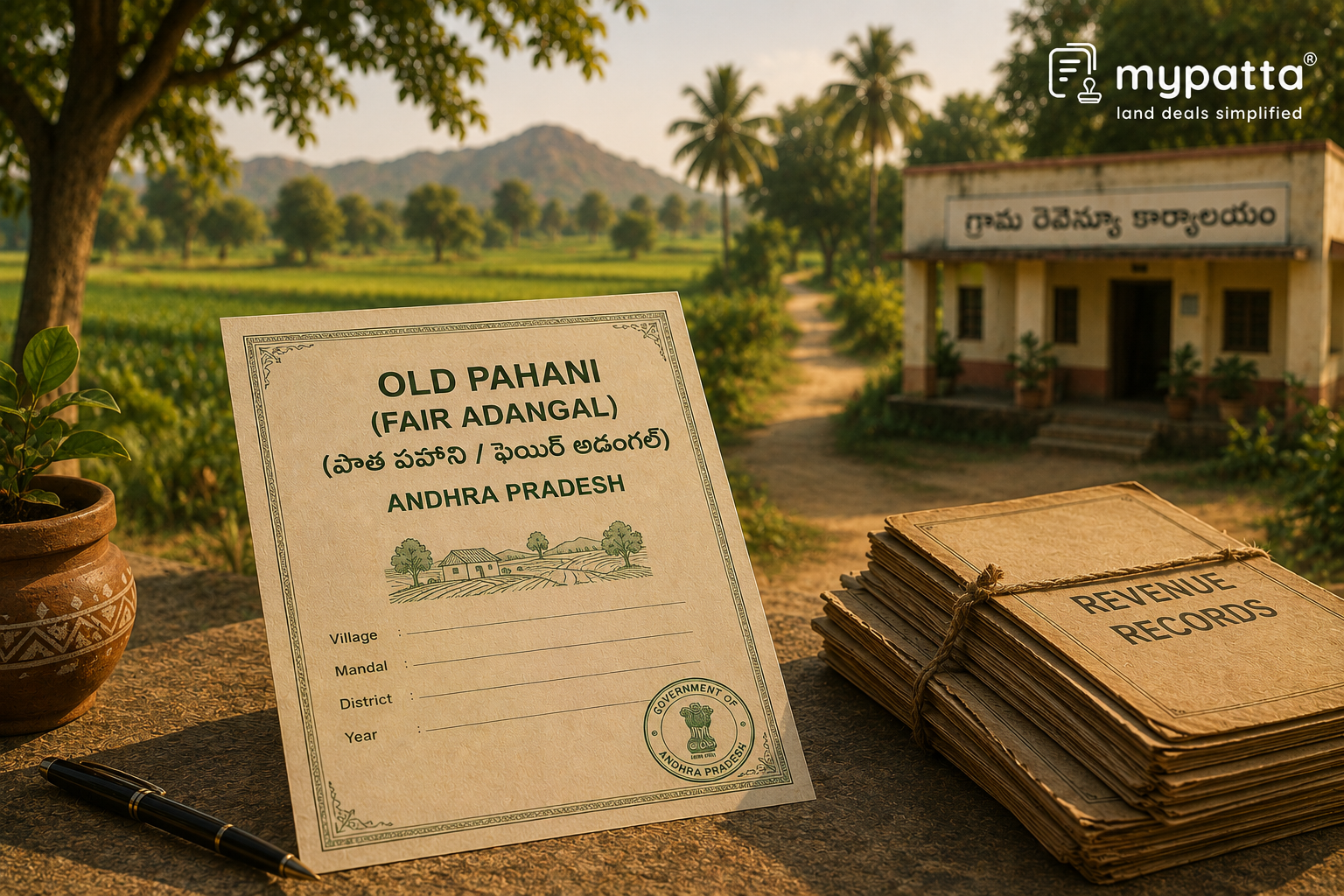
How to get Old Pahani (Fair Adangal) in Andhra Pradesh
You can get the Old ROR online easily via mypatta without visiting the Sub-Registrar office.
- Open mypatta and log in or sign up if needed.
- Go to property documents, ensure “Andhra Pradesh” is selected as the state, then tap the “Old Pahani (Fair Adangal)” icon.
- Enter required information.
- Tap “Search”
- Once the Old Pahani (Fair Adangal) is available to download, tap “View Document”.
What Does Ownership Proof Mean in a Land Transaction?
Ownership proof means evidence showing how a person legally acquired rights over a specific property and whether those rights continue to remain with that person.
A document may contain a person’s name or land details without being a title document. Different property records perform different functions:
- A registered sale deed records the transfer of property rights.
- A Mother Deed and link documents trace the earlier ownership chain.
- A partition or release deed records the division or relinquishment of rights.
- Succession documents explain how land passed after an owner’s death.
- Revenue records show how land is entered for administrative purposes.
- Survey records help identify the location, extent and boundaries of the property.
A complete ownership claim should therefore explain who held the land earlier, how it passed to the present claimant and whether any later transfer, mortgage, government restriction or competing claim affects it.
The identity of the property must also remain consistent. The village, survey number, sub-division, khata details, extent and boundaries appearing in the title documents should correspond with the current land and survey records.
Old Pahani or Fair Adangal helps verify the historical revenue-record and cultivation-related position of agricultural land. It does not ordinarily explain the complete legal transaction through which ownership was acquired.
Where Does Old Pahani (Fair Adangal) Fit in the Ownership Evidence Chain?
Old Pahani or Fair Adangal fits into the ownership evidence chain as a historical land revenue record.
It is generally associated with agricultural land and may contain information relating to:
- village and survey number;
- land extent;
- khata or revenue-account particulars;
- land nature or classification;
- pattadar, occupant or enjoyment-related entries;
- cultivator details;
- crop and cultivation information;
- irrigation or land-use particulars; and
- other remarks concerning the land.
Its primary value is that it helps trace how a particular land parcel was recorded in earlier revenue records before later digitisation, mutation, subdivision, correction or transfer.
For example, if a seller claims that agricultural land belonged to their family for several decades, Old Pahani or Fair Adangal may help show whether the seller’s predecessor was historically recorded against the relevant survey number.
However, Old Pahani or Fair Adangal is not normally the instrument through which land is sold, gifted, partitioned or inherited. It records the revenue and cultivation-related position of the land at a particular point in time.
Old Pahani or Fair Adangal should therefore be viewed as a supporting historical link between title documents and present land records, rather than the legal source of ownership itself.
What Can Old Pahani (Fair Adangal) Legally Establish?
Old Pahani or Fair Adangal can establish or support several factual matters concerning the history, identity and revenue-record status of land.
Depending on the record, it may help show:
- that a particular name was historically entered against the land;
- that the land was associated with a specified survey number;
- the extent recorded during the relevant period;
- the nature or classification of the land;
- possession, enjoyment or cultivation-related particulars;
- crop or agricultural-use information;
- continuity or change in revenue entries over time; and
- the possible connection between an earlier recorded landholder and the present claimant.
For example, where the current owner claims title through inheritance from a parent or grandparent, Old Pahani or Fair Adangal may support the historical link if the ancestor’s name appears in the old record.
It may also help where present land records show a new survey number, sub-division or khata entry. The old record can be compared with mutation proceedings, current ROR-1B, AP Adangal, FMB and LP Map to determine whether the old and present land parcels correspond.
Its evidentiary value becomes stronger when it matches:
- the registered title deed;
- Mother Deed and link documents;
- current ROR-1B;
- AP Adangal;
- mutation records;
- Pattadar Passbook;
- Encumbrance Certificate;
- FMB or LP Map; and
- physical possession of the property.
Old Pahani or Fair Adangal can therefore support the factual and historical side of an ownership claim. Its value depends on whether the underlying title documents point to the same person and property.
What Can Old Pahani (Fair Adangal) Not Establish?
Old Pahani or Fair Adangal cannot independently establish that the person named in it has a complete, valid and marketable title.
By itself, it cannot conclusively prove:
- how the person acquired ownership;
- whether the earlier owner had valid and transferable title;
- whether a sale, gift, partition or inheritance was legally effective;
- whether all legal heirs or co-owners transferred their shares;
- whether the land was later sold, mortgaged or attached;
- whether an unregistered family dispute exists;
- whether a court case affects the land;
- whether the entire recorded extent remains available with the seller; or
- whether the property is free from government restrictions.
A person may appear in Old Pahani or Fair Adangal as a pattadar, cultivator, occupant or person in enjoyment without having a complete title chain. Similarly, a genuine purchaser may hold a valid registered deed even though an old revenue record continues to show an earlier owner’s name.
Old Pahani or Fair Adangal also cannot cure an invalid transaction. If a person who had no title executed a sale deed, the existence of an old revenue entry would not automatically make the sale legally valid.
The record may also become outdated. The land may later have been partitioned, acquired, subdivided, converted, mortgaged, transferred or affected by government restrictions.
Old Pahani or Fair Adangal should not be used as a substitute for examining the registered deeds and the legal source of the seller’s rights.
When Can Old Pahani (Fair Adangal) Strengthen an Ownership Claim?
Old Pahani or Fair Adangal can significantly strengthen an ownership claim when it forms part of a clear and consistent documentary chain.
Its value is stronger when:
- the old recorded landholder is connected to the present owner through valid documents;
- the survey number and extent match the registered title deed;
- changes in survey number, sub-division or khata are officially explained;
- mutation followed a valid registered transfer or succession;
- current ROR-1B and AP Adangal show consistent particulars;
- the Pattadar Passbook supports the same landholder details;
- the Encumbrance Certificate reveals no conflicting later transaction;
- FMB, LP Map and village records identify the same land;
- physical possession matches the records; and
- no court order or prohibited-property entry contradicts the claim.
For example, Old Pahani or Fair Adangal shows land in the name of a person’s grandfather. After his death, succession documents identify the legal heirs, a registered partition deed gives the relevant land to the seller’s parent, and a later registered deed transfers it to the seller. Current ROR-1B, AP Adangal, mutation records and survey records carry matching details. In that situation, Old Pahani or Fair Adangal strengthens the title by supporting the historical continuity of the land record.
The position is weaker where the seller relies only on Old Pahani or Fair Adangal carrying an ancestor’s name but cannot produce documents showing inheritance, partition or later transfer.
Which Documents Carry Greater Weight Than Old Pahani (Fair Adangal)?
The following documents generally carry greater or more direct weight when legal ownership is being established:
| Document | Role in Ownership Verification |
|---|
| Registered Sale Deed | Records the legal transaction through which property rights were transferred |
| Mother Deed and Link Documents | Trace ownership from earlier holders to the present claimant |
| Gift, Partition, Settlement or Release Deed | Shows transfer, division or relinquishment of rights |
| Succession and Inheritance Documents | Explain how land passed after an owner’s death |
| Government Grant or Valid Patta | May establish the original source and nature of land rights |
| Court Decree or Order | May declare, divide or determine ownership rights |
| Current ROR-1B and Mutation Records | Support the present revenue-account position |
| AP Adangal | Supports current land use, cultivation, recorded name and revenue-record details |
| Encumbrance Certificate | Helps identify registered transfers, mortgages and charges |
| FMB, LP Map and Survey Records | Help verify the land’s identity, measurements and boundaries |
| Prohibited-Property Records | Help determine whether the land can legally be transferred |
These records perform different functions. A registered deed may establish transfer, while Old Pahani or Fair Adangal supports the historical revenue-record position. Current ROR-1B and mutation records show present administrative entries, while survey documents help identify the land physically.
The strongest ownership claim arises when the title documents, Old Pahani or Fair Adangal, AP Adangal, current ROR-1B, registration history and survey records consistently refer to the same owner and land parcel.
Why mypatta?
- Trusted by 7 Lakh+ Customers
- 1 Crore+ Documents Delivered
- mypatta Guarantee – Your money is safe with us. Guaranteed delivery or a 100% amount refund.
- 4.8 Star App Rating
Your money is safe with us - guaranteed delivery or a 100% amount refund
FAQs
- 1. Is Old Pahani the same as Fair Adangal in Andhra Pradesh?+
Old Pahani and Fair Adangal are often used to refer to older agricultural land revenue records. The exact format may depend on the period, village records and issuing authority.
- 2. Is Old Pahani useful if current AP Adangal is available?+
Yes. Current AP Adangal shows the present revenue position, while Old Pahani or Fair Adangal may help trace historical entries and earlier landholder details.
- 3. Can Old Pahani help in ancestral land verification?+
Yes. It may support an ancestral ownership claim if the old recorded name is properly connected to the present claimant through succession, partition or other valid documents
- 4. What if Old Pahani and current ROR-1B show different names?+
The title chain, mutation history, succession records, registered transfers and correction proceedings should be checked before relying on either entry.
- 5. Which documents should be checked with Old Pahani or Fair Adangal?+
Check the registered sale deed, Mother Deed, link documents, current ROR-1B, AP Adangal, mutation record, Pattadar Passbook, Encumbrance Certificate, FMB, LP Map and prohibited-property status.
Shivangi
Real Estate Content Writer
Shivangi is a real estate content writer with 3+ years of experience helping readers understand property documentation, land records, and legal requirements through clear and actionable content.