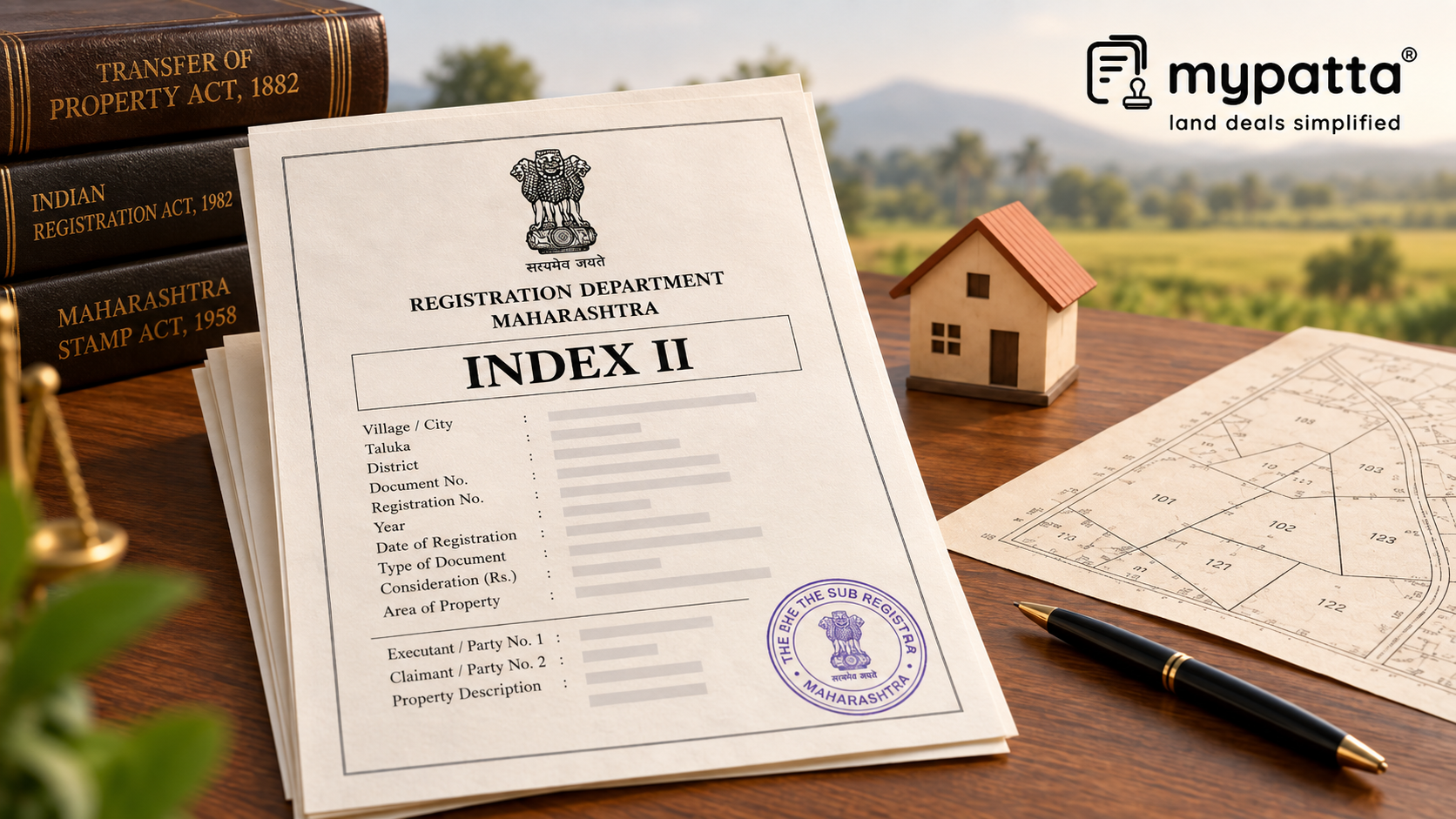
You can get the Maharashtra Index 2 for Lawyers online easily via mypatta without visiting the Sub-Registrar office.
- Open mypatta and log in or sign up if needed.
- Go to property documents, ensure “Maharashtra” is selected as the state, then tap the “Maharashtra Index 2 for Lawyers” icon.
- Enter required information.
- Tap “Search”
- Once Maharashtra Index 2 for Lawyers is available to download, tap “View Document”. You can now save or share or download this document in PDF on your device.
What Does a Multi-Year Index II History Actually Establish?
Index II is part of the statutory indexing system for registered documents. It records prescribed particulars relating to registered transactions involving immovable property.
MH Index 2 Lawyers becomes useful because it collects these records over a longer period. Depending on the available entries, it can help establish:
- names of parties to registered transactions;
- nature of the registered document;
- registration date and document number;
- property description;
- consideration or market value particulars; and
- a sequence of transactions involving the same property.
This can provide documentary support for the registration history behind an ownership claim.
If a claimant says that their family purchased the property through successive registered transfers, a multi-year Index II history can help test whether those transactions actually appear in the registration record.
Why Is a Registration History Different From Proof of Title?
A transaction appearing in Index II proves an important fact: a document relating to that transaction was registered.
It does not automatically prove that the person transferring the property had a perfect legal title.
For example, the Index II history may show:
A → B → C → D
That sequence can strongly support the registered transaction history leading to D. However, if A never legally owned the property, the later sequence does not automatically cure the original title defect.
The Supreme Court has reaffirmed that registration creates a public record of property transactions but does not provide guaranteed or conclusive ownership. A registered document can transfer only the rights that the person executing it actually possesses.
MH Index 2 Lawyers should therefore be treated as evidence of the registered chain, not as certification that every link in that chain is legally valid.
When Does MH Index 2 Lawyers Strongly Support Ownership?
Its value becomes much stronger where the multi-year history corresponds with independently valid title documents.
For example, ownership evidence is stronger where:
- each major Index II entry corresponds with a registered deed;
- the parties connect logically from one transaction to the next;
- property identifiers remain traceable throughout the history;
- no later transaction contradicts the present claimant's rights; and
- current land records reflect the result of the documented transfers.
In such a case, the multi-year Index II history provides independent corroboration that the claimed ownership chain is reflected in registration records.
What Ownership Gaps Can the Index II History Reveal?
One of the strongest uses of MH Index 2 Lawyers is identifying breaks in the claimed ownership story.
For example:
| Finding | Why It Matters |
|---|
| Unexpected seller appears | Earlier source of rights requires verification |
| Property is transferred twice | Competing transactions may need examination |
| Only a share is recorded | Claimant may not have acquired the entire property |
| Property description changes | Identity of the parcel must be reconciled |
| Mortgage appears in history | Corresponding transaction and release may need checking |
| Claimed purchase is absent | Underlying transaction details require further verification |
These findings do not themselves decide ownership. They identify where stronger documentary evidence is required.
Why Does the Underlying Registered Deed Still Matter?
Index II contains transaction particulars, while the underlying registered deed contains the complete legal terms of the transfer.
The deed may reveal matters that a short Index II entry cannot fully explain, including:
- whether the entire property or only a share was transferred;
- how the transferor claimed title;
- conditions attached to the transfer;
- detailed property schedules; and
- rights reserved or excluded from the transaction.
Therefore, an important Index II entry should lead back to the corresponding registered deed whenever ownership itself must be established.
Which Records Complete the Ownership Claim?
MH Index 2 Lawyers is strongest when read with the documents performing the other parts of title verification.
Relevant records may include registered sale, gift, partition or release deeds; Mother Deed and link documents; 7/12 extracts for rural land; Property Cards where applicable; Ferfar or mutation records; succession documents; and relevant court orders.
The objective is to establish both the legal source of ownership and a registration history that consistently supports it.
Why I Trust mypatta
- Trusted by 7 Lakh+ Customers
- 1 Crore+ Documents Delivered
- mypatta Guarantee – Your money is safe with us. Guaranteed delivery or a 100% amount refund.
- 4.8 Star App Rating
Frequently Asked Questions
- 1. Can MH Index 2 Lawyers alone prove ownership?+
No. It supports the registered transaction history but should be backed by the underlying title documents.
- 2. Does a continuous Index II chain mean the title is automatically valid?+
No. Each transfer still depends on the transferor having rights capable of being transferred.
- 3. Why is the multi-year version useful for ownership verification?+
It helps reveal whether the claimed chain of registered transactions remains consistent across a longer period.
- 4. What if two Index II entries show competing transfers of the same property?+
The corresponding deeds and surrounding title records should be examined to determine their legal effect.
Shivangi
Real Estate Content Writer
Shivangi is a real estate content writer with 3+ years of experience helping readers understand property documentation, land records, and legal requirements through clear and actionable content.