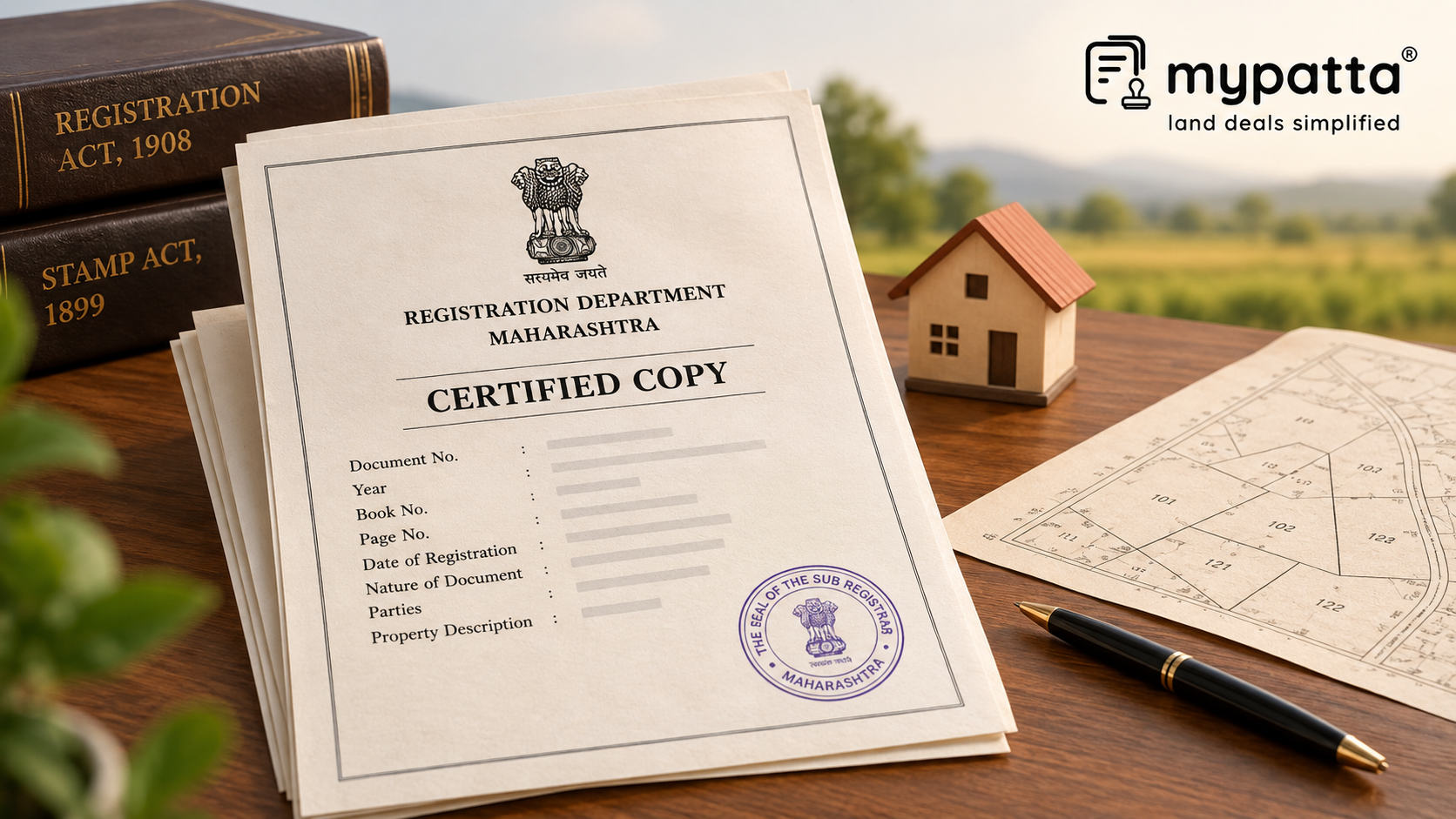
You can get the Maharashtra Certified Copy (MH CC) online easily via mypatta without visiting the Sub-Registrar office.
- Open mypatta and log in or sign up if needed.
- Go to property documents, ensure “Maharashtra” is selected as the state, then tap the “Maharashtra Certified Copy (MH CC)” icon.
- Enter required information.
- Tap “Search”
- Once Maharashtra Certified Copy (MH CC) is available to download, tap “View Document”. You can now save or share or download this document in PDF on your device.
What Evidentiary Status Does MH CC Have?
A Maharashtra Certified Copy has a recognised evidentiary role because it comes from the registration record rather than being an ordinary photocopy supplied by a private person.
Section 57 of the Registration Act, 1908 provides for certified copies of specified registration entries and states that copies issued under the provision are admissible for proving the contents of the original documents.
Maharashtra also specifically provides for certified copies of registered documents, reinforcing their role as official registration records.
Therefore, if ownership is claimed under a registered sale deed, its Certified Copy can provide recognised documentary evidence of what that deed records about the parties, property and transfer.
Does Certification Prove the Transferor's Ownership?
No. This is the most important limitation of MH CC.
A Certified Copy confirms the contents of a registered document. It does not independently establish that every statement concerning ownership in that document was legally correct.
The Supreme Court has clarified that the registration system deals with documents rather than guaranteed titles. A registering authority does not finally determine whether the person executing a deed actually owns the property. A registered instrument transfers only the rights, if any, that its executant possesses.
For example, if A executes a registered deed transferring an entire property to B but A legally owned only a half share, the existence of a certified registered deed cannot enlarge A's rights or automatically give B the remaining half.
Can MH CC Be Used When the Original Deed Is Unavailable?
Yes. This is one of the strongest practical uses of a Certified Copy.
Section 57 expressly recognises certified copies for proving the contents of registered original documents.
This can be important where an older deed forming part of the ownership chain has been lost, damaged or is otherwise unavailable. The Certified Copy can reproduce the registered record and help establish what transaction took place.
However, the absence of the original and the reason for its non-availability may still require consideration depending on the facts. Obtaining a Certified Copy answers the question of what the registered record contains; it does not eliminate every possible dispute concerning that document.
What If the Registered Deed Itself Is Challenged?
A Certified Copy does not make the underlying transaction immune from legal challenge.
A registered deed may still be questioned where, for example:
- the executant lacked title over the property;
- only a limited share could legally be transferred;
- another person claims a superior title;
- the deed has subsequently been cancelled or set aside;
- succession rights affect the property; or
- the property described in the deed is not the property presently claimed.
The Supreme Court has emphasised that registration gives a document important legal and evidentiary consequences, but does not make every registered conveyance unimpeachable.
MH CC therefore proves the registered document much more readily than it proves an undisputed title.
When Does MH CC Become Strong Ownership Evidence?
MH CC becomes considerably stronger when it fits into a continuous and consistent ownership chain.
For example, a Certified Copy records a sale to the present claimant, earlier registered deeds establish the seller's own rights, the property description remains consistent, and no later transaction or court decision contradicts the claimant's ownership.
In that situation, MH CC performs an important role because the registered transaction it reproduces is supported by both the earlier source of title and the later property records.
The position is much weaker where the claimant produces only one Certified Copy but cannot establish how the transferor acquired the property.
Which Documents Should Support MH CC?
| Document | Role in Ownership Evidence |
|---|
| MH Certified Copy | Establishes the contents of the registered deed |
| Mother Deed / Link Documents | Traces the transferor's earlier title |
| 7/12 Extract | Supports the current rural land-record position |
| Property Card | Supports relevant city-survey property particulars |
| Ferfar / Mutation Records | Shows changes entered following transfers or succession |
| Index II | Helps corroborate registration particulars |
| Succession / Partition Documents | Establish rights arising outside an ordinary sale |
| Court Order or Decree | May determine or alter ownership rights |
The strongest ownership claim arises when the Certified Copy and the records surrounding it consistently establish the same person, property and chain of rights.
Why I Trust mypatta
- Trusted by 7 Lakh+ Customers
- 1 Crore+ Documents Delivered
- mypatta Guarantee – Your money is safe with us. Guaranteed delivery or a 100% amount refund.
- 4.8 Star App Rating
Frequently Asked Questions
- 1. Can Maharashtra Certified Copy alone prove ownership?+
Not conclusively. It proves the contents of the registered document, while the transferor's title and surrounding ownership history must also support the claim.
- 2. Does MH CC have legal evidentiary value?+
Yes. Certified copies issued under Section 57 can be used to prove the contents of registered original documents.
- 3. Is a Certified Copy useful if the original deed is lost?+
Yes. It can provide officially certified evidence of what the registered original contains.
- 4. Does a registered and certified sale deed guarantee clear title?+
No. Registration does not amount to a conclusive determination that the seller had valid title.
Shivangi
Real Estate Content Writer
Shivangi is a real estate content writer with 3+ years of experience helping readers understand property documentation, land records, and legal requirements through clear and actionable content.