
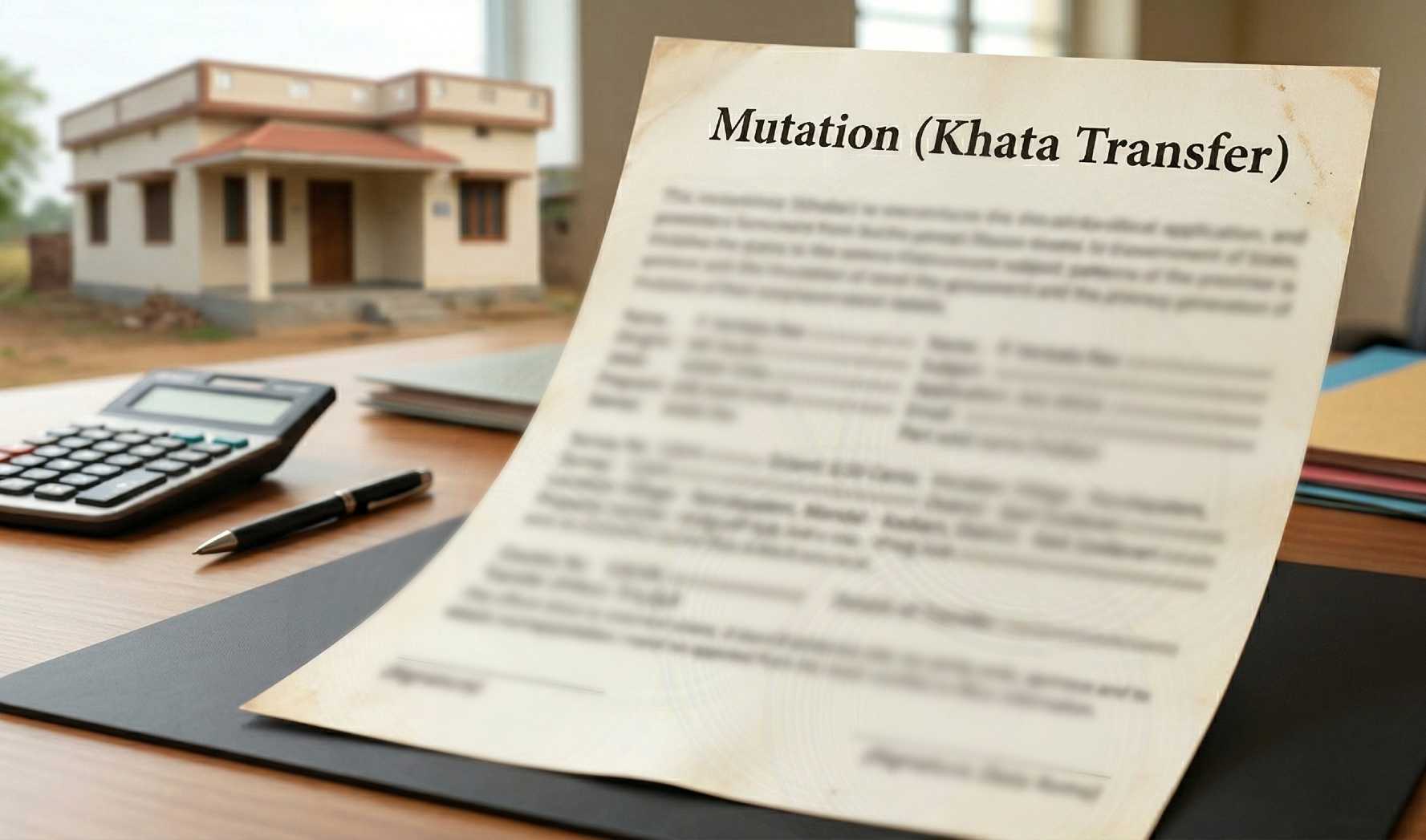
Mutation / Khata Transfer can be used for boundary or survey verification in Telangana as a supporting revenue record. It may help check whether the land has been updated in the revenue records after sale, inheritance, partition, gift, court order or another recognised change. It can support verification of details such as survey number, sub-division, khata number, recorded extent and pattadar details. However, Mutation / Khata Transfer should not be treated as final proof of exact boundaries by itself. It must be compared with current ROR-1B, Bhu Bharati records, registered deed schedule, Pattadar Passbook, village map, Tippan or survey sketch and physical survey or demarcation.
How to Use Mutation / Khata Transfer for Boundary or Survey Verification in Telangana?
You can get the Mutation/Khata Transfer easily via mypatta without visiting the Sub-Registrar office.
- Open mypatta and log in or sign up if needed.
- Go to property documents, ensure “Telangana” is selected as the state, then tap the “Mutation/Khata Transfer” icon.
- Enter required information.
- Tap “Search”
- Once Tippan Map is available to download, tap “View Document”. You can now save or share or download this document in PDF on your device
What Does Boundary or Survey Verification Mean in a Land Transaction?
Boundary or survey verification means confirming whether the land described in the documents is the same land that exists on the ground. It checks the identity, location, extent and physical limits of the property.
This is different from ownership verification. Ownership verification checks whether a person has legal title to the land. Boundary or survey verification checks whether the land parcel has been correctly identified and whether its recorded details match the actual site.
In a land transaction in Telangana, boundary or survey verification usually involves checking:
- village and mandal;
- survey number;
- sub-division number;
- khata or revenue-account details;
- recorded extent;
- pattadar or recorded landholder details;
- mutation or khata transfer entry;
- land classification;
- adjoining survey numbers or neighbouring lands;
- village map, Tippan or survey sketch; and
- physical possession and site location.
For example, a Mutation / Khata Transfer record may show that the khata was transferred in favour of a purchaser after a registered sale deed. That may support the current revenue-record position. However, it does not by itself confirm that the land shown at the site has the same boundaries or measurements as the land described in the records.
What Details Should Be Checked in Mutation / Khata Transfer?
Mutation / Khata Transfer should be checked carefully because it helps explain how the revenue record was updated after a transaction, inheritance or other change.
| Detail in Mutation / Khata Transfer | What Should Be Checked | Why It Matters |
|---|---|---|
| Village and Mandal | Whether the record relates to the correct village and mandal | Similar survey numbers may exist in different villages |
| Mutation / Application Number | Whether the mutation entry can be traced in the official record | Helps identify the specific revenue update being relied on |
| Date of Mutation | Whether the mutation took place after the relevant deed, succession or partition | Helps connect the revenue update with the legal event |
| Basis of Mutation | Whether it is based on sale, inheritance, partition, gift, court order or correction | Explains why the khata or recorded name changed |
| Survey Number | Whether the survey number matches current land records and title documents | Identifies the land parcel being verified |
| Sub-division Number | Whether the land was later divided, corrected or renumbered | Helps connect old and current survey records |
| Khata Number | Whether the khata number matches current ROR-1B and Pattadar Passbook details | Connects the land with the revenue account |
| Recorded Extent | Whether the area in the mutation record matches deed and current records | Helps detect shortage, excess land or wrong parcel claims |
| Name of Transferee / Pattadar | Whether the name corresponds with the present claimant or recorded landholder | Supports revenue-record consistency, but does not prove boundary accuracy |
| Land Classification | Whether the classification is consistent with current records | May affect use, transferability and verification |
| Remarks or Objections | Whether any dispute, correction, objection or restriction is recorded | May affect reliance on the mutation entry |
A mismatch in survey number, extent, khata number, recorded name or classification should not be ignored. It may indicate a mutation error, subdivision, wrong parcel identification, pending correction or boundary dispute.
How to Compare Mutation / Khata Transfer With Current Survey and Land Records?
Mutation / Khata Transfer should be compared with current Telangana land and survey records before it is used for boundary verification.
The following checks can be followed:
- Start with the village, mandal and district mentioned in the Mutation / Khata Transfer record.
- Note the mutation number, date, khata number, survey number, sub-division number, recorded extent and landholder details.
- Check the basis of mutation, such as registered sale deed, inheritance, partition, gift deed, court order or correction proceedings.
- Compare the survey number and sub-division number with current ROR-1B and Bhu Bharati records.
- Compare the recorded extent with the registered deed, Pattadar Passbook and current land records.
- Check whether the khata number after transfer matches the current revenue-account position.
- Verify whether the name recorded after mutation corresponds with the person relying on the record.
- Check whether the land classification in the mutation record is consistent with present land records.
- Compare the survey number with the village map, land parcel map, Tippan or survey sketch.
- Verify whether adjoining survey numbers or neighbouring lands match the physical site.
- Inspect the land to confirm whether the property shown on the ground corresponds with the mutated survey details.
- Where records do not match, obtain mutation history, survey clarification, correction proceedings or official demarcation.
This comparison is important because mutation usually updates the revenue record. It does not necessarily measure the land afresh or finally settle boundary disputes. The land may have been subdivided, corrected, encroached upon, inherited in shares or affected by survey changes after the mutation entry.
What Can Mutation / Khata Transfer Not Verify by Itself?
Mutation / Khata Transfer cannot, by itself, finally verify the exact physical boundary of the land.
Standing alone, it may not prove:
- exact on-ground measurement of the property;
- final demarcated boundary;
- whether the land shown at the site is the same land mentioned in the mutation record;
- whether the survey number was correctly measured;
- whether the recorded extent is physically available;
- whether there is encroachment on any side;
- whether neighbouring landholders accept the boundary;
- whether the land was later subdivided, corrected or renumbered;
- whether the mutation was based on a complete and valid title chain;
- whether the person named in the mutation record owns the entire land;
- whether the land has been affected by acquisition, road widening or government reservation;
- whether the land classification has changed; or
- whether there is any pending boundary, possession or survey dispute.
For example, a khata may be transferred in favour of a purchaser after registration of a sale deed. However, if the survey map shows a different extent, or if part of the land is occupied by a neighbour, the mutation entry alone cannot resolve the boundary issue.
Similarly, if mutation is completed for a survey number but the land was later subdivided among family members, the mutation record may not identify the exact present boundary of each share unless supported by partition, subdivision and survey records.
Mutation / Khata Transfer is therefore useful for checking whether revenue records were updated, but it should not replace survey maps, title documents or physical boundary verification.
Which Documents Should Be Checked Along With Mutation / Khata Transfer?
Mutation / Khata Transfer should be checked with title documents, current land records and survey records to confirm whether the same land parcel is being identified across records.
| Document | Role in Boundary / Survey Verification |
|---|---|
| Registered Sale Deed / Title Deed | Provides the property schedule, extent and boundary description |
| Mother Deed and Link Documents | Help confirm whether the same land continued through earlier transactions |
| Current ROR-1B | Shows the current revenue-record position of the land |
| Bhu Bharati Land Record | Helps verify current land details, ownership history and land status |
| Pattadar Passbook | Supports current pattadar and land details where applicable |
| Mutation Proceedings / Order | Shows the basis and manner in which the revenue record was updated |
| Old Pahani / Old ROR | Helps compare historical revenue entries with current mutation details |
| Village Map / Land Parcel Map | Helps locate the land in relation to adjoining survey numbers |
| Tippan / Survey Sketch | Helps verify field-level measurements and survey details |
| Subdivision or Correction Proceedings | Explain changes in survey number, extent or land classification |
| Partition, Succession or Legal Heir Records | Important where mutation followed inheritance or family division |
| Encumbrance Certificate / Registered Document Search | Helps identify later transfers, mortgages or registered claims affecting the land |
| Prohibited Property Records | Helps check whether the land is affected by transfer restrictions |
| Physical Survey / Demarcation Report | Confirms the on-ground boundary and measurements |
| Neighbouring Land Records | Help verify adjoining survey numbers and boundary consistency |
| Court or Revenue Orders | Relevant where a boundary, possession, classification or survey dispute has been decided |
The strongest boundary verification is created when the Mutation / Khata Transfer record, current ROR-1B, Bhu Bharati record, registered deed schedule, Pattadar Passbook, village map, Tippan, mutation history and physical survey all identify the same land parcel.
If these records do not match, the discrepancy should be resolved before relying on Mutation / Khata Transfer for sale, purchase, partition, construction, loan, litigation or any other land-related purpose.
FAQs
- 1. Can Mutation / Khata Transfer be used for boundary verification in Telangana?
Yes. Mutation / Khata Transfer can be used as a supporting record for boundary verification by checking survey number, sub-division, khata number, recorded extent and pattadar details. However, it should be compared with current land and survey records.
- 2. Can Mutation / Khata Transfer prove exact land boundaries by itself?
No. Mutation / Khata Transfer mainly records a change in revenue entries. Exact boundaries should be verified through current ROR-1B, Bhu Bharati records, village map, Tippan, survey sketch and physical demarcation
- 3. What should be checked in Mutation / Khata Transfer before relying on it?
Check the village, mandal, mutation number, date, basis of mutation, survey number, sub-division, khata number, recorded extent, pattadar name, land classification and any remarks or objections.
- 4. What if Mutation / Khata Transfer and current survey records show different details?
The difference should be checked through current ROR-1B, Bhu Bharati records, mutation history, subdivision records, correction proceedings, survey map, Tippan and official survey clarification. The document should not be relied on until the mismatch is explained.
- 5. Which documents should be checked along with Mutation / Khata Transfer?
Check the registered deed, Mother Deed, link documents, current ROR-1B, Bhu Bharati record, Pattadar Passbook, mutation order, Old Pahani, village map, Tippan, Encumbrance Certificate and physical survey or demarcation report.