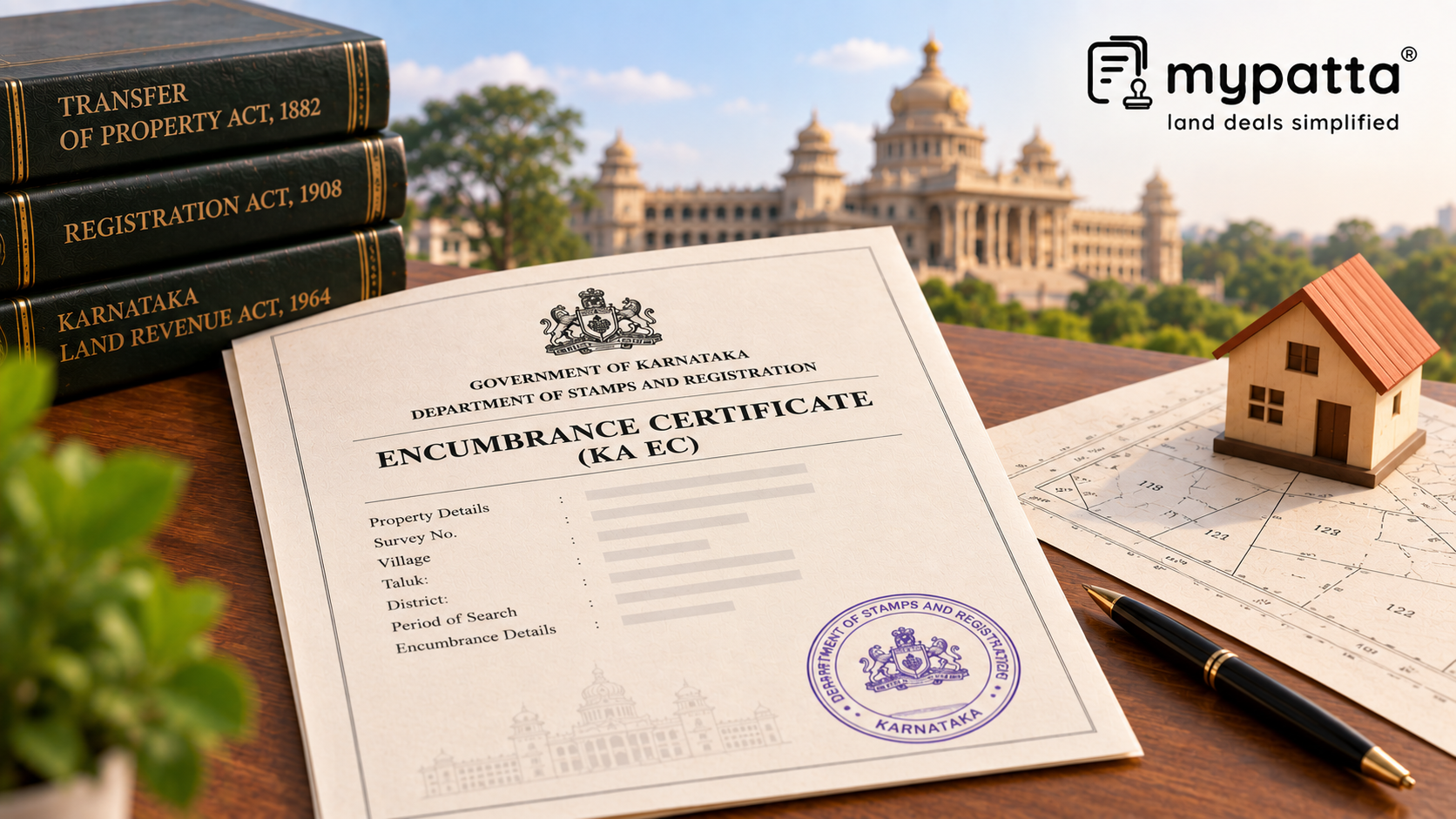
How to Download Karnataka Encumbrance Certificate (KA EC) in Karnataka
You can get the Karnataka Encumbrance Certificate (KA EC) online easily via mypatta without visiting the Sub-Registrar office.
- Open mypatta and log in or sign up if needed.
- Go to property documents, ensure “Karnataka” is selected as the state, then tap the “Karnataka Encumbrance Certificate (KA EC)” icon.
- Enter required information.
- Tap “Search”
- Once Karnataka Encumbrance Certificate (KA EC) is available to download, tap “View Document”. You can now save or share or download this document in PDF on your device.
Why Does the EC Search Period Matter Before a Purchase?
An EC is not an unlimited history of the property. It reports registered transactions found during the period covered by the search. Karnataka expressly describes EC as a record of registered transactions and notes that an EC displays transactions for the specific period searched.
This means a buyer should pay attention to the beginning and end dates rather than simply seeing whether the certificate contains an adverse entry.
For example, if the seller’s family claims to have held the property for several decades, an EC covering only a short recent period cannot independently explain the earlier history.
For records from 1 April 2004 onwards, Karnataka maintains the relevant EC service digitally. Where the title history begins earlier, the pre-2004 history should not disappear from the due-diligence exercise merely because the recent EC is clear.
How Should You Read the Transaction Sequence in KA EC?
The EC becomes more useful when its entries are read as a timeline rather than individually.
Suppose the seller claims to have purchased the land in 2016. The EC should be examined for the corresponding registered transaction and then for what happened afterwards.
A later mortgage may indicate that the property was offered as security. A subsequent release or discharge-related transaction may explain how that liability was dealt with. A later sale, gift or other transfer can fundamentally change the seller’s present claim.
The key question is whether the sequence of registered transactions is logically consistent with the seller still having the rights they propose to transfer.
KA EC can contain transaction information including owner history, sale or purchase details, mortgages, registration dates and document numbers.
What Does a NIL EC Really Mean?
A NIL EC requires careful interpretation.
Karnataka defines a NIL Encumbrance Certificate as indicating that no deeds of transactions or liabilities were registered against the property for the relevant period searched.
It does not mean:
- the seller has conclusively proved ownership;
- the land has never been transferred;
- no family or inheritance claim exists;
- there is no litigation;
- no unregistered arrangement affects possession; or
- the property has been correctly identified in the search.
A NIL result is therefore meaningful only after confirming that the correct property and an appropriate period have been examined.
What Can Remain Outside KA EC?
One of the most important things for a buyer to understand is what an EC does not capture.
Karnataka expressly states that an EC reflects transactions registered in the relevant Book 1 for the period searched. Wills and adoption deeds recorded in Book 3 and powers of attorney recorded in Book 4 are not reflected. The State also specifically states that pending litigation concerning the property is not reflected in the EC.
This creates a critical distinction:
No adverse entry in EC does not mean no adverse issue exists.
For inherited or disputed land in particular, the absence of an EC entry should therefore be read together with succession, court and title documents.
Which EC Entries Need Closer Attention?
| EC Finding | Why It Matters |
|---|
| Sale after seller’s acquisition | May indicate that rights were subsequently transferred |
| Registered mortgage | Property may have been offered as security |
| Release or discharge entry | Should correspond with the earlier liability |
| Multiple transactions close together | Requires closer examination of the transaction chain |
| Different property identifiers | May indicate an incorrect parcel or search mismatch |
| NIL result despite known deed | Search particulars or property identification may require rechecking |
| Long gap in transaction history | Earlier title documents become especially important |
A suspicious entry does not automatically mean the purchase cannot proceed. Its legal effect must be understood from the corresponding registered document.
How Should KA EC Be Matched With the Seller’s Records?
The EC should ultimately act as a cross-check against the seller’s transaction story.
If the seller produces a sale deed, its registration particulars should correspond with the relevant EC entry. If the seller says an old mortgage has been cleared, the documentary history should support that position. If the property has changed survey number, subdivision or description, the land records should explain how the EC property corresponds with the parcel currently being sold.
RTC, mutation records, Akarband and applicable survey documents then provide information that the EC itself does not establish.
This separation is important: KA EC tracks registered dealings; it does not replace title, revenue or survey verification.
Why I Trust mypatta
- Trusted by 7 Lakh+ customers.
- 1 Crore+ documents delivered.
- 4.8-star app rating.
- mypatta Guarantee – Your money is safe with us. Guaranteed delivery or a 100% amount refund.
Frequently Asked Questions
- 1. What does Karnataka EC show?+
It records registered transactions relating to a property during the period searched.
- 2. Does a NIL EC mean the land is completely clear?+
No. It only indicates that no relevant registered transaction was found for the specified property and period.
- 3. Does pending property litigation appear in KA EC?+
Not necessarily. Karnataka expressly states that pending litigation is not reflected in the EC.
- 4. Can a will or power of attorney appear in KA EC?+
Documents recorded outside the relevant Book 1, including wills and powers of attorney registered in the specified separate books, are not reflected in the EC.
Shivangi
Real Estate Content Writer
Shivangi is a real estate content writer with 3+ years of experience helping readers understand property documentation, land records, and legal requirements through clear and actionable content.