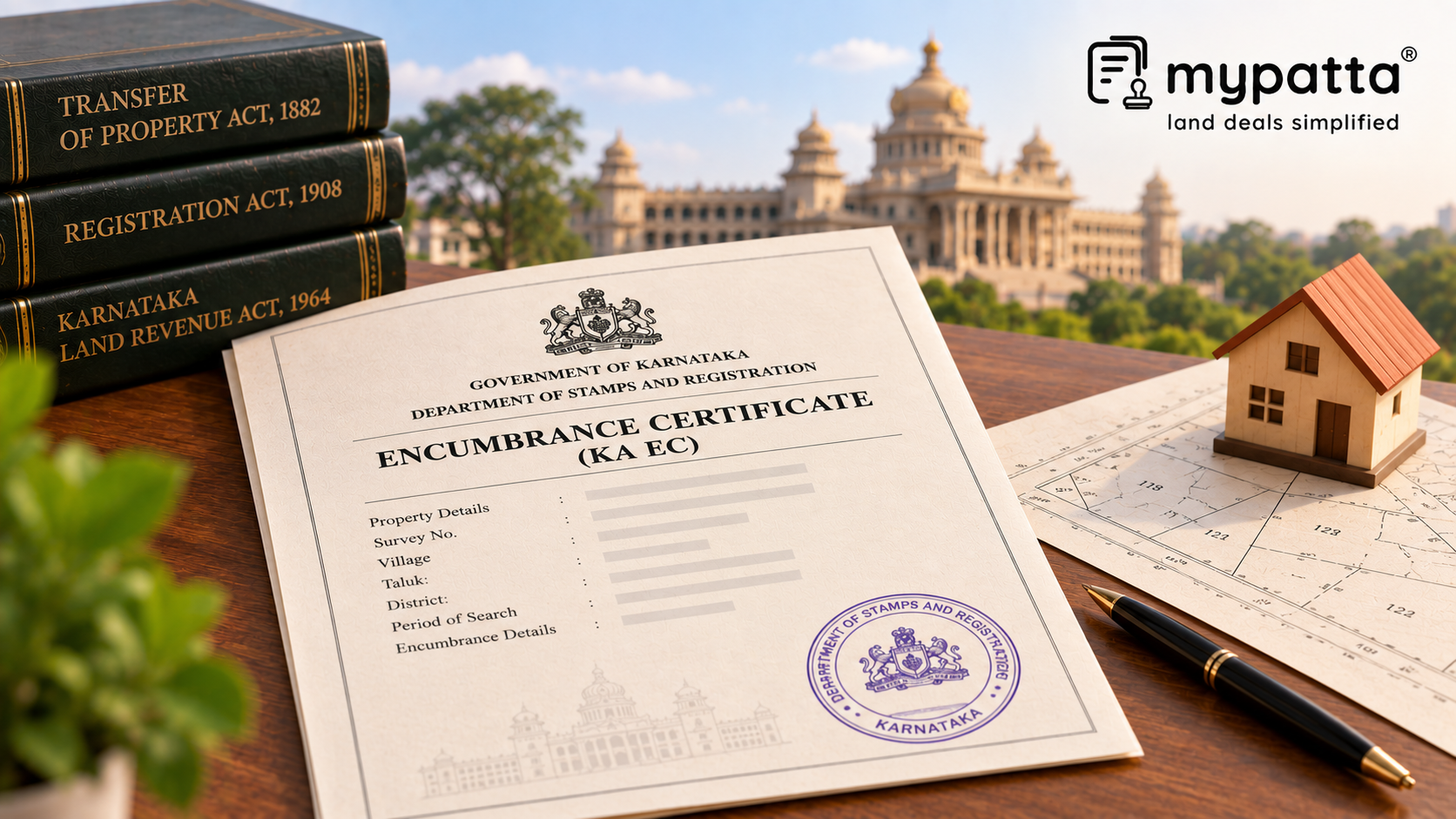
How to Download Karnataka Encumbrance Certificate (KA EC) in Karnataka
You can get the Karnataka Encumbrance Certificate (KA EC) online easily via mypatta without visiting the Sub-Registrar office.
- Open mypatta and log in or sign up if needed.
- Go to property documents, ensure “Karnataka” is selected as the state, then tap the “Karnataka Encumbrance Certificate (KA EC)” icon.
- Enter required information.
- Tap “Search”
- Once Karnataka Encumbrance Certificate (KA EC) is available to download, tap “View Document”. You can now save or share or download this document in PDF on your device.
What Is KA EC Evidence of in an Ownership Claim?
The legal value of KA EC lies primarily in documenting the registered dealings associated with a property.
Karnataka defines an Encumbrance Certificate as a record showing registered transactions pertaining to a property.
Suppose A claims ownership because A purchased land from B. If that sale appears in the EC, the certificate supports the existence of a registered transaction between the relevant parties concerning that property.
The EC can therefore corroborate an ownership story. What it does not independently answer is whether B actually possessed a legally valid title capable of being transferred to A.
That question requires examination of the title documents preceding B.
Does a Person’s Name in KA EC Establish Ownership?
No. A name appearing as a purchaser in the EC establishes an important transactional fact, but it should not be equated with conclusive ownership.
India follows a system in which registration primarily creates a public record of transactions. In a 2025 judgment, the Supreme Court explained that registration of a document recording the purchase of immovable property does not confer guaranteed title. It has evidentiary value, but ownership can still be challenged by someone with a superior title.
The distinction is even clearer for an EC. The certificate records information about registered dealings; it is not the instrument through which the claimant acquired the property.
Therefore:
Name in EC = evidence of a registered transaction.
Valid ownership = transaction plus a legally sustainable title behind it.
Can Multiple EC Entries Prove a Complete Title Chain?
A sequence of transactions in KA EC can help trace an apparent ownership chain, but it does not independently validate every link in that chain.
For example, an EC may show:
A sold to B → B sold to C → C sold to D.
That sequence supports a registration history leading to D. But it does not answer whether A originally owned the property, whether A owned the entire extent sold, or whether another person had a superior right.
Each important link should therefore be supported by its underlying registered deed or other source of title.
An EC can help identify which transactions require examination. It cannot substitute for examining the legal effect of those transactions.
Why Is a NIL EC Different From Proof of Ownership?
A NIL EC has a much narrower meaning than “clear ownership”.
Karnataka states that a NIL EC is issued where no registered transactions or liabilities are found against the property for the relevant period searched.
That does not identify who owns the land.
For example, ancestral land may have no recent registered transaction at all. A NIL EC could therefore exist even though ownership is divided between several heirs.
Similarly, a person cannot prove ownership merely by producing a NIL EC in their name. The legal event through which they acquired the property must still be established separately.
The correct inference is therefore “no registered encumbrance found for this search period”, not “ownership conclusively established.”
Can Ownership Issues Exist Even When KA EC Is Clear?
Yes. This is one of the main reasons EC cannot serve as standalone ownership proof.
Karnataka expressly states that an EC does not capture every type of relevant record. For example, pending property litigation is not reflected, and certain documents maintained outside the relevant registration book are also excluded.
Ownership may also be affected by matters such as:
- inheritance claims between legal heirs;
- an earlier defective transfer;
- rights of co-owners;
- a court decree;
- an invalid or cancelled deed; or
- differences between the property described in the transaction and the land actually claimed.
A clear EC therefore removes only part of the uncertainty surrounding ownership.
When Does KA EC Strongly Support an Ownership Claim?
KA EC becomes valuable ownership evidence when it corroborates an otherwise complete title.
Consider a claimant who has a registered sale deed from a seller whose ownership is supported by earlier link deeds. The relevant sale appears in KA EC, no subsequent registered transaction contradicts the claimant’s rights, and the current RTC and mutation records correspond with the same property.
Here, the EC strengthens the claim because several independent records point in the same direction.
Its value is considerably weaker where a claimant produces an EC showing their name but cannot produce the deed or documents establishing the transferor’s own rights.
Which Documents Carry Greater Ownership Weight Than KA EC?
| Document | Role in Ownership Evidence |
|---|
| Registered Sale Deed | Records the legal transaction through which rights are claimed |
| Mother Deed / Link Deeds | Establish earlier continuity of title |
| Gift / Partition / Release Deed | Shows other legally recognised transfers or division of rights |
| Succession Documents | Establish rights passing through inheritance |
| Grant Documents | May establish the original source of granted land rights |
| Court Decree | May declare or determine ownership |
| RTC / Certified Mutation | Supports the corresponding current revenue position |
| KA EC | Corroborates registered transaction and encumbrance history |
The strongest ownership claim therefore comes from a valid title source supported by a consistent registration and land-record history, rather than from the EC alone.
Why Trust mypatta
- Trusted by 7 Lakh+ customers.
- 1 Crore+ documents delivered.
- 4.8-star app rating.
- mypatta Guarantee – Your money is safe with us. Guaranteed delivery or a 100% amount refund.
- 1. Can KA EC alone prove ownership in Karnataka?+
No. It records registered transactions but does not independently establish complete legal title.
- 2. Does a purchaser’s name in KA EC mean they are the absolute owner?+
Not necessarily. The underlying deed and the transferor’s own title must support the transaction.
- 3. Is a NIL EC proof that someone owns the property?+
No. It only indicates that no relevant registered transactions or liabilities were found for the period searched.
- 4. Can KA EC support a title claim?+
Yes. It can strongly corroborate a title claim when its transaction history matches valid title deeds and current property records.
Shivangi
Real Estate Content Writer
Shivangi is a real estate content writer with 3+ years of experience helping readers understand property documentation, land records, and legal requirements through clear and actionable content.