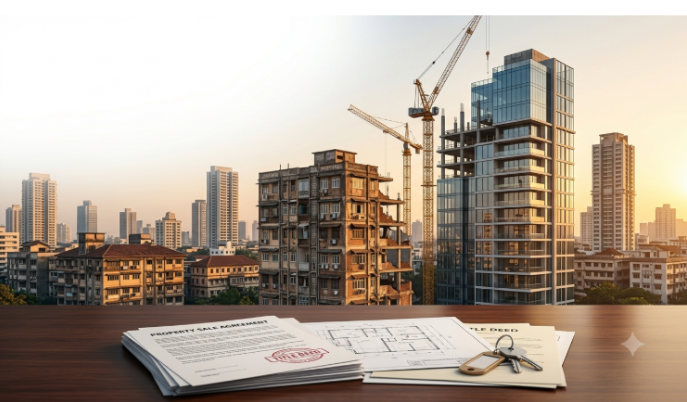
Redevelopment is not a new concept in Mumbai. For decades, the city has struggled with aging buildings, limited land availability, and a growing urban population. Many residential societies built during the 1960s, 70s, and 80s are now reaching the end of their structural lifespan.
Initially, redevelopment focused on replacing unsafe buildings with newer residential towers. Over time, it expanded to include MHADA colonies, cessed buildings in South Mumbai, Slum Rehabilitation Authority (SRA) projects, and cluster redevelopment initiatives.
Today, redevelopment is one of Mumbai's most significant urban transformation strategies. It not only improves housing quality but also supports better infrastructure, wider roads, and more efficient land utilisation. Recent legislative efforts aim to speed up redevelopment across thousands of aging buildings in the city.
<b>What is Property Redevelopment?</b>
Property redevelopment is the process of demolishing an old residential or commercial building and constructing a new one on the same land. Existing residents generally receive newly built homes, while developers sell additional units to recover project costs.
For buyers, redevelopment provides an opportunity to purchase modern homes in established locations that already have schools, hospitals, public transport, and commercial infrastructure.
Table 1: Understanding Redevelopment
| Feature | Explanation |
|---|
| Purpose | Replace old or unsafe buildings with modern developments |
| Who Initiates It? | Housing societies, developers, MHADA, SRA, or government authorities |
| Benefits | Better safety, infrastructure, amenities, and property value |
| Common Areas | Housing societies, cessed buildings, MHADA colonies, cluster redevelopment zones |
| Buyer Advantage | New homes in prime locations with improved facilities |
<b>Why is Mumbai's Redevelopment Boom Important?</b>
Redevelopment is reshaping Mumbai's property market because the city has very limited vacant land available for new construction. Instead of expanding outward, developers are creating new housing supply within existing neighbourhoods.
For homebuyers, this means access to:
- Better construction quality
- Earthquake-resistant buildings
- Modern amenities
- Improved parking facilities
- Enhanced security systems
- Higher long-term appreciation potential
For investors, redevelopment projects offer opportunities in established localities where demand has remained consistently strong.
Mumbai's Redevelopment Boom in 2026
Mumbai's redevelopment activity has accelerated significantly over the past year. Several large-scale projects involving housing societies, MHADA colonies, and cluster redevelopment are moving forward, driven by policy support and strong housing demand.
Some of the key trends include:
- MHADA has identified redevelopment opportunities across approximately 925 acres of land, with investment potential estimated at around ₹4 lakh crore.
- Proposed legal reforms aim to simplify and accelerate redevelopment approvals for thousands of older buildings across Mumbai.
- Large redevelopment projects in areas such as Dharavi and other urban clusters continue to attract developer interest due to their long-term economic potential.
These developments are expected to create new housing supply while improving urban infrastructure, making redevelopment one of the most influential trends in Mumbai's real estate market.
Redeveloped Property vs Newly Constructed Property
| Redeveloped Property | Newly Developed Property |
|---|
| Located in established neighbourhoods | Often located in developing suburbs |
| Existing social infrastructure | Infrastructure may still be evolving |
| Strong resale demand | More future growth potential in emerging areas |
| Requires careful verification of redevelopment history | Simpler ownership history in many cases |
| Usually better connectivity | May require future infrastructure development |
Common Mistakes Homebuyers Make During Redevelopment Projects
Redeveloped properties often come with attractive brochures, modern amenities, and premium pricing. However, buyers sometimes overlook essential legal and technical checks in the excitement of purchasing a new home. Even in reputed redevelopment projects, verifying documents before making a payment can help avoid future disputes.
Some of the most common mistakes include:
- Purchasing without verifying the property's ownership history.
- Ignoring redevelopment approvals and sanctioned building plans.
- Assuming every redeveloped project has received all required permissions.
- Not checking whether the Occupancy Certificate has been issued.
- Overlooking pending loans, legal disputes, or encumbrances.
- Relying only on verbal assurances instead of documented evidence.
Property Verification Checklist Before Buying
A redeveloped property may look brand new, but the legal history of the land and ownership still matters. Before finalising your purchase, verify the following:
Essential Verification Checklist
✔ Confirm the seller's ownership.
✔ Verify the Sale Deed.
✔ Check the Encumbrance Certificate.
✔ Review approved building plans.
✔ Verify the Occupancy Certificate.
✔ Check mutation and property tax records.
✔ Ensure there are no pending legal disputes.
✔ Verify redevelopment approvals and society documentation where applicable.
Legal Documents Every Homebuyer Should Verify
Verifying the right documents is one of the most effective ways to reduce legal and financial risks when purchasing a redeveloped property.
Important Property Documents
| Document | Why It Matters |
|---|
| Sale Deed | Establishes legal ownership |
| Property Card | Confirms ownership details and land records |
| 7/12 Extract (where applicable) | Provides land ownership and revenue information |
| Mutation Records | Shows updated ownership in revenue records |
| Encumbrance Certificate | Reveals loans or legal liabilities |
| Approved Building Plan | Confirms construction approvals |
| Occupancy Certificate | Indicates the building is approved for occupation |
| Property Tax Receipt | Confirms municipal tax payments |
Why Property Verification Matters More Than Ever
Mumbai's redevelopment boom has created exciting opportunities for homebuyers, but it has also increased the importance of due diligence.
Property verification helps buyers:
- Confirm legal ownership.
- Identify pending loans or encumbrances.
- Reduce the risk of fraudulent transactions.
- Verify whether redevelopment approvals are in place.
- Make informed investment decisions before paying an advance.
Whether you're purchasing a ready-to-move-in apartment or investing in a redevelopment project, proper verification can provide greater confidence throughout the buying process.
How mypatta Helps
Buying a redeveloped property is a significant investment, and verifying property documents beforehand can help reduce legal and financial risks.
With mypatta, you can:
- ✔ Access Property Verification services in Maharashtra.
- ✔ Obtain property-related records such as Property Card, 7/12 Extract (Satbara), Mutation Records (Ferfar), Index II, Village Maps, and other available land records.
- ✔ Verify ownership details before purchasing a property.
- ✔ Review essential property documents through a fast, secure, and completely online process.
- ✔ Trusted by 5+ lakh users across India.
- ✔ 70+ lakh land documents delivered.
- ✔ Guaranteed service: Get your document or receive a full refund if the requested document cannot be delivered.
How to use mypatta
- Open mypatta and log in or sign up if needed.
- Download for Android
- Download for iPhone
- Select Maharashtra and choose the required document or property verification service.
- Enter the necessary property details.
- Submit your request and receive your document or verification report online.
Conclusion
Mumbai's redevelopment boom is transforming the city's real estate market by replacing aging buildings with modern, well-planned residential communities. As redevelopment projects continue to expand across established neighbourhoods, buyers have more opportunities to own homes in prime locations with improved infrastructure and long-term growth potential.
However, every property purchase should begin with proper verification—not just of the apartment, but of the underlying ownership, approvals, and legal records. Taking the time to verify essential documents before investing can help prevent future disputes and ensure a smoother buying experience.
With reliable property verification and access to important land records, mypatta helps homebuyers make informed decisions with greater confidence.
Frequently Asked Questions
- 1. Why are redevelopment projects becoming more common in Mumbai?+
Mumbai has limited vacant land available for new construction. Redevelopment allows older buildings to be replaced with modern residential projects while making better use of existing urban land.
- 2. Is buying a redeveloped property a good investment?+
Redeveloped properties often offer better infrastructure, improved amenities, and locations within established neighbourhoods. However, buyers should always complete proper legal verification before purchasing.
- 3. Which documents should I verify before buying a redeveloped property?+
Important documents include the Sale Deed, Property Card, Encumbrance Certificate, Mutation Records, Occupancy Certificate, approved building plans, and property tax records.
- 4. What is an Occupancy Certificate, and why is it important?+
An Occupancy Certificate confirms that a building complies with approved plans and is considered fit for occupation by the relevant authority.
Archita
Real Estate Content Writer
Archita is a real estate content writer with 3+ years of experience creating easy-to-understand guides on property documents, land records, and registration services, helping users make informed property decisions.