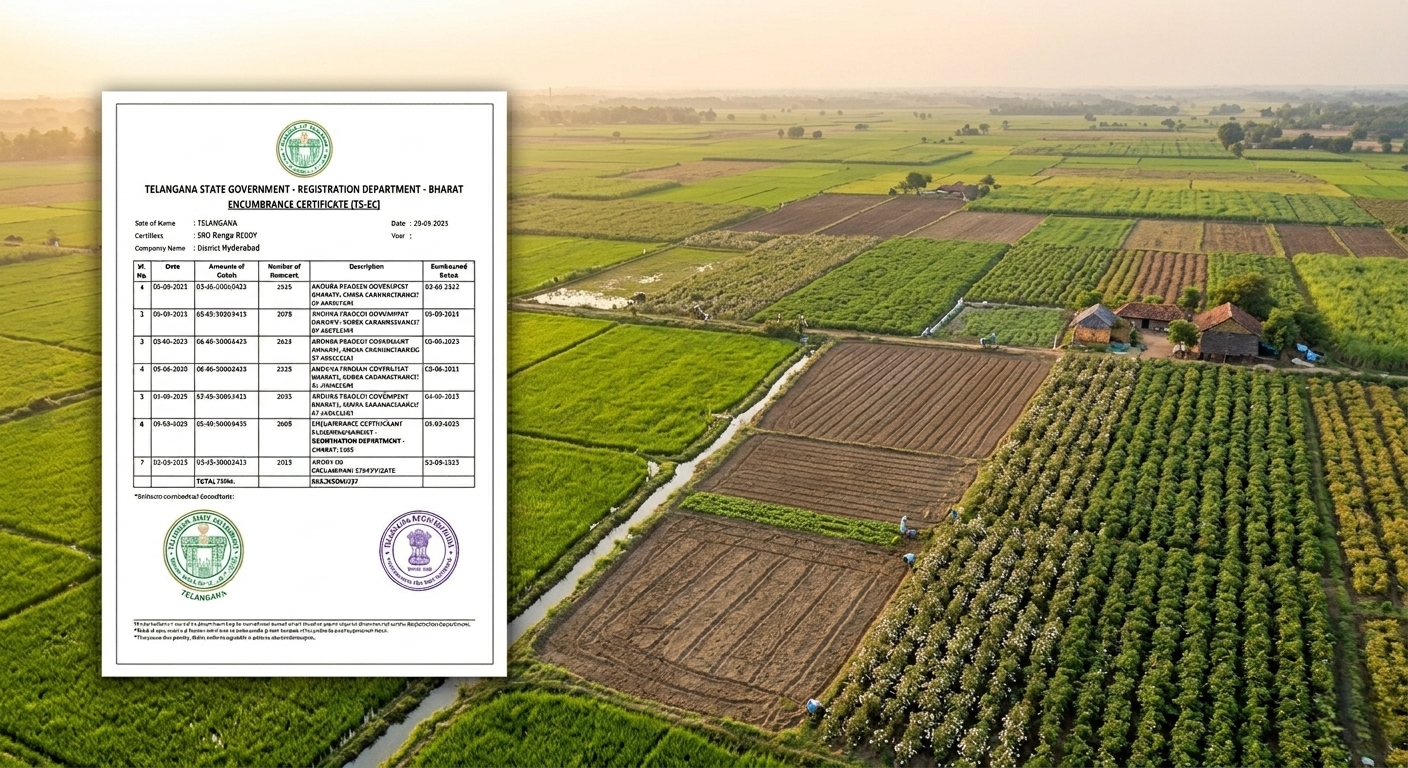
What is Encumbrance Certificate (IGRS EC)?
An Encumbrance Certificate (EC) is an official property document that records all registered transactions related to a property. It is mainly used to check whether a property has any legal or financial liabilities such as loans, mortgages, or claims.
EC reflects data only when a transaction is officially registered at the Sub-Registrar Office (SRO). If no registration exists, the property or owner details will not appear in the EC.
This applies to all property types:
- Ancestral properties
- Private properties
- Government lands
👉 Ownership alone is not enough — your name appears in EC only after a registered transaction is recorded.
What Details Are Included in IGRS EC?
The Encumbrance Certificate contains important information related to property transactions:
1.Property Information(Column 2)
- Village name
- Survey number
- Sub-division number
- Property extent
- Boundary details (North, South, East, West)
2. Transaction Details(Column 4)
- Type of document (Sale Deed, Gift Deed, Partition Deed, Mortgage, etc.)
- Nature of transaction
- Market value of the property
- Consideration value (registered transaction amount)
3. Important Dates(Column 3: Reg. Date, Exe. Date, Pres. Date)
- Registration Date
- Execution Date
- Presented Date
4. Parties Involved(Column 5: Names of Parties)
- Buyer and seller names
- Transferor and transferee details
5. Registration Details(Column 6: Document Details)
- Document number and year
- Sub-Registrar Office (SRO) name
Important Note on Older Records
- For properties registered before 2000, EC may include volume and page numbers
- If shown as 0/0, the document is digitally scanned
- Some older records may require manual verification at the SRO in Telangana
How to Check IGRS EC Online in Telangana?
You can easily check EC online in Telangana through mypatta:
- Open mypatta and log in or sign up if needed.
- Select State as Telangana and Click EC icon
- Choose By Document Number or By Property tab
- Enter Required Information
- Once the Encumbrance Certificate(EC) is made available, you can download, save, or share it .
- Incase you do not understand your EC - please use our EC Explainer where you can get explanation of your EC
Through mypatta, you can get EC online quickly without any worries
Why Checking EC is Important
- Confirms the property is free from legal issues
- Verifies ownership history
- Helps avoid fraudulent property transactions
- Required for bank loans and legal verification
Frequently Asked Questions (FAQs)
- 1.How can I check EC in Telangana online (తెలంగాణ EC శోధన)?+
You can perform an EC search (EC శోధన) through mypatta, which provides access to official property records in a simple and consolidated way.
- 2.How can I get Encumbrance Certificate in Telangana online (తెలంగాణ EC ఆన్లైన్)?+
You can access the Encumbrance Certificate (ఎన్కంబ్రెన్స్ సర్టిఫికేట్) online through mypatta, which helps fetch property records from official systems.
- 3.What is a Non-Encumbrance Certificate (నాన్ ఎన్కంబ్రెన్స్ సర్టిఫికేట్)?+
A non-encumbrance certificate (నాన్ ఎన్కంబ్రెన్స్ సర్టిఫికేట్) confirms that a property has no registered financial or legal liabilities (బాధ్యతలు) during a specific period.
- 4.How many years of EC should be checked?+
It is recommended to review EC records for at least 20–30 years to ensure there are no hidden liabilities (బాధ్యతలు) or disputes (వివాదాలు).
- 5.What is the difference between EC and Sale Deed (సేల్ డీడ్)?+
An Encumbrance Certificate shows transaction history and liabilities, while a Sale Deed (సేల్ డీడ్) serves as proof of ownership transfer (స్వామ్య బదిలీ).
- 6.Can EC show ownership details?+
Yes, EC (ఎన్కంబ్రెన్స్ సర్టిఫికేట్) reflects ownership details, including the names of current and previous owners (ప్రస్తుత మరియు గత యజమానులు).
Conclusion
The Encumbrance Certificate (EC) is an essential document for verifying property ownership and legal status in Telangana. By understanding the details included in EC and knowing how to check it online, you can ensure safe and secure property transactions.