Introduction
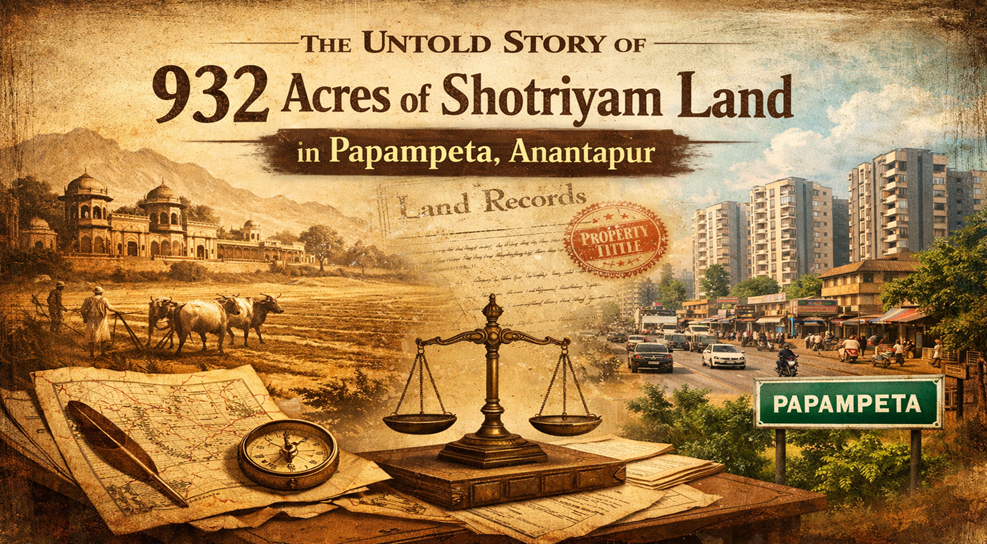
Behind the busy streets and modern apartments of Papampeta village, in Anantapur Rural mandal, lies a fascinating history that stretches back more than 150 years.
What is today a thriving urban locality once belonged to a vast Shotriyam estate spread over 932 acres of land.
This story is not just about land — it’s about heritage, ownership, and the legal transformation that shaped modern-day Anantapur.
📜 What is a Shotriyam Land?
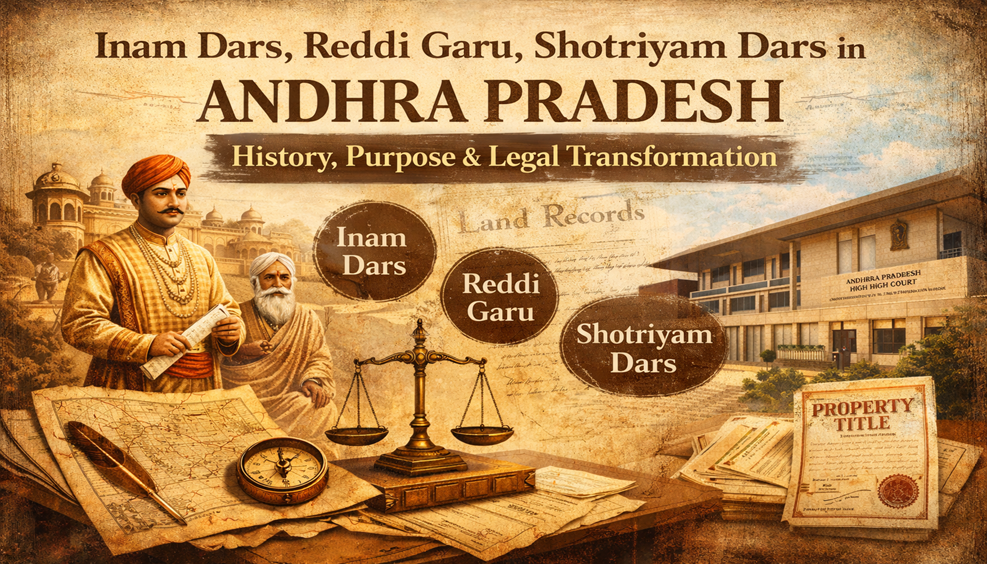
Before India’s independence, the kings of Andhra Pradesh granted certain villages to Pandits, priests, and temple servants as a reward for their service. These lands were called Inam lands, and when they were given for scholarly or temple service purposes, they were known as Shotriyam Dars.
The grantees of these lands were called Shotriyamdars, and they held these lands either rent-free or under special privileges recognized by the local rulers and later by the British administration.
📘 The Beginning: The 932-Acre Shotriyam Land in Papampeta
In 1866, a Shotriyam land grant covering 932 acres in Papampeta was awarded to P. Sheshagiri Rao under Praimasi No. 27 (a British land record) with Settlement Deed No. 1712.
In 1879, P. Sheshagiri Rao sold the entire land to K. Venkata Rao for ₹500.
Later, in 1910, K. Venkata Rao sold the same land to Gollapalli Lakshmi Narasimha Sastry for ₹2,000, registered at SRO Proddatur under Document No. 984.
During his lifetime, Sastry sold 382 acres to various third parties. Upon his passing, the remaining land was inherited by two family branches — Rachuru and Gollapalli — as Sastry had two wives.
⚖️ Partition and Sale of the Estate
After G. L. Narasimha Sastry’s death, the estate was divided among his successors:
- Rachuru Subbayya
- Rachuru Venkata Ramana Sastry
- Gollapalli Shankariah
- Gollapalli Seetha Ramayya
These four individuals jointly gifted 50 acres to Gollapalli Ramakrishna in 1949 (Document No. 2260, Anantapur R.O.).
In 1952, they executed a Partition Deed (Doc No. 1607, Anantapur R.O.), dividing the remaining 550 acres as follows:
- Schedule A (137.5 acres) → Gollapalli family
- Schedule B (412.5 acres) → Rachuru family
Over time, both families sold portions of their land under different documents. However, the exact details of how much land was sold and retained remain unclear.
🏛️ The Legal Transformation: Abolition of Shotriyam Estates
A major turning point came in 1964 when the Government of Andhra Pradesh issued G.O.M.S. No. 728 (Revenue Department) dated 29 April 1964, published in the A.P. Gazette (pages 1746 & 1747, Part I).
This order referenced the Madras Estates (Abolition and Conversion into Ryotwari) Act, 1948, which aimed to abolish Zamindari and Inam estates and distribute ownership to the actual cultivators (Ryots).
According to this notification:
- All Shotriyam Dars lands were converted into Ryotwari lands
- Ryotwari Pattas were issued by the Court of the Settlement Officer, Nellore
- The village map was updated accordingly (Board Ref. L.Dis.No. 38366.65S & LRS, dated 31-10-1965)
🌾 From Estates to Agriculture to Urbanization
After the issuance of Ryotwari Pattas, the newly recognized landholders — the Ryots — became the lawful owners.
From the 1970s onwards, many sold their land, and over decades the area transformed into residential and commercial layouts with proper NOCs from the District Collector.
🌆 Papampeta Today
Fast forward to 2025, Papampeta has evolved into a bustling part of Anantapur city, with:
✔️ 10,000+ Residential Houses
🏢 Apartments & Commercial Complexes
🏥 Hospitals
🏦 Banks
🍴 Restaurants
🕌 Temples & Parks
What was once a Shotriyam estate is now a thriving residential hub.
⚖️ The 2025 Legal Claim
In a new twist, Rachuru Venkata Kiran, a descendant of the Rachuru family, has filed a writ petition (W.P. No. 29282/2025) in the High Court of Andhra Pradesh claiming 292 acres of the original 932-acre estate.
Government officials including the Collector, MRO, VRO, and Mandal Surveyor are listed as respondents.
🧩 Key Legal Observations
- It is important to verify how much land was sold by the Rachuru and Gollapalli families before the 1964 conversion.
- As per the Madras Estates Abolition and Conversion into Ryotwari Act, 1948, all Shotriyam lands were abolished and converted into individual Ryotwari Pattas.
- Buyers and property owners in Papampeta should verify whether their land traces back to valid Ryotwari Patta holders.
- The chain of ownership after Ryotwari conversion must be examined to ensure clear and marketable title.
🧾 Why This Matters Today
Land disputes like these remind us how critical historical verification is when dealing with old Inam or Shotriyam lands.
At mypatta, we frequently come across such complex title histories during EC, CC, Adangal, ROR-1B, and Patta verifications.
Our legal and document procurement team ensures:
- Every buyer understands the title chain
- Old land grants and conversions are verified through G.O.s and Gazette references
- All documents align with Ryotwari Pattas and Collector NOCs
🧭 Need Help Verifying Your Land Documents?
mypatta provides trusted land document verification services in Andhra Pradesh, helping you quickly access EC, CC, Adangal, ROR-1B, and complete legal verification directly from SRO and MRO offices.
Whether you are buying, selling, or validating property details, our experts ensure accurate, government-verified land records without any hassle.
- 📞 +91 91774 58818 – Call us for instant assistance with EC, CC, Adangal, ROR-1B, and legal verification.
- 📩 contact@mypatta.com –Email us for detailed guidance or document-related queries.
- 🧑⚖️ Consult with Expert – Talk to an property expert for document/title verification.
Key Takeaway
The story of Papampeta’s 932 acres of Shotriyam land is more than history — it’s a case study in land evolution, from royal grants to ryotwari farms, and finally to urban real estate.
As cities expand and properties change hands, legal clarity and historical understanding remain the foundation of secure property ownership.
If you own or plan to buy land in Anantapur, ensure your property has a clear title traceable to valid government-issued pattas.