
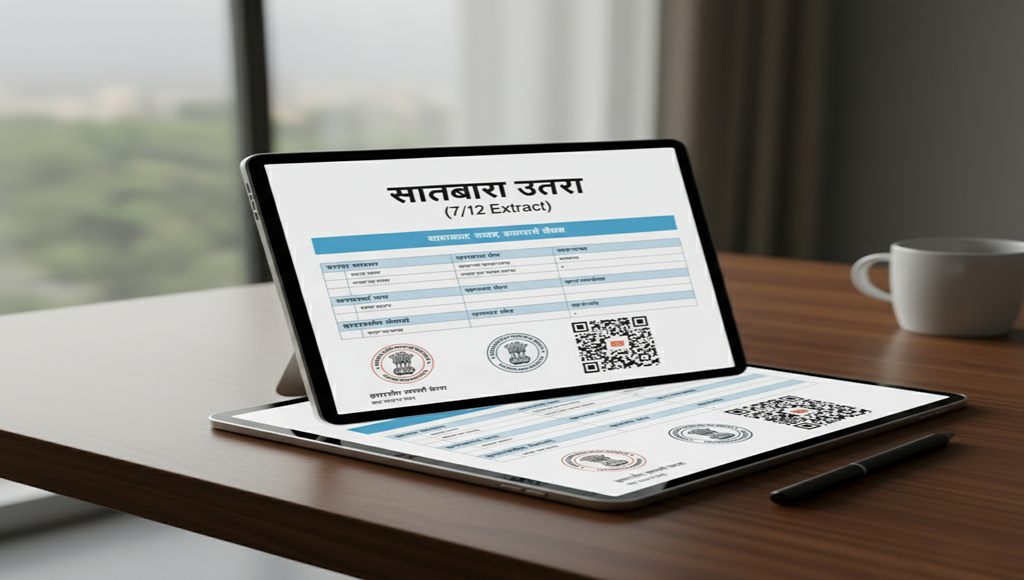
What is Satbara (7/12 Utara) in Maharashtra?
The Satbara (7/12 Utara) in Maharashtra is an official land record extract issued by the Government of Maharashtra.It combines two important forms:
- Form 7 – Contains ownership details of the landholder.
- Form 12 – Contains agricultural information such as crop details, cultivation type, and irrigation.
This document provides key details like the survey number, owner’s name, land area, cultivation type, and crop details.
Importance of Satbara (7/12 Utara) in Maharashtra
A Satbara extract is critical because it:
- Acts as legal proof of ownership for agricultural land.
- Displays land type (agriculture / non-agriculture) and crop details.
- Is mandatory for bank loans, mortgages, and crop insurance.
- Helps in resolving property disputes, inheritance, and partition cases.
- Supports government planning, taxation, and subsidy schemes.
- Prevents land fraud by showing authentic digital records.
How to Check Satbara (7/12 Utara) Online in Maharashtra
You can get the Satbara(7/12 Utara) easily through mypatta—without visiting the Government office.
- Open mypatta and log in or sign up if needed.
- Ensure “Maharashtra” is selected as the state, then tap the “(7/12) Satbara” icon
- There are two ways to find a document in Satbara(7/12 Utara)
- Survey Number – Fill District,Taluka,Village and Survey Number/Gat Number
- ULPIN – Fill ULPIN Number
- Tap Search, view your details, and pay the fee
- Once Satbara(7/12) is available to download, tap “View Document”. You can now save or share or download this document in PDF on your device.
Key Details in a Satbara (7/12 Utara) of Maharashtra
A Satbara extract typically includes:
- Survey / Gat Number – Unique identifier of the land parcel.
- Owner’s Name – Current landholder’s details.
- Land Area & Type – Size in hectares/acres, irrigated or barren.
- Cultivation & Crop Details – Seasonal crops, usage type.
- Digital Seal/Signature – Authentication by Government Officer
Important Tips and Considerations
- Use Digital Satbara (e-Satbara) from mypatta for authenticity.
- Verify with Mutation (Ferfar) records for complete ownership history.
- Cross-check survey numbers with Bhunaksha, property card or Title deed.
- Keep both digital and physical copies for banks, loans, and legal use.
- Update your Satbara after sale, inheritance, or partition to avoid disputes.
Frequently Asked Questions(FAQs)
1.Is the Satbara(7/12 utara) required for non-agricultural land?
No, the 7/12 extract is primarily used for agricultural land. For urban properties, a Property Card is used instead.
2.What is the difference between 7/12 and 8A extract?
The 7/12 extract contains ownership and agricultural details, while the 8A extract records tax-related information for the land.
3.Is the 7/12 extract mandatory for availing crop insurance?
Yes, the 7/12 extract is required for crop insurance as it contains crop details and landownership proof.
4.What is the importance of Satbara (7/12) in resolving boundary disputes?
The 7/12 extract provides survey numbers and land area details, which are crucial in resolving boundary or ownership disputes.
5.Can I use 7/12 Utara for land loans?
Yes, banks and financial institutions often require a recent 7/12 extract when processing agriculture or land-based loans.
6.What are the differences between 7/12 and a property card?
Satbara (7/12 Utara) is primarily for agricultural land in rural areas. Whereas Property Card is used for all types of land, including urban areas, and provides comprehensive details
Key Takeaway
- The 7/12 Utara (Satbara) is a crucial document for anyone dealing with agricultural land in Maharashtra.
- It proves land ownership, shows crop details, and supports various legal and financial processes.
- This document is required for transactions, loans, and land-related verification.
- With mypatta, you can easily download your 7/12 Utara online without visiting any office.