Chandrasekhar
Very useful app. Easy to use and it made my life easy. Very good customer support.



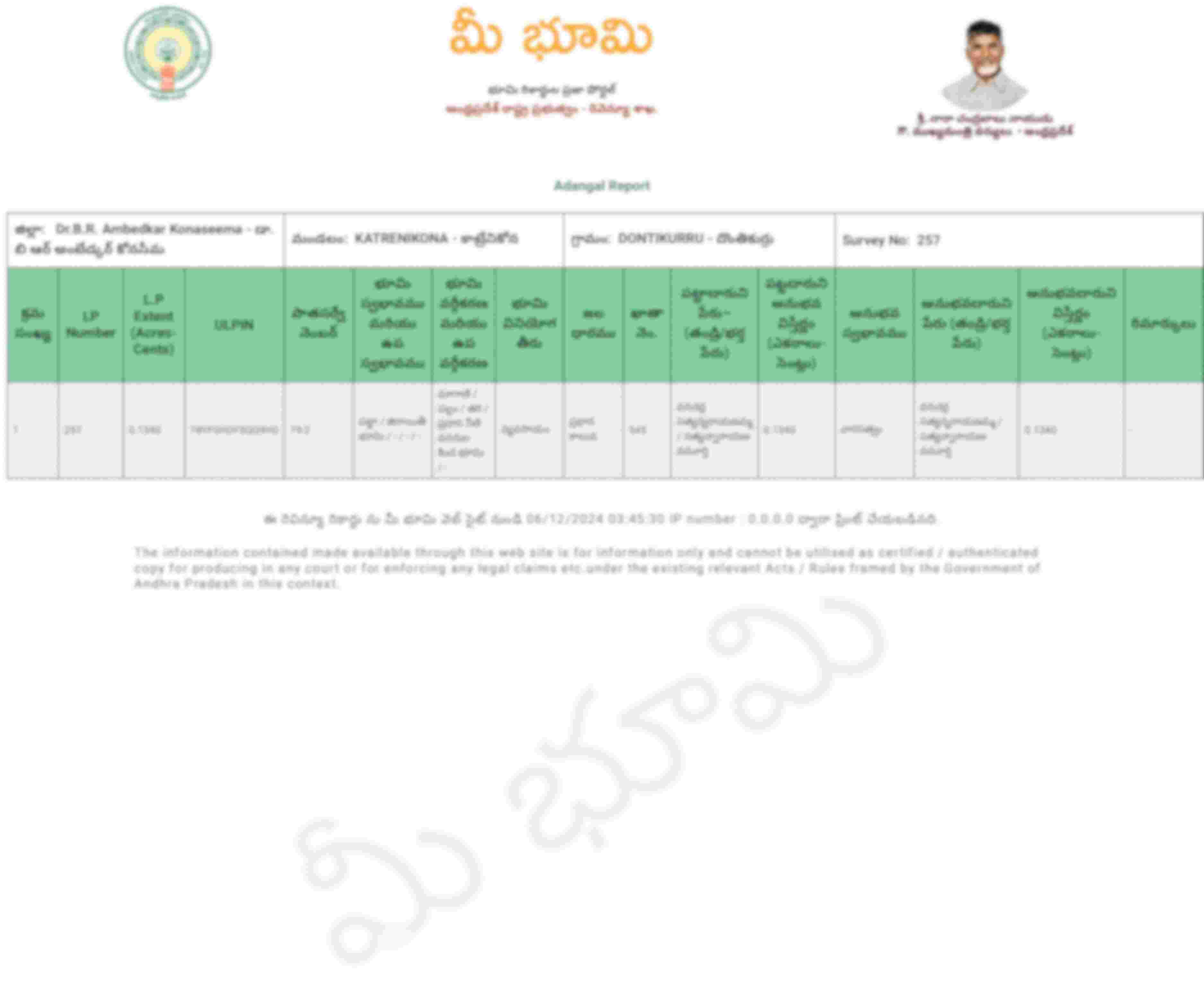
The Adangal, also known as the Pahani, is an official land record maintained by the revenue department in Andhra Pradesh. It contains vital information about land ownership, cultivation details, crop patterns, and tenancy. Adangal is used to track land utilization and monitor agricultural activities. It is a key document for farmers, landowners, and authorities for administrative, legal, and financial purposes.



5 Lakh+
Happy customers

80 Lakh+
Docs downloaded

100%
Safe & secure

15000+
User Consultations
Many users opted for expert consultation while ordering Certified Copy/Nakal


 Safe & Secure
 Fast & Guaranteed Delivery
 Trusted by 4 Lakh+ Customers
What information is included in an Adangal in Andhra Pradesh?
The Adangal provides comprehensive details of all agricultural properties associated with a survey number in a village. It may include landowner's name, pattadar details, khata number, survey number, village, land status, conversion details, property type, extent, crops grown, soil type, irrigation methods, water rate, and the mutation history of the agricultural land records.
Is Adangal applicable only for agricultural land?
Primarily, yes. Adangal focuses on agricultural land details, including crop and cultivation patterns.
Can Adangal be used as proof of ownership?
While it provides ownership details, it is not a legal title deed. For ownership proof, documents like the Sale Deed or Title Deed or Certified Copy are required, which you can get from our 'Certified Copy' option in mypatta app.
Is Adangal required for land registration?
Yes, Adangal may be required during agricultural land registration to confirm land details and usage.
What is the difference between Adangal and ROR-1B?
Adangal records details of land use, crops, and tenancy, while ROR-1B focuses on ownership and landholding rights. Both are complementary land records.
Can multiple owners have their names listed in the Adangal?
Yes, if the land is jointly owned, all owners’ names will be recorded in the Adangal.
Very useful app. Easy to use and it made my life easy. Very good customer support.
Good Experience after using this app. Very useful and time saving process.
Good helpful information about agriculture lands.
Phenomenal!! I got my required documents in one day.